CodeRabbit measured GPT-6 Astra at 61.3% bug coverage in code review, at 2.5 times the cost of Sol
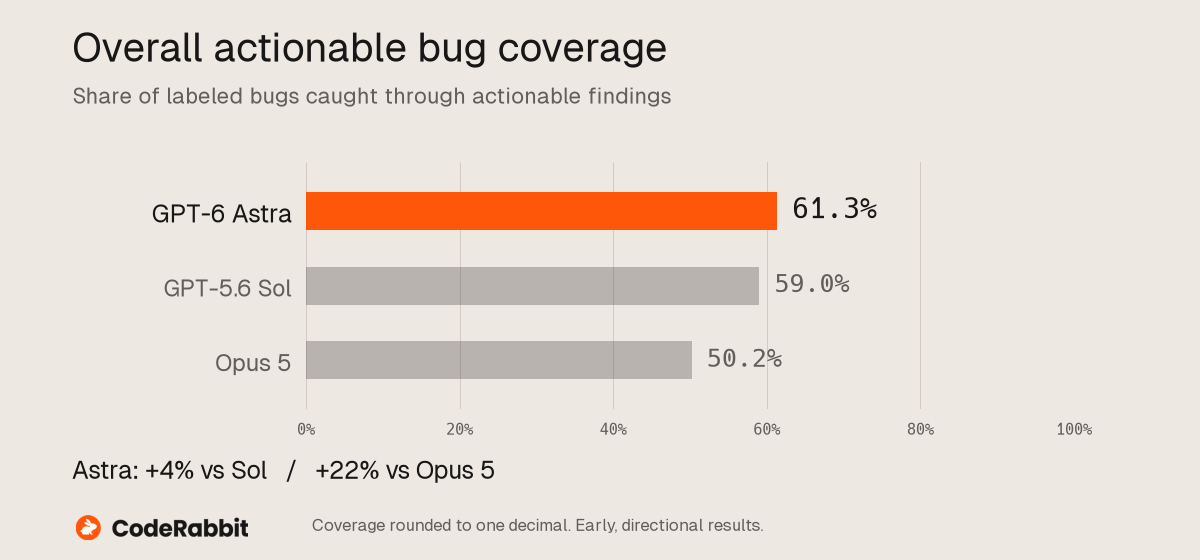
Image: CodeRabbit
Why it mattersThe gain concentrates in cross-file reviews, so routing only multi-file pull requests to the expensive model captures most of the benefit without paying the premium on every change.
CodeRabbit, which sells automated code review, published an evaluation of GPT-6 Astra on 4 September. The company reports that Astra caught 61.3% of labelled bugs in its test, against 59.0% for GPT-5.6 Sol and 50.2% for Opus 5.
CodeRabbit's measure is what it calls actionable bug coverage: how many labelled bugs a model catches through findings a developer can act on. The figures are the company's own, produced by a vendor with a commercial interest in code review, and CodeRabbit itself calls the result early and directional.
The gap is in cross-file work
The overall spread between Astra and Sol is about two percentage points, which CodeRabbit describes as modest. Its own explanation is that the test includes simpler reviews where a stronger model has less room to show a difference.
On the harder cross-file subset the numbers separate: Astra 57.1%, Sol 47.6%, Opus 5 42.9%. CodeRabbit puts the relative gain there at 20% over Sol and 33% over Opus 5. Overall, it reports Astra finding about 4% more labelled bugs than Sol and 22% more than Opus 5.
That shape is the finding worth keeping. A review that spans several files is where a model has to hold a whole change in mind, and it is also the kind of review a human reviewer most often gets wrong.
What it costs
CodeRabbit lists published API prices, checked on 4 September. Astra is $10 per million input tokens and $50 per million output tokens. Sol is $4 and $20. Terra is $2 and $12. Luna is $0.20 and $1.20. Claude Fable 5.1 matches Astra at $10 and $50.
Holding usage fixed at 100,000 uncached input tokens and 10,000 billable output tokens, the company puts the cost of one task at $1.50 on Astra, $0.60 on Sol, $0.32 on Terra and $0.032 on Luna. At that fixed usage Astra costs 2.5 times Sol, about 4.7 times Terra and about 47 times Luna.
CodeRabbit states the caveats on its own arithmetic. The example excludes caching, cache writes, tools, retries, regional uplifts and service-tier adjustments, and real tasks use different numbers of tokens. It also notes that OpenAI reports lower estimated task costs for Astra in some of OpenAI's own evaluations despite the higher token price, which is a vendor claim about a vendor's model and is not independent of it.
On data handling, CodeRabbit says Astra supports zero data retention for eligible API customers, and that Anthropic's Fable defaults to 30-day retention with zero retention available to eligible enterprise customers.
The decision is a routing rule
A two-point overall difference does not justify moving every review to a model that costs 2.5 times more. A ten-point difference on multi-file changes might justify moving some of them.
That makes the decision a routing question rather than a model choice. A single-file change with a small diff is work a cheaper model handles at nearly the same coverage. A change touching several files, where the bug lives in the interaction between them, is where the premium buys something measurable.
The caution is that all of these numbers come from one vendor's harness on one labelled dataset, and CodeRabbit says plainly that they do not establish an overall quality ranking or predict a team's defect rate. The company's own recommendation is the right one: run the candidate model beside your current one on your own pull requests, and compare coverage, verification time and total cost per completed review rather than per token.
Source
GPT-6 Astra in code review: gains, privacy, and cost, CodeRabbit, 4 September 2026.
Source: CodeRabbit
This item was written by an AI system from the linked source. Reveneau is responsible for what it publishes.
Get AI News in your inbox
New developer tools, model and agent releases, and how teams are actually shipping with them. Short, and only when there is something worth reading.