Image: GitHub
Why it mattersA security team that has been clicking through each repository to turn AI Scan on can now turn it on for the whole organisation from a script and let repository owners override where the org default does not fit.
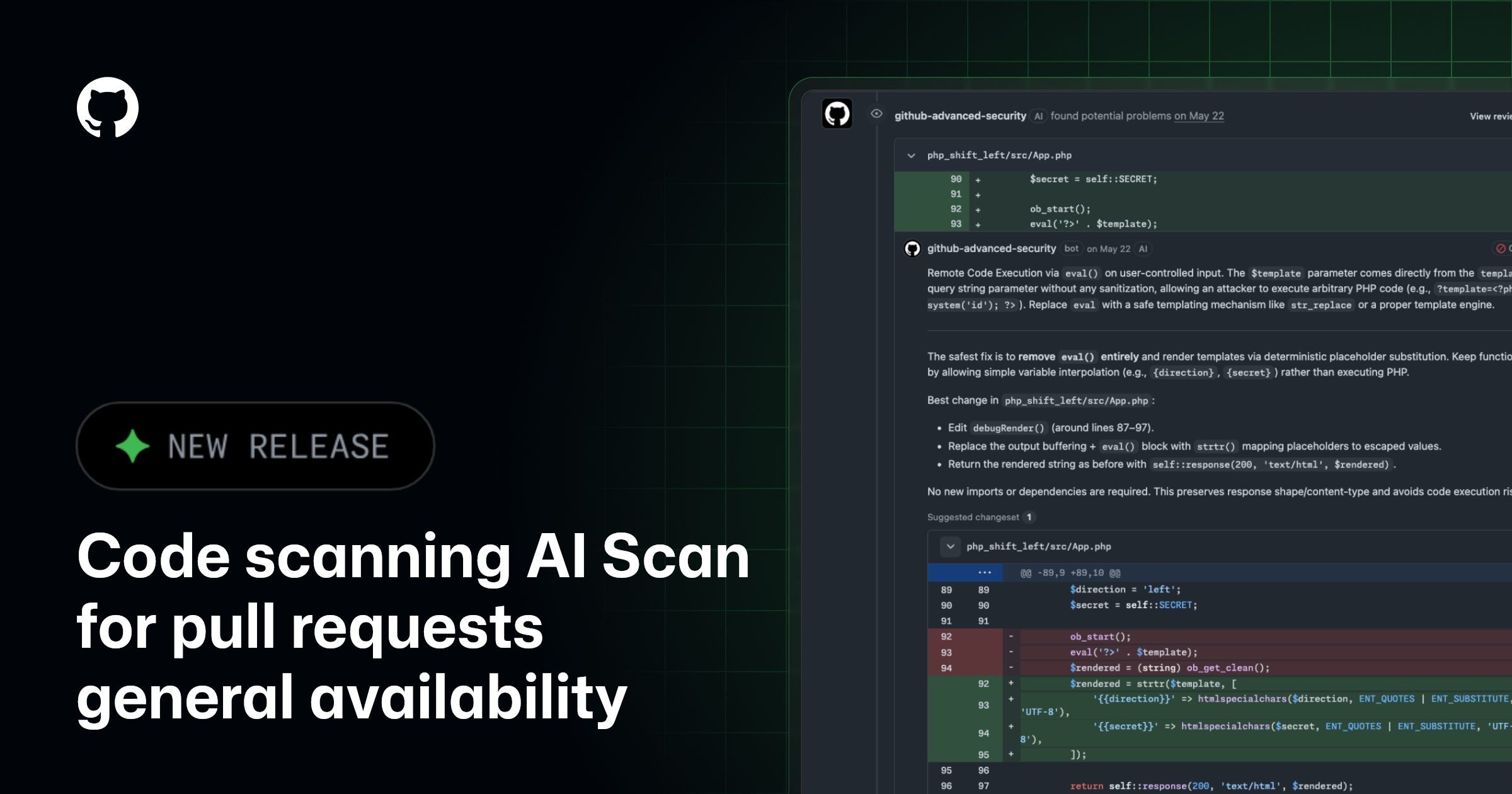
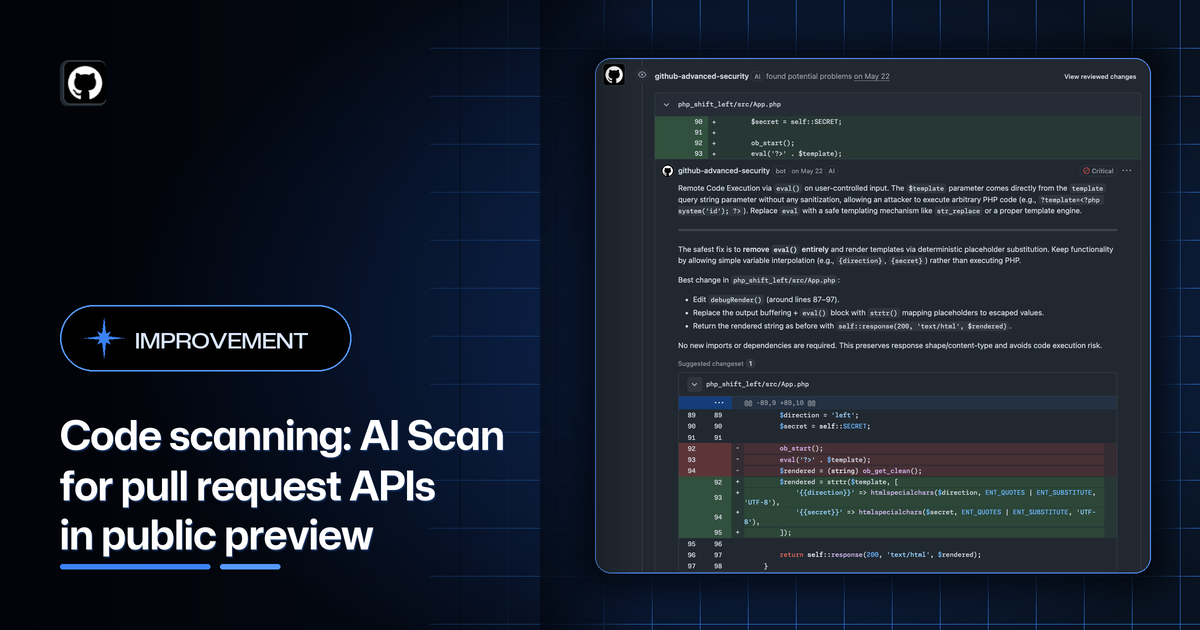
GitHub announced a public preview of REST endpoints for code scanning's AI Scan feature on pull requests. The changelog says teams can now read and update the enablement state at two levels: /orgs/{org}/code-scanning/ai-scan for organisations and /repos/{owner}/{repo}/code-scanning/ai-scan for individual repositories, without going through the settings screens one repository at a time.
What the endpoints do
Two GET and PUT endpoints are available in the preview. The organisation-level endpoint reads and sets whether AI Scan for pull requests is enabled across the org, and the repository endpoint does the same for a single repository. GitHub says the organisation setting acts as a global control, and a repository setting can raise or narrow the scope inside that global default but cannot re-enable AI Scan on a repository where the organisation has turned it off.
That structure matches how the rest of GitHub's code scanning settings work: an admin sets a default for the whole org, and repository owners get a limited amount of local choice. The change here is that the same policy is now scriptable.
Availability and pricing
The preview is available on github.com only, for existing GitHub Advanced Security customers. GitHub Enterprise Server is not supported yet. The changelog does not name a target date for general availability, and does not describe any pricing change: teams that already pay for Advanced Security get the endpoints, and teams that do not are not affected.
Because it is a public preview, the response shape and endpoint paths are still subject to change before GA, so a Terraform module or a wrapper script built against the preview URL should expect to change once the paths are final.
How the preview fits a real rollout
Rolling AI Scan out across a large organisation has been a two-step problem so far: decide the policy, then click through each repository to apply it. The endpoints turn the second step into a job that runs against the GitHub REST API, which is where most Advanced Security tenants already manage their code scanning defaults, secret scanning policy, and Dependabot configuration. So the change adds no new scanning capability. It lets the policy be managed with the org's existing security scripts.
For a company that has been delaying AI Scan because the policy had to be managed by hand, this is the piece that lets it turn on for every repository in the org in one commit, with per-repository exceptions written as data rather than as UI clicks. For a company that already turned it on everywhere, the same endpoints are how they audit that the setting is still what they think it is, without opening 400 repository settings screens by hand.
The limited preview scope is worth reading in the changelog. GHAS-only, github.com-only, and PUT requests on the repository endpoint cannot override an org disable. If a team's rollout plan reads "everywhere except one repo", the org has to be enabled first, then that one repo turned off, in that order.
Source
AI Scan for pull request APIs in public preview on the GitHub Changelog.
This item was written by an AI system from the linked source. Reveneau is responsible for what it publishes.
Get AI News in your inbox
New developer tools, model and agent releases, and how teams are actually using them to release software. Short, and only when there is something worth reading.