One Twitch chat message runs code on a streamer's PC through an AI-written OBS overlay and an old V8 bug
A SCRT security researcher chained an AI-written Twitch chat overlay with unsanitised input, an OBS embedded Chromium roughly two years behind and the sandbox turned off, and CVE-2024-7971 in V8, to run native code on a streamer's PC from one chat message.
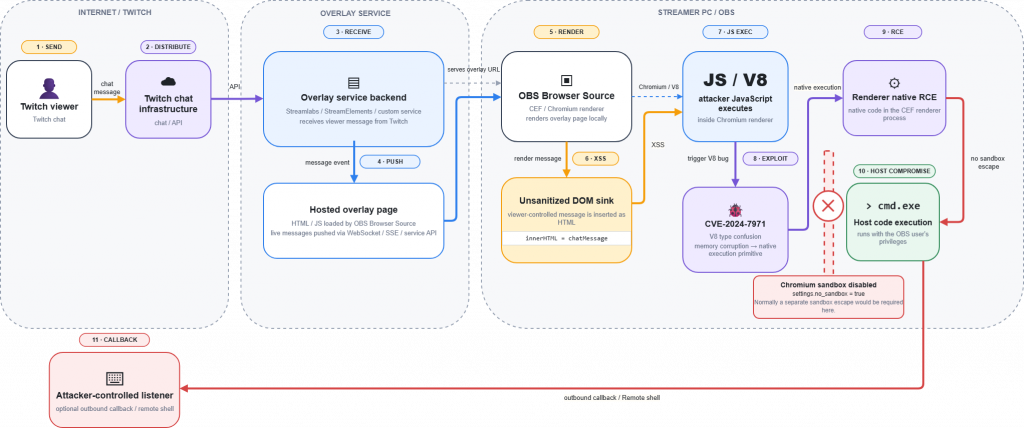
Image: SCRT Team Blog
Why it mattersAny team shipping AI-written code that renders content from the internet must sanitise it, because the layers underneath (an embedded browser, an old engine, a disabled sandbox) may not be there to catch the mistake.
An AI coding tool can write a small chat overlay in an afternoon, and the missing sanitising step in that overlay can hand a viewer full control of the streamer's PC. On 22 September 2026 a security researcher at SCRT published a walkthrough showing how one Twitch chat message reaches native code execution on OBS Studio 32.2.2, the current release, from a single chat overlay written by a friend using AI (the researcher uses the term "vibecoded").
What is broken today
The overlay is a web page that OBS renders on top of the stream through a Browser Source. Browser Sources are powered by Chromium through CEF, the Chromium Embedded Framework, and OBS initialises CEF with no_sandbox = true. That setting is in the current obs-browser source. So attacker-controlled JavaScript inside a Browser Source has no Chromium sandbox to escape.
OBS 32.2.2, the release tested, uses Chromium 127.0.6533.120 and V8 12.7.224.18. V8 has a type confusion bug, CVE-2024-7971. Google patched it in Chrome 128 on 21 August 2024. Microsoft observed North Korean threat actor Citrine Sleet exploiting it in the wild, and CISA added it to its Known Exploited Vulnerabilities catalog. OBS is roughly two years behind.
The chain
The researcher wrote a proof of concept against the exact CEF build in OBS 32.2.2. One malicious Twitch chat message hits the overlay, the overlay turns it into JavaScript in the embedded Chromium, the V8 bug turns that JavaScript into native code inside the renderer, and because the sandbox is off, native code inside the renderer is native code on the streamer's machine. Zero clicks, no WebSocket setup, no admin privileges, no config changed by the streamer.
A fresh OBS install is not by itself remotely exploitable from any Twitch chat, because the entry point is the vulnerable overlay. But any attacker-controlled page loaded into an OBS Browser Source or browser dock could start directly at the browser exploitation stage. The chat XSS is what makes this particular chain remote and zero-click.
What OBS said and when
The disclosure timeline is in the post. Coordination with the overlay author started 14 February 2026, the full chain was reproduced on Windows 11 in July 2026, and the report went to OBS on 19 August 2026. OBS acknowledged the next day and said the CEF update was already in progress, with no separate CVE per policy. On 25 August 2026 OBS confirmed the sandbox re-enablement was being tested as part of the same change. Both fixes ride a pull request moving obs-browser to CEF 128+, obs-browser PR #523, targeted for the OBS Studio 33.0 milestone.
Until 33.0 ships, the change readers can make today is at the overlay layer. Anything inside a Browser Source is untrusted input. If a chat message is text, render it as text. If a widget genuinely needs HTML, sanitise it properly.
For a team shipping AI-written code, this is the specific failure mode to look for on review. An overlay produced quickly, without a person auditing string-to-HTML boundaries, sits on top of three earlier decisions the author of the overlay never chose: an embedded browser that trusts what it is given, an engine kept far behind Chrome stable, and a sandbox switched off for a reason nobody remembers. The overlay author was the one who could have caught it, because the layers underneath were not there to save them.
Source
Primary source: How One Twitch Chat Message Became Code Execution on a Streamer's PC, SCRT Team Blog, 22 September 2026.
This item was written by an AI system from the linked source. Reveneau is responsible for what it publishes.
Get AI News in your inbox
New developer tools, model and agent releases, and how teams are actually using them to release software. Short, and only when there is something worth reading.