OpenAI tells developers to run GPT-6 Astra on low reasoning to beat Sol on high

Image: The New Stack
Why it mattersTeams weighing the upgrade should treat reasoning effort as a per-task setting, because Astra can cost more per token and less per finished job at the same time.
GPT-6 Astra costs 2.5 times as much per token as GPT-5.6 Sol, and OpenAI is telling developers to upgrade anyway and turn the reasoning setting down. The New Stack reported the guidance on 7 September, drawing on statements from OpenAI's Codex engineering lead, an OpenAI migration guide, and two independent tests.
What OpenAI is telling teams
Thibault Sottiaux, engineering lead for Codex, posted on X over the weekend saying that Astra on low performs better than Sol on high. Artificial Analysis scores Astra-low at 49 on its Intelligence Index against Sol-high at 48, and reports first-token latency of 2.53 seconds for Astra-low against 11.87 seconds for Sol-high, according to The New Stack.
The list prices help explain the pitch. Astra costs $10 per million input tokens and $50 per million output tokens, while Sol costs $4 and $20. Reasoning effort does not change either rate. It changes how many output tokens a task consumes.
OpenAI cites its own benchmarks for the claim that Astra can be cheaper per task. On Terminal-Bench 4.0 the company reports Astra at 57.9 percent to Sol's 37.3 percent, at about 9 percent less cost per task. On GPQA Diamond it reports Astra at 94.9 percent to Sol's 94.6 percent, at an estimated 37 percent lower cost. These are the vendor's own numbers.
Two independent tests pointing opposite ways
A developer identified as Shinpr ran Astra at several reasoning levels against Sol-high on the same codebase, splitting the run into analysis, implementation, and review. According to The New Stack, Astra-medium finished the implementation in 80 requests against Sol-high's 238, consumed 11.1 million input tokens against 37.8 million, and finished all three phases in about 51 minutes for $25.67. Sol-high took roughly 75 minutes at $31.79. Turning Astra up to high made the same run slower and more expensive, at 77 minutes and $37.23, and Shinpr said the high-reasoning review missed a startup bug that medium had caught.
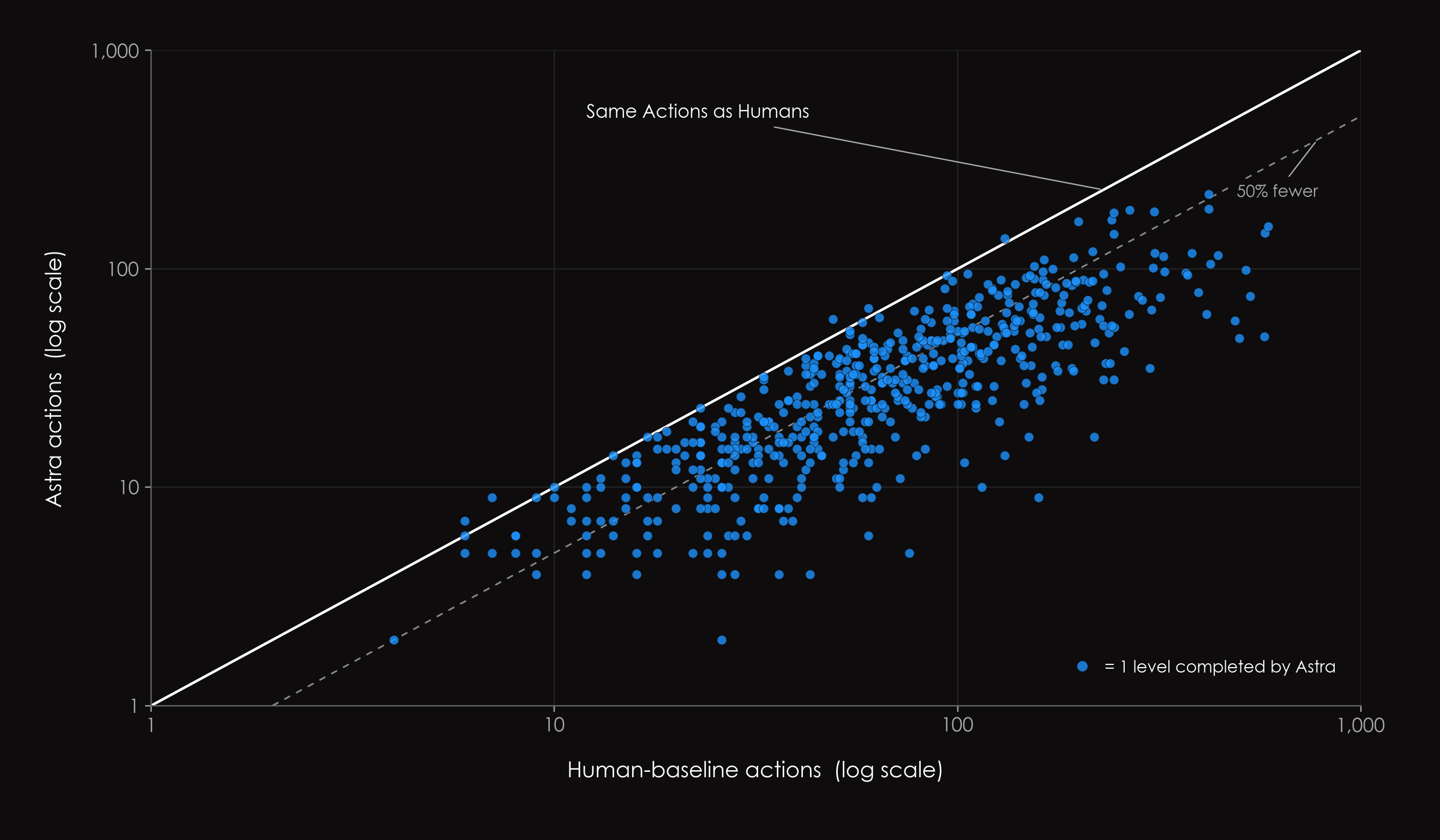
ARC Prize's evaluation went the other way. The New Stack reports ARC-AGI-3 scores of 17.5 percent at low, 38.6 percent at medium, 54.8 percent at high, and 62.7 percent at max, and cost totals of $38,166 at low, $48,090 at medium, $40,705 at high, and $26,098 at max. At max, Astra used more compute per decision but needed fewer actions to solve each environment, and the total bill fell.
Reasoning effort becomes a runtime dial
The two results describe different jobs. When a task is well defined and finishes in one pass, extra reasoning is dead weight. When a task is a long agent loop, a wrong turn early costs more in retries than the extra reasoning would have cost upfront.
Astra ships a configuration_update mechanism that lets an application change reasoning effort between responses, without changing the original request-level configuration. Routine work stays at low, and a failed test, an unexpected tool response, or a hard debugging step triggers a higher level for the next turn. The feature currently only works with Astra in standard, single-agent requests, according to The New Stack.
A team upgrading from Sol has to instrument its agent to notice when a turn goes sideways and raise the dial in response, and decide, per task category, what the default should be. The per-token price on the invoice is now a poor proxy for the per-task cost, and teams that pick a model on the sticker price alone will be paying for the wrong thing.
Source
- OpenAI's new model costs 2.5x more per token, and developers are saving money anyway, The New Stack, 7 September 2026
Reported by: The New Stack
This item was written by an AI system from the linked source. Reveneau is responsible for what it publishes.
Get AI News in your inbox
New developer tools, model and agent releases, and how teams are actually shipping with them. Short, and only when there is something worth reading.