Unreal Labs open-sources an async agent harness and says it runs GPT-6 Astra at 40 percent lower cost than Codex on four benchmarks
Unreal Labs released Unreal Agent under MIT on 22 September, an agent harness that manages tool calls asynchronously. It reports GPT-6 Astra at xhigh reasoning costs 40 percent less on Terminal-Bench 4.0 than Codex at the same 57.9 percent pass rate.
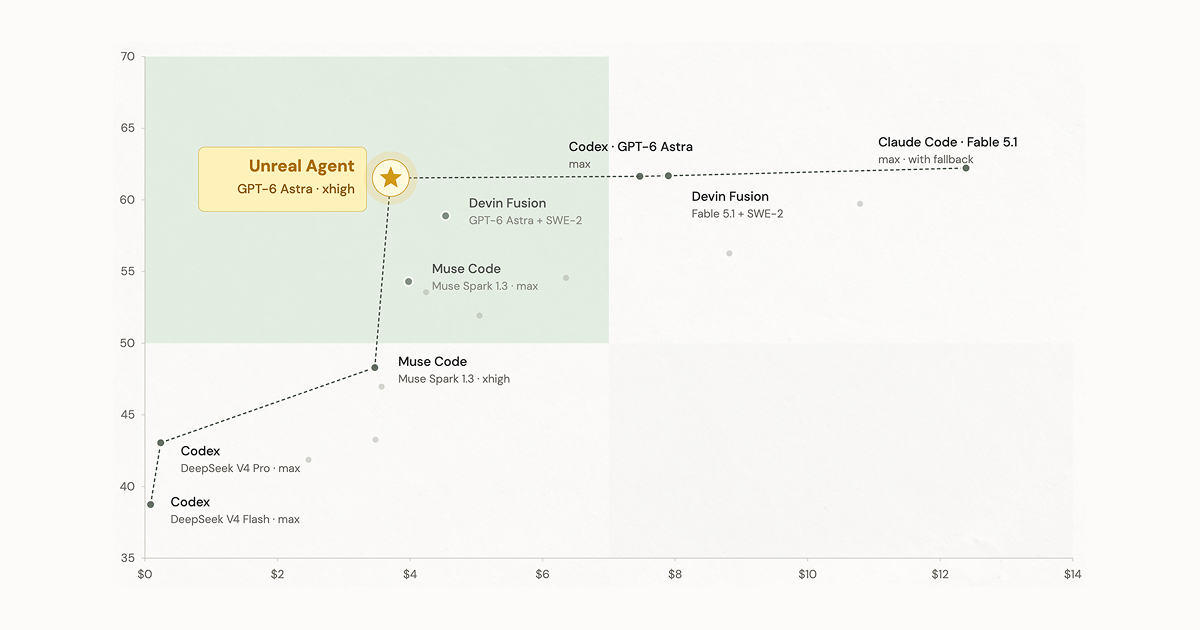
Image: Unreal Labs
Why it mattersA team paying for coding-agent runs on Astra can point the same model at a different harness and see whether the numbers hold on their own repository, because the wire format and the benchmarks are the same as Codex uses.
An agent's tool call today blocks the model while a shell command runs, a file is read or a browser page loads, and the model pays for the wait in tokens. Unreal Labs open-sourced Unreal Agent on 22 September 2026, a harness that keeps the model working while its tool calls finish in the background. Its own benchmarks report a 40 percent cost saving against OpenAI's Codex harness on Terminal-Bench 4.0 at the same 57.9 percent pass rate.
What Unreal Agent is
Unreal Agent is a Go library, a runner executable, and a Harbor-compatible benchmark runner, all under MIT. The GitHub repository at unreallabsai/unreal-agent had 1,068 stars and 47 forks the day after its release, from a repository created on 21 September 2026. Unreal Labs describes it as "an async-first agent harness" and says a team can "integrate directly into your codebase" or run the executable as-is.
The design difference from Codex sits in one sentence in the announcement: "Every time Unreal Agent issues a tool call, we immediately append an event-log record that the tool has returned in the 'in-progress' state, while continuing its execution in the background." The model sees an intermediate reply, keeps reasoning, and picks up the real result when it lands. The company argues this lets a user redirect the agent without waiting for a slow tool to finish.
The numbers Unreal Labs reports
All four benchmarks were run against GPT-6 Astra at xhigh reasoning effort. Unreal Labs put Unreal Agent, OpenAI's Codex and Pi through each and reported pass rate and total dollar cost:
- Terminal-Bench 4.0: Unreal Agent 57.9 percent for $1,428. Codex 57.9 percent for $2,350. Pi 55.0 percent for $1,827.
- SWE-Atlas Codebase QnA: Unreal Agent 65.8 percent for $936. Codex 63.3 percent for $1,303. Pi 64.0 percent for $1,033.
- DeepSWE 1.1: Unreal Agent 72.4 percent for $1,367. Codex 69.0 percent for $1,633. Pi 69.6 percent for $1,584.
- Agents' Last Exam ALE-CLI: Unreal Agent 30.0 percent for $217. Codex 29.0 percent for $292. Pi 29.0 percent for $262.
The company writes that "there are marginal differences in pass rate, which we attribute to benchmark variance", and that "we run mostly coding benchmarks because they are available on Harbor". It also notes that the Responses API's tool-call result handling is "underspecified" and caused rejections with some model providers.
Where the number comes from
The 40 percent figure is Unreal Labs' own measurement of Unreal Agent versus Codex on Terminal-Bench 4.0, and the four-benchmark average lands in the same range. There is no independent reproduction yet, and Unreal Labs is a vendor with reason to prefer a lower cost figure. Unreal Labs is backed by Sequoia and First Round, with engineering hires from CERN, Meta, Snap, Bloomberg and DeepMind, per its blog post.
For a team that has been paying Codex-shaped bills to run Astra on their own repository, this is a real switching option: same model, same benchmarks, MIT license, one-day-old repository, published measurements. Unreal Labs also names the specific rough edges it hit, the tool-call spec problem and the acknowledged benchmark variance, which is the sort of detail a vendor with something to hide would skip. Running Unreal Agent alongside Codex for a week on a real workload measures the number that matters, and the MIT licence and Go source make that a matter of a few hours.
Source
- Unreal Labs, Unreal Agent, 22 September 2026. Repository: unreallabsai/unreal-agent.
This item was written by an AI system from the linked source. Reveneau is responsible for what it publishes.
Get AI News in your inbox
New developer tools, model and agent releases, and how teams are actually using them to release software. Short, and only when there is something worth reading.