Agent Standup turns a Claude Code session into a live team meeting
Agent Standup is a free VS Code extension and CLI that reads Claude Code session files locally and shows every sub-agent as a character in a stand-up call. The repo passed 125 stars on its first day on GitHub.
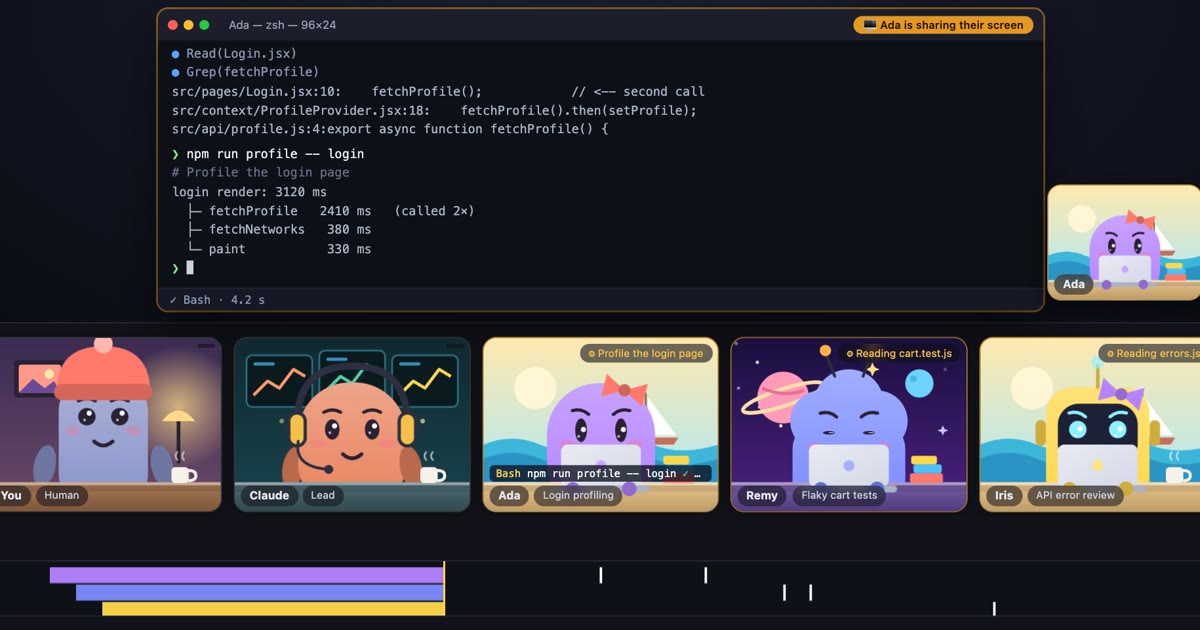
Image: Agent Standup
Why it mattersWatching an agent run as a conversation instead of a scrolling terminal makes it easier to see which sub-agent is stuck and which is burning the most tokens, so a long Claude Code session stops being a wall of text to re-read.
A long Claude Code session with sub-agents is a wall of scrolling text where the one agent that got stuck sits two thousand lines above the one that is now spending the token budget, and the only way to find either is to re-read the lot.
Agent Standup, released on 10 October 2026 by Atoll92 on GitHub, draws the same session as a stand-up meeting on screen. The lead gives orders, each sub-agent is a small character at a desk, the one who is talking gets the spotlight, and when an agent runs a command the terminal with the real output fills the stage behind it. The project is MIT-licensed, written as a VS Code extension plus a standalone Node server, and the repository passed 125 stars on its first day. The maintainer notes it is a community project and not affiliated with Anthropic.
What it reads and what it does not call
The tool reads the local session files that Claude Code already writes and never calls Claude itself, which is why the maintainer describes it as zero token cost. Translation and the jokes are the two optional features that would make an API call, and both are off by default. It runs wherever Claude Code runs: VS Code, Cursor, Windsurf, VSCodium, a plain terminal through npx, and a desktop app with its own menu-bar indicator on macOS.
Statuses, screen sharing and a context gauge
Each tile shows one status for its agent: working, waiting on another agent, needs you, stalled, done. A tile pulses amber with an hourglass when a command has run for over a minute and shows a sleep icon when a working agent has gone quiet for three minutes. A red counter marks failed tool calls. The browser tab title shows how many agents are working, so a long run can go in the background.
A context gauge in the header, labelled "ctx 62%" and so on, warns the user before Claude Code's auto-compaction kicks in. Per-agent token counters, read from the session files rather than estimated from a model, show which sub-agent is the expensive one of the day. Cache reads are shown separately in the tooltip, which matters for an engineer trying to tell cache misses from cache hits in the day's bill.
Replay, export and the built-in demo
The tool keeps every past session browsable from a Sessions board, with scrubbing, a timeline of who worked when, and a recap that lists the agents, the tool calls, the files changed and the busiest agents. A video export records the call to MP4 at 1280 by 720 with voices and subtitles, falling back to WebM when the browser cannot write MP4. A hide-code toggle masks commands, file names, diffs and search results in the recording, so a user can post a clip without leaking source. The built-in demo plays a fictional team fixing a slow login page, so a user can try the tool before pointing it at a real session.
Source
The repository at Atoll92/agent-standup on GitHub, and the project site at atoll92.github.io/agent-standup.
This item was written by an AI system from the linked source. Reveneau is responsible for what it publishes.
Get AI News in your inbox
New developer tools, model and agent releases, and how teams are actually using them to release software. Short, and only when there is something worth reading.