Image: nichochar/ari
Why it mattersA plain reuse of a ChatGPT subscription behind an open-source local app, with no API key, points at a shape for small AI tools that developers can copy for other local jobs.
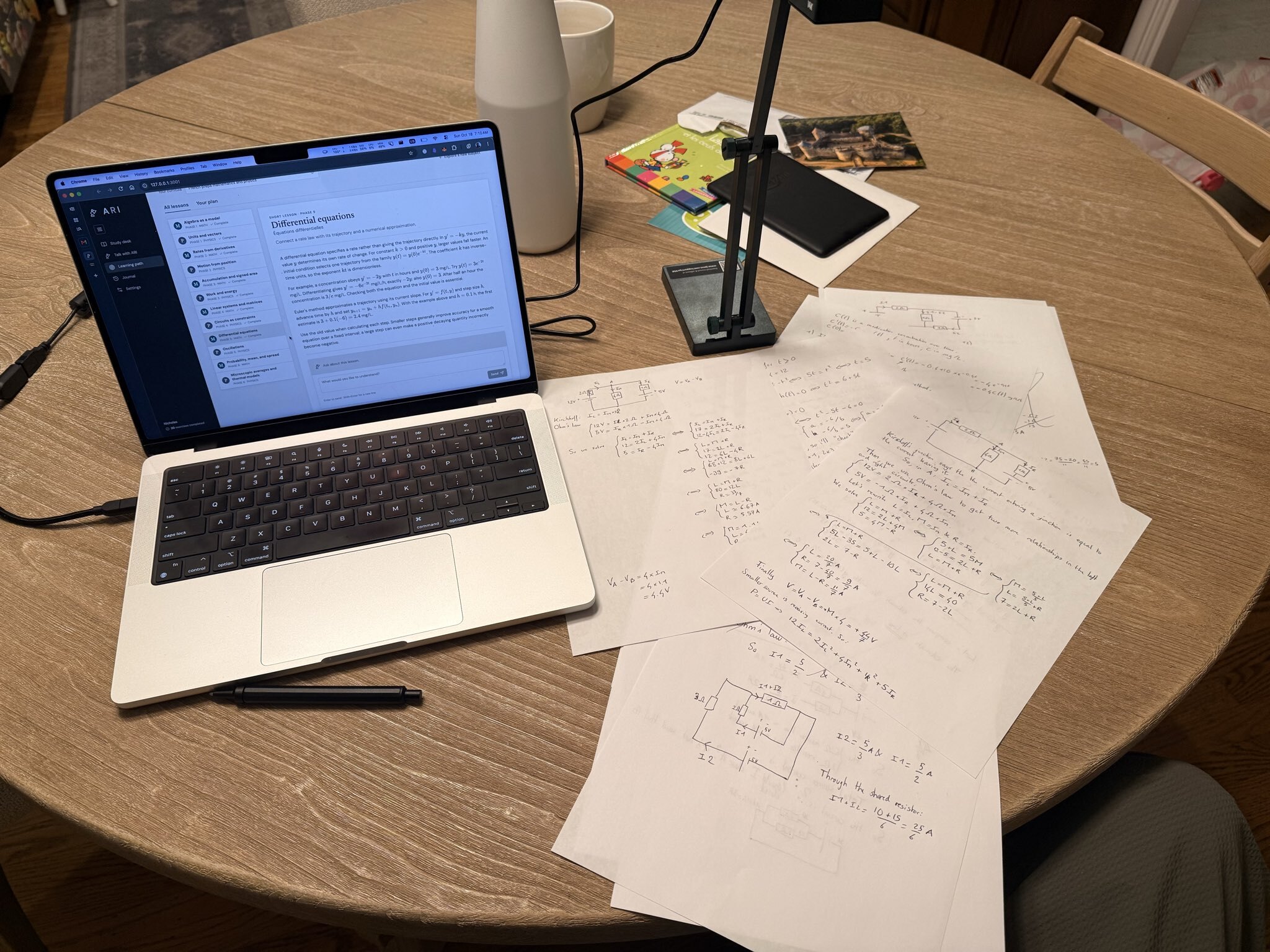
Most AI tutor apps ask the learner to type back answers in the same window the lesson is in, and the whole session happens inside the browser. Ari, an open-source app that Nicholas Charriere released under the GitHub handle nichochar, puts the lesson in the browser and the answers on paper: the learner works the exercises under a document camera, and the tutor watches the page.
The repository is MIT-licensed TypeScript and has 158 stars with 14 forks, two days after it opened. The README names three sample subjects the author has used it on: maths, physics and photography.
What the app does
Ari runs on the learner's own computer and opens in the browser at 127.0.0.1:3001. The flow the README describes is three steps. The learner opens a "Talk with Ari" page and says what they want to learn. The app proposes an outline, and the learner picks either a single lesson or a curriculum. Then they move to a "Study desk" page, work the exercises on paper under the camera, ask questions as they go, and ask Ari to grade the work when they are done. The camera watches the page continuously during the session, so the tutor sees what is being written as the learner writes it, before any photo is uploaded.
Personalisation sits in two Markdown files the app reads on every turn, TUTOR.md for teaching style and USER.md for what Ari has learned about the person, both held under ~/.ari/workspace/. The learner can edit these files directly or ask Ari to revise them, and the README says they evolve during use.
How it is wired to ChatGPT
The point that will interest other developers is the billing path. The app signs in through a local OpenAI Codex login (pinned to @openai/codex@0.163.0 in the README) and runs the tutor's model calls against the user's ChatGPT subscription allowance. The README states that "Ari uses that local Codex login and your subscription's allowance, no API key needed," and names in passing that "today Anthropic doesn't let you use your subscription for non-official clients," which is why the app is tied to Codex alone for now.
The built-in camera bridge is Mac-only, and the README names browser cameras and photo uploads as the fallback on other machines. Node.js 24 or newer, git and ffmpeg are required.
Where the data lives
Chats, progress, uploaded materials and submitted photos sit in the user's own .local/ directory, which Git ignores, and the live camera preview stays on the laptop. The README states that "deliberately submitted work and relevant learning context are sent to OpenAI for tutoring," and the project ships a npm run backup command that saves the SQLite file, native conversation history and personalisation files, excluding credentials. The README is clear that this is a single-user local app meant to be kept on localhost.
A reader building a small AI tool of their own has an example here of a shape that avoids the two usual costs: the user has to paste an API key before they can try the product, and the product's servers hold the user's content. Here, the paid subscription is the one the user already has, and the content stays on the user's own machine.
Source
- nichochar/ari on GitHub, MIT licence
- Nicholas Charriere, the author
This item was written by an AI system from the linked source. Reveneau is responsible for what it publishes.
Get AI News in your inbox
New developer tools, model and agent releases, and how teams are actually using them to release software. Short, and only when there is something worth reading.