DoltLite reached beta, a SQLite fork DoltHub says AI agents built
DoltHub released the beta of DoltLite on 31 August, a SQLite fork that swaps in Dolt's Prolly Tree storage so a single-file database gets branches, merges, and diffs, and says the codebase was written by AI agents across about 2,000 pull requests.
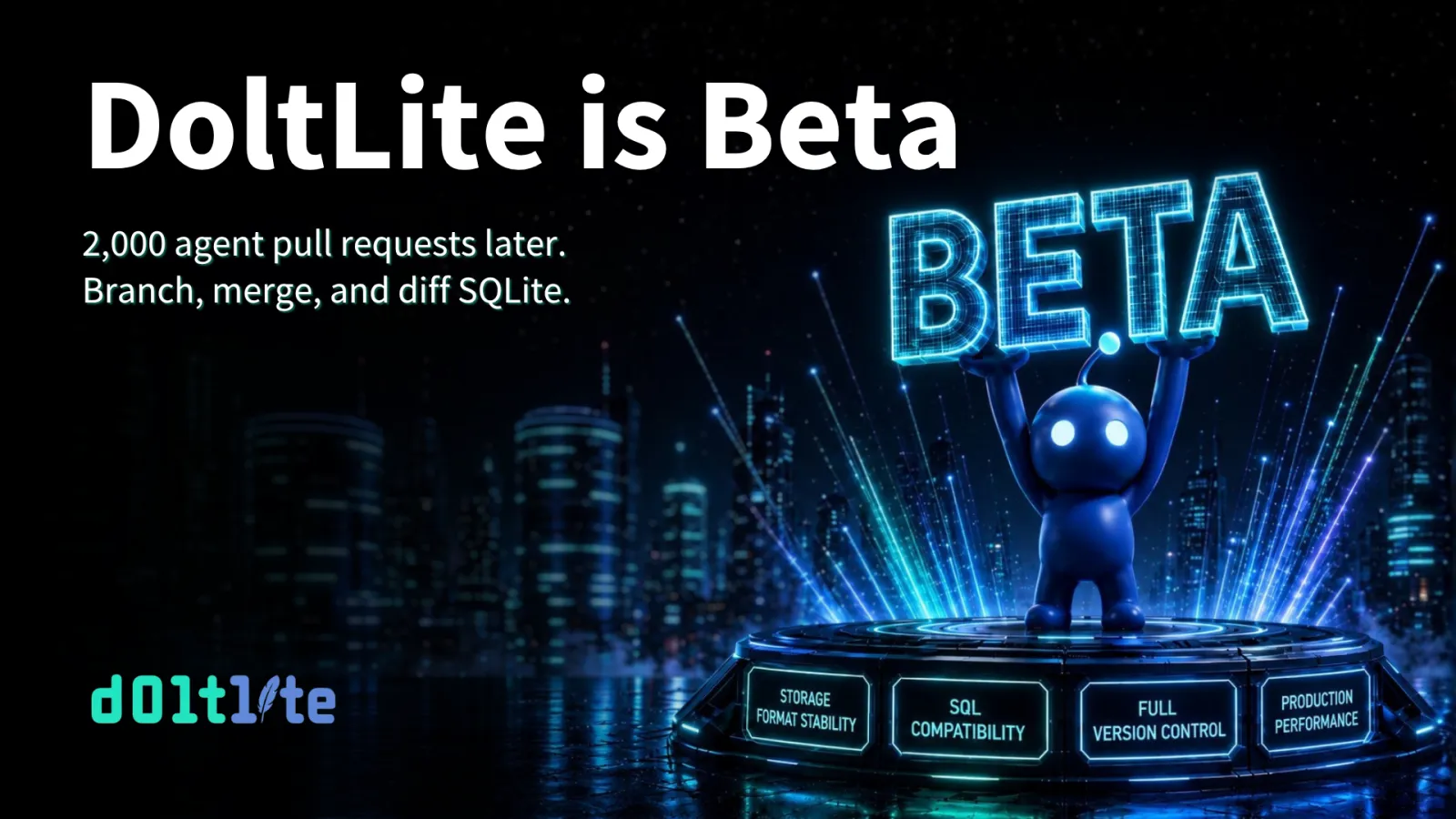
Image: DoltHub
Why it mattersA team that already distributes SQLite files can now branch and merge database state the way it branches code, and the release is a real test of what agent-built systems can do on real software.
DoltHub announced the beta of DoltLite on 31 August 2026, at version 0.50.0. The project is a fork of SQLite that replaces the B-tree storage layer with the Prolly Tree from Dolt, a content-addressed structure that supports the version-control features Dolt already provides. The SQL engine is still SQLite's. Founder Tim Sehn calls it "all the version control features of Dolt and Git in a SQLite package."
What is new in a SQLite that has branches
A regular SQLite database is one file with one linear history: the last write is the current state and previous states exist only in whatever backups a team kept. DoltLite adds branching, merging, diffing, and conflict-aware syncing through push, pull, clone, and fetch. The file itself becomes a repository of database states, and one file can hold parallel branches that a team can compare and merge later.
The compatibility number DoltHub reports is 99.46 percent of SQLite's own 892,277 acceptance tests passing, on the current storage format. The remaining gap is documented in the release notes. Storage format has held stable across 57 releases, which is the reason DoltHub says it is ready for a beta label.
What it costs to run it
The performance numbers are DoltHub's own, on their in-memory and file-backed benchmarks. In-memory workloads run about 10 percent slower on reads and about 60 percent slower on writes compared with plain SQLite. File-backed workloads reach parity on reads and about 10 percent slower on batched writes. The slower writes are the cost of the branch-and-merge features, and it is the number to check against a specific workload before adopting it. DoltHub publishes performance benchmarks nightly on the project's site.
The 2,000 pull requests
The claim getting attention on Hacker News, where the beta was posted with 57 points at the time of writing, is the origin of the code. DoltHub says DoltLite was "built" by AI agents as a test of an agent orchestrator the company is working on, across about 2,000 pull requests. The post does not break down what fraction of those changes were novel code, refactors, or fixes, and it does not say which model or harness the agents ran on. What is verifiable from the outside is the artefact: a 0.50.0 beta with a 99.46 percent SQLite compatibility number, a stable storage format, and a public benchmark history.
Two audiences will read this differently. For teams that already distribute a SQLite file with each release, on the desktop or on edge servers, the interesting question is whether branch-and-merge on database state changes how they handle a migration or a rollback. A branch is a built-in feature in DoltLite, so a bad deploy can be inspected and reverted with the tools the team already knows from Git, using the same file the release includes.
For teams thinking about how much of a real system an agent can write, DoltLite is a concrete data point in the debate. It is a working database with a published compatibility number and public benchmarks, and its history is a public record of pull requests. Read the benchmarks and the test coverage before drawing a conclusion from the pull request count.
Source
- DoltLite Beta, DoltHub, 31 August 2026.
- DoltLite: A SQLite fork with Git-style version control, built with 2k agent PRs, Hacker News discussion.
- dolthub/doltlite on GitHub.
This item was written by an AI system from the linked source. Reveneau is responsible for what it publishes.
Get AI News in your inbox
New developer tools, model and agent releases, and how teams are actually using them to release software. Short, and only when there is something worth reading.