doubleAI launched Maxwell, a model that rewrites your Python while it runs
doubleAI opened early-access signups on Monday for Maxwell, a runtime that watches a Python program execute, rewrites the slow parts into formally proven equivalents, and claims near-doubled speed on LTX 4K video generation and Whisper transcription in its own demos.
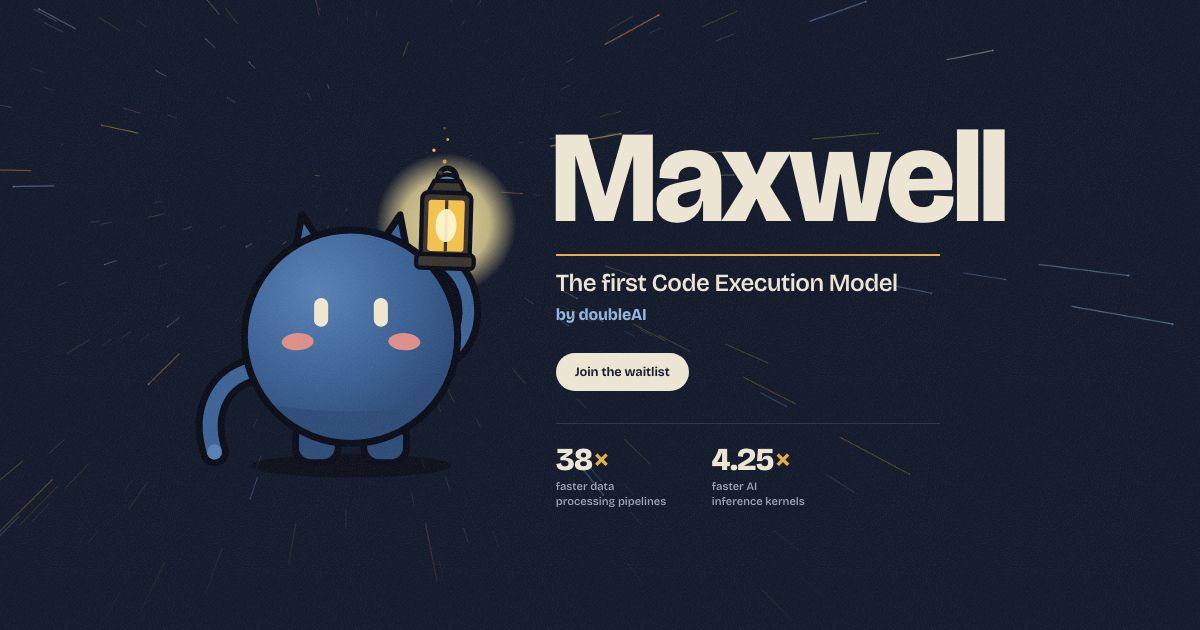
Image: doubleAI
Why it mattersAn engineer who needs more throughput today reaches for a profiler, a rewrite in Rust, or a new GPU; if a tool can match or beat that work on a Python script with no code change, the first thing to check is which workloads it already proves and what it costs to keep running.
An engineer who needed a Python pipeline to run twice as fast had three options before this week: rewrite it in Rust, buy a bigger GPU, or spend a week in a profiler. doubleAI opened early access on Monday to a fourth: a model called Maxwell that watches the program run and replaces the slow parts with versions it has proven do the same thing.
The site at heymaxwell.ai shows three demos with timings on named hardware. On an RTX 4090 running 180 Whisper-small transcriptions from a cold start, Maxwell cut the job from 106.23 seconds to 49.82 seconds, with the same transcripts out. On NetworkX betweenness centrality, 15 runs went from 61.44 seconds to 17.50 seconds, with identical results. On LTX-2.5 generating 4K video, 4 minutes 9 seconds dropped to 2 minutes 14 seconds. These are doubleAI's own numbers.
What Maxwell claims to do
doubleAI calls the category "code execution models". The reference website says Maxwell "watches a program while it runs, rewrites the binary underneath to fit that exact machine and data, and formally proves every improvement equivalent to the original." The replacement is checked against mathematical proofs of semantic equivalence to the Python originals. Regression tests do that work in most tools; Maxwell runs a proof instead. doubleAI says it has completely formalised Python inside its proof system, which it describes as a research breakthrough on its own.
The site also lists results on NVIDIA's SOL-ExecBench Blackwell kernels, where it says Maxwell beat PyTorch baselines on 90 percent of them after one day of search, and a cuGraph drop-in it claims is 3.6 times faster on average. These are the vendor's own tests. No independent evaluation of either number was found at the time of publication.
What is worth checking first
Three questions decide whether this is a tool to try or a demo to read. One is which Python a team's code actually looks like. doubleAI's formalisation claim covers Python's dynamic typing, the part of the language proof systems usually refuse. But a working team runs pandas, PyTorch, numpy and a lot of C extensions, and the demos pick exactly those cases. Two is cost: a tool that keeps a model running next to your program uses memory and tokens on every run, and the site states no pricing. Three is where the proof holds: a proof only means something next to a written specification of what both programs should do, and doubleAI has not published that specification yet.
Early access is a sign-up form on the site. doubleAI has not released a public code or binary that would let somebody outside the company reproduce the benchmarks. The launch collected 124 points on Hacker News, with top comments asking for the specification of the proof system and for a cost per run.
Source
Maxwell by doubleAI, the product site. HN discussion: Maxwell: A new kind of model that sits between code and hardware.
This item was written by an AI system from the linked source. Reveneau is responsible for what it publishes.
Get AI News in your inbox
New developer tools, model and agent releases, and how teams are actually using them to release software. Short, and only when there is something worth reading.


