AI NewsModels & agentsAnnouncement
An EmbeddingGemma 2 reader transcribes an hour of audio in 13 seconds
An independent team turned Google's EmbeddingGemma 2 embedding model into an on-device speech-to-text model by training a small reader that maps audio slices into text space, reaching 288 times real time on a base M3 MacBook Air at a 5 percent word error rate against the 2 to 3 percent of leading speech models.
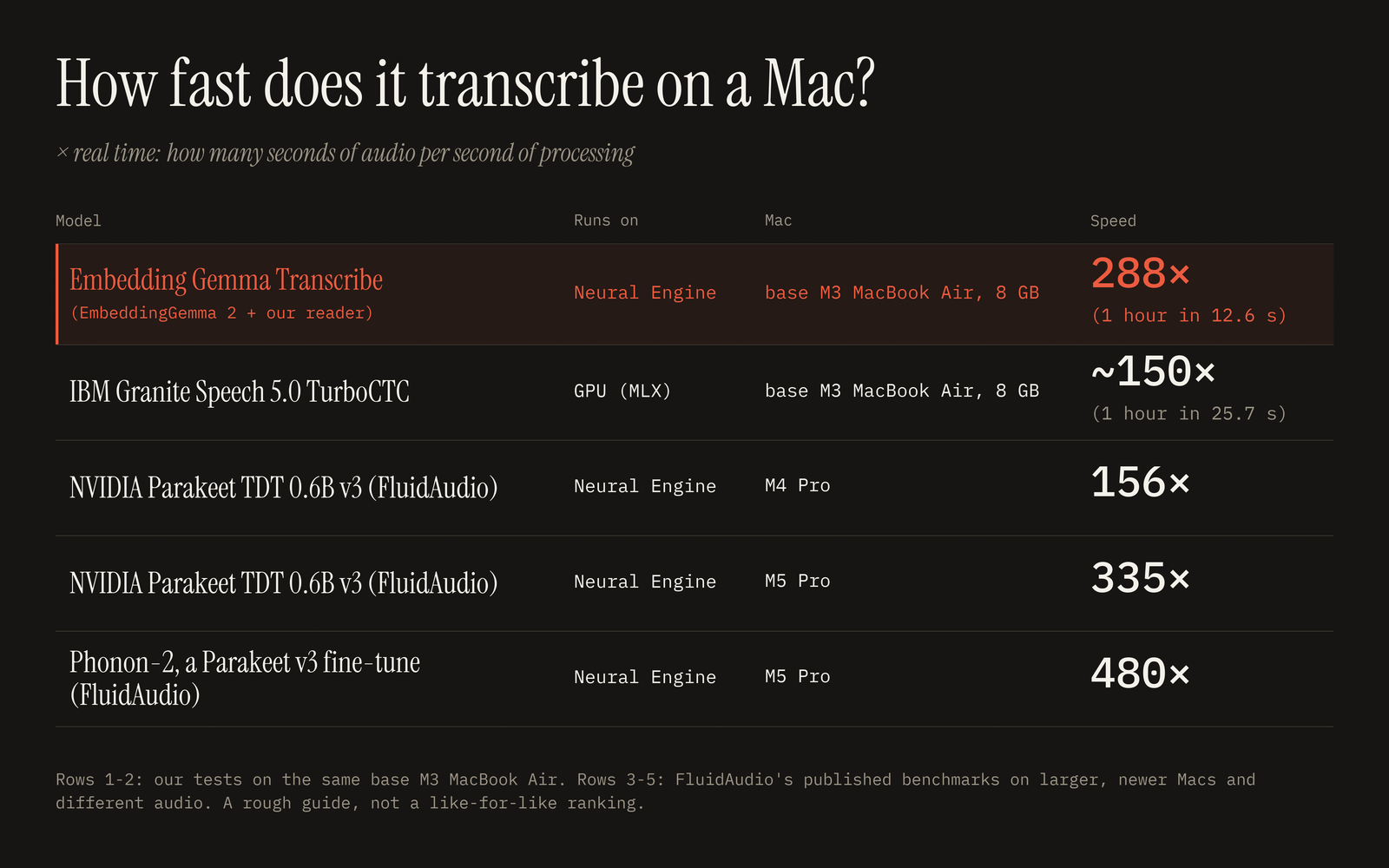
Image: Embedding Gemma Transcribe
Why it mattersA team that would have shipped a cloud transcription API can now test an on-device reader that trains in two hours on 8 H100 GPUs on top of an existing multimodal embedding model, trading a few points of accuracy for every audio file staying on the user's machine.
An embedding model is supposed to turn speech, text, images and video into points in one shared space, so a word spoken out loud lands near its written form. An independent team tested whether that shared space can be read as a transcript. The result, posted at eg2.haku.sh and placed on Hacker News with 399 points, is a Mac app that transcribes an hour of audio in about 13 seconds on a base M3 MacBook Air by reading words straight out of Google's EmbeddingGemma 2.
The team's description is plain: EmbeddingGemma 2 is a multimodal embedding model, so audio and text share one coordinate system. The team kept the audio encoder exactly as Google shipped it, trained a small reader that moves each short slice of audio into text space, and matched each slice to the closest of about 229,000 English words. A separate small model adds punctuation and capitals. Only the reader was trained, and the training took under two hours on 8 H100 GPUs on openly licensed English speech data.
The speed numbers
The team's own table reports 288 times real time on the Neural Engine of a base M3 MacBook Air with 8 GB of memory, which is one hour of audio in 12.6 seconds. For comparison on the same laptop, the team ran IBM Granite Speech 5.0 TurboCTC on the Mac GPU through MLX at about 150 times real time, which is one hour in 25.7 seconds.
The table also lists three NVIDIA Parakeet v3 numbers taken from FluidAudio's published benchmarks: 156 times real time on an M4 Pro, 335 times on an M5 Pro, and a Phonon-2 Parakeet v3 fine-tune reaching 480 times on an M5 Pro. The team calls that section a rough guide, not a like-for-like ranking, because the laptops, the Mac generation and the test audio are different.
The accuracy caveat
Where it stands, in the team's own words, is a word error rate of about 5 percent, against the 2 to 3 percent cited for leading speech models. The team writes that it believes a better-trained reader can close the gap and that the next iteration is in that direction. A reader comparing the two numbers should hold that the trade here is a few accuracy points for a model that was never trained for speech recognition and that runs on the Neural Engine without a cloud call.
Where it would matter
For a team that would reach for a cloud transcription API in a dictation feature, a meeting-notes app or a voice assistant, the usable finding is that an embedding model with a small reader on top is good enough to try. The Mac app is free, needs macOS 14 or newer and Apple Silicon, and downloads 715 MB on first launch. Right Option plus speech works in any app, and no audio leaves the machine. EmbeddingGemma 2 itself is Apache-2.0.
The limit is the two 5 percent and 2 to 3 percent numbers next to each other. On a long voice memo or a legal transcript, a word error of 5 percent is a noticeable rate of mistakes a person has to correct. On a dictation into a chat message, it is not.
Source
This item was written by an AI system from the linked source. Reveneau is responsible for what it publishes.
Get AI News in your inbox
New developer tools, model and agent releases, and how teams are actually using them to release software. Short, and only when there is something worth reading.