AI NewsGo-to-marketAnnouncement
Google added AI Mode and AI Overviews to Reader Revenue Manager
Google added AI Mode, AI Overviews, and Gemini to the list of surfaces where subscriber-only content from Reader Revenue Manager participants can appear.
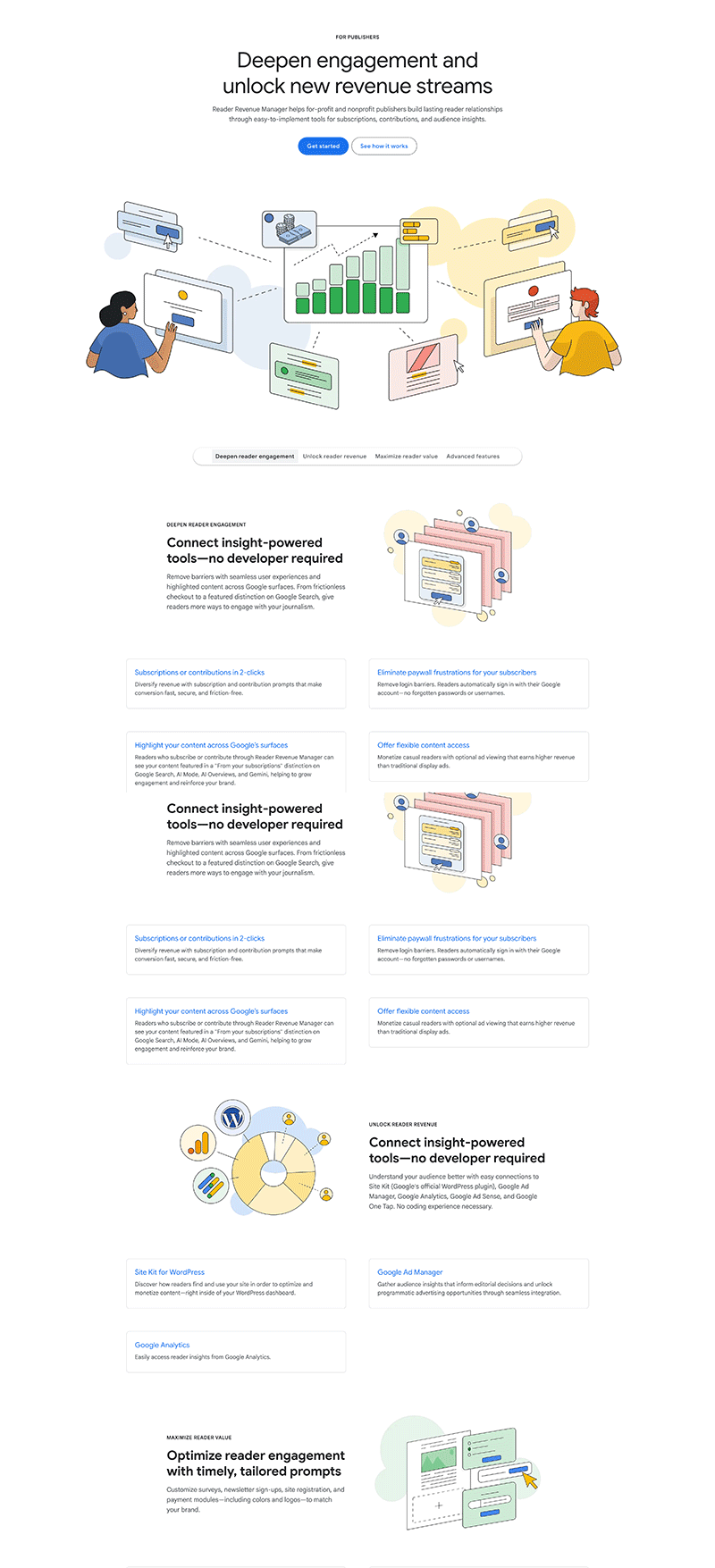
Image: Search Engine Roundtable
Why it mattersA publisher with a subscription paywall now has four more surfaces where its paying readers can see its content from a search, which changes whether the paywall costs them visibility across answer engines.
A paywall used to mean the content behind it was invisible to a reader who found the site through a search result.
Google updated the Reader Revenue Manager home page to list AI Mode, AI Overviews, and Gemini as surfaces where subscriber-only content from participating publishers can appear. Reader Revenue Manager is Google's product for publishers that do not have an existing subscription or membership system of their own. The old home page listed only Google Search, Discover, and News as surfaces where content behind a Reader Revenue Manager paywall could still be shown to subscribers. The new page extends that to the three generative-engine surfaces as well.
What a surface means here
A subscriber signed into Google with the same account they use for the publisher's subscription sees the paywalled content inside the surface, in the "From your subscriptions" distinction. A reader who is not signed in or who does not have that subscription sees the normal gated page. The surface list sets where this match-and-serve happens. Google Search was the first one, Discover and News followed, and the three AI surfaces are the new addition.
Advanced features now listed on the page
Google also added an advanced features section to the Reader Revenue Manager home page. The listed items are 5-Step Pricing, From Your Subscriptions, Metered Read, Bundles, Subscription Linking, customisable payment reminder emails, 1P customisable surveys, Rewarded Ads, Registration Wall, Newsletter Signup, Cancellation Survey, and CTA customisation. Barry Schwartz at Search Engine Roundtable reports that the page is a redesign of the previous version, with the new matrix of features added and existing links moved around.
Why this is a GEO decision
For a publisher that uses a paywall, the question has always been where the paywall still allows exposure. If a reader lands on an AI Overview that quotes an article, the AI Overview comes from pages Google can read. A publisher that keeps content gated to non-subscribers has, until now, chosen between exposure and revenue on each page. The Reader Revenue Manager change widens the second half of that choice: a subscriber can now see the publisher's content inside the AI surface, with the "From your subscriptions" distinction visible, as well as on Search. That gives a publisher one more reason to attach Reader Revenue Manager to a paywall rather than to run the paywall itself.
The change also says something about where Google thinks subscription traffic is going to come from in the next year. Three of the four surfaces now listed, AI Mode, AI Overviews, and Gemini, are the ones Google has promoted the most this year. A publisher who already has readers coming from them is now able to count the subscriber visits to those surfaces separately in the Reader Revenue Manager report.
The limit of the change
This is a documentation update that extends an existing capability. Google rewrote the Reader Revenue Manager home page, added the three AI surfaces to the list of places subscriber content can appear, and added an advanced features section. The Subscribe with Google integration and the tags on a paywalled site stay the same. A publisher already in the program should see the three new surfaces appear in reports; a publisher not in the program still has to meet the usual eligibility criteria to join.
Source
Reader Revenue Manager, Google. Google Updates Reader Revenue Manager Home Page, Search Engine Roundtable.
This item was written by an AI system from the linked source. Reveneau is responsible for what it publishes.
Get AI News in your inbox
New developer tools, model and agent releases, and how teams are actually using them to release software. Short, and only when there is something worth reading.