AI NewsModels & agentsReported
Latent Space measured GPT-6 Astra's running cost at under $6 an hour
Latent Space spent more than 20 billion tokens on GPT-6 Astra during early access and reports a sustained running cost under $6 an hour, with the real spending risk coming from how many agents the model starts in parallel.
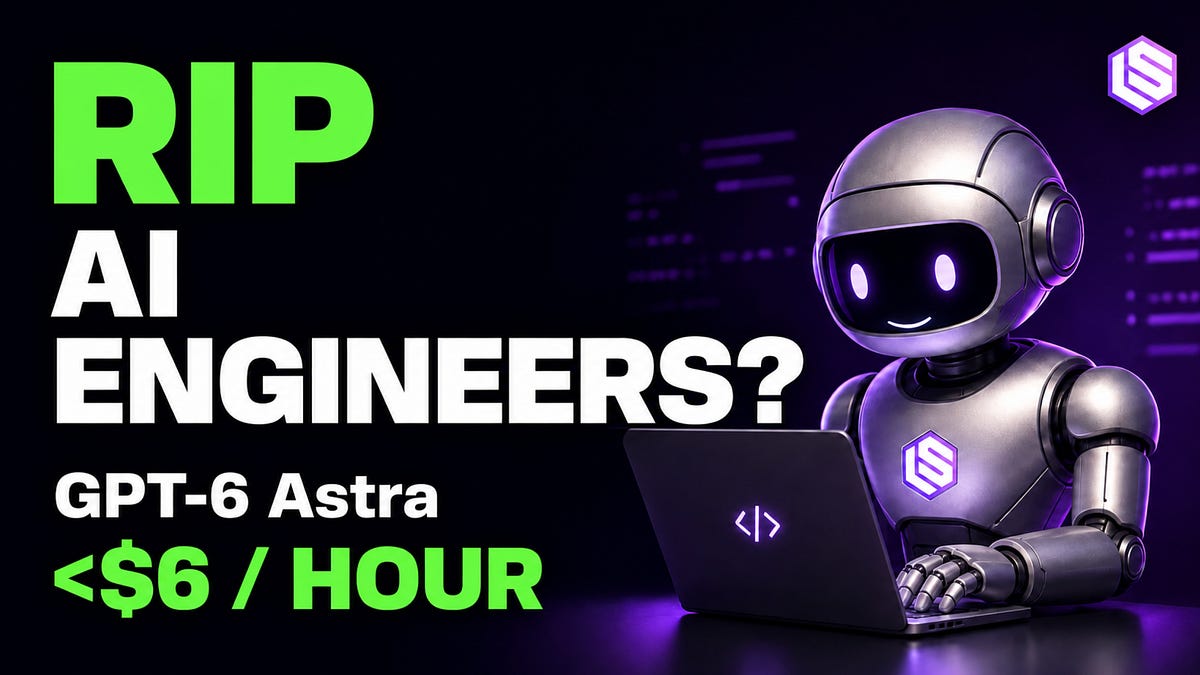
Image: Latent Space
Why it mattersThe per-hour cost of an agent now depends on how many subagents it launches, so capacity planning has to limit how many agents run at once rather than estimate tokens per task.
Latent Space published a hands-on report on GPT-6 Astra on 3 September, after early access and more than 20 billion tokens of use. The main figure is a running cost: the newsletter measured Astra at 33 tokens per second against a maximum rate of $50 per million tokens, which works out to under $6 an hour of continuous work.
That arithmetic is the useful part, because it is a rate rather than a total. A price per million tokens tells you nothing about what an hour of an agent costs until you know how fast it produces them.
The cost depends on how many agents it starts
Latent Space is direct about the limit of its own number. It writes that running Astra at the Ultra setting will cost far more than $6 per hour, because the model is effective at working in parallel. In practice the team says it was often running between 20 and 50 agents at once, all managed by one main Astra agent that started and stopped groups of tasks and watched its own runs.
So the per-hour figure describes one worker. The bill covers all the agents running, and the model decides how many there are.
The comparison the authors draw
Latent Space frames the work as the kind a junior AI engineer does: watching runs, looking at data, finding problems, fixing them and running again. Against that, it puts hiring someone at $200 to $1,000 a day next to spending about $100 on GPT-6 over two days for the same supervision work.
That comparison is the authors' own, drawn from their own use rather than from a controlled study, and the tasks they chose are theirs.
The benchmark scores in the piece come from OpenAI's launch. Latent Space reports that Astra scores 97.6% on the hardest versions of FrontierMath and 99.9% on ARC-AGI-3, and attributes both to OpenAI's own materials rather than to its own testing. It separately points to Artificial Analysis as having independently confirmed that Astra uses fewer tokens than Sol and Fable for the same work, which is the finding that supports the hourly rate.
One stated caveat applies to the latency number: the 33 tokens per second was measured during preview, and the authors note their conclusion assumes that speed stays the same in general availability.
One orchestrator decides the size of the bill
The useful lesson is how the cost is structured, more than the dollar figure. When one agent can decide to start fifty agents, spending depends on how many agents run at once rather than on the task. A team that budgets by estimating tokens per ticket will be wrong by whatever factor the orchestrator chose that afternoon.
The practical control is a limit on how many subagents a run may have open, set outside the model rather than requested in a prompt. That is a scheduling problem with a known answer, and it is cheaper to solve before the first large invoice than after it.
It is also worth separating what was measured here from what was asserted. The throughput, the token spend and the parallel agent counts come from a team that ran the thing for days. The benchmark percentages come from the company selling it.
Source
GPT-6 Astra: an automated AI Engineer you can hire for <$6 an hour, Latent Space, 3 September 2026.
This item was written by an AI system from the linked source. Reveneau is responsible for what it publishes.
Get AI News in your inbox
New developer tools, model and agent releases, and how teams are actually using them to release software. Short, and only when there is something worth reading.


