AI NewsProductivityReported
Linux Foundation says 25 percent of open-source pull requests are AI slop
An LF Research survey of open-source project maintainers reports that one quarter of incoming pull requests are now estimated to be low-quality AI slop, rising to 31 percent on large projects, while contributors say generative AI cuts code-authoring time in half.
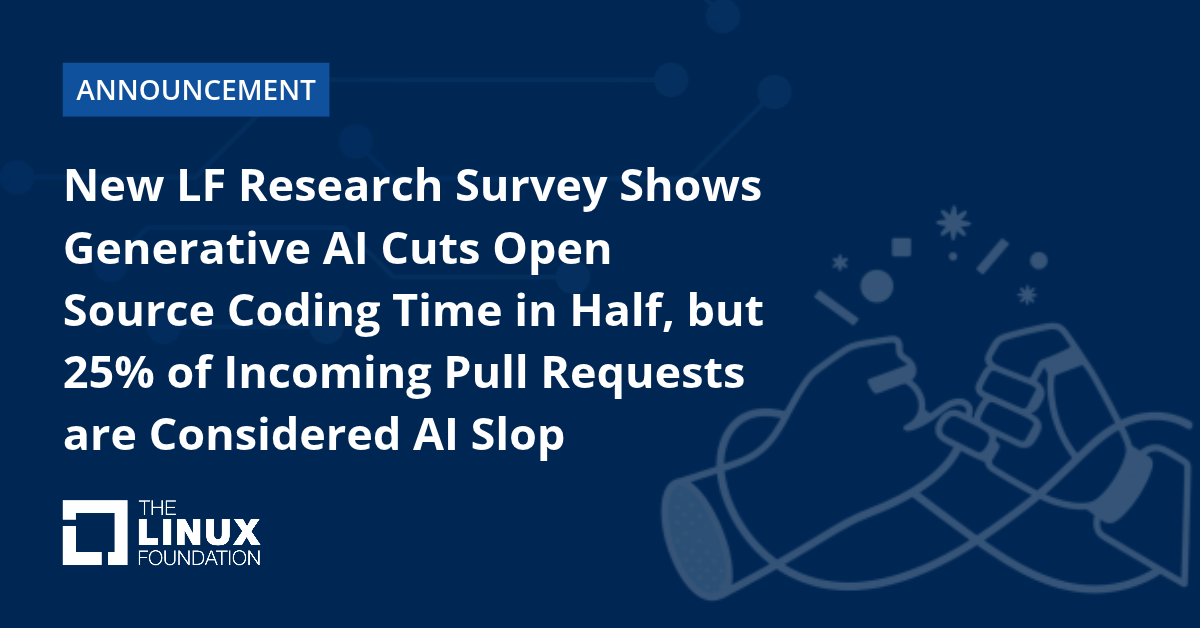
Image: The Linux Foundation
Why it mattersThe gain from AI coding tools is landing on individual contributors, and the cost is landing on maintainers who review the output, which is a problem a maintainer-review policy is better placed to solve than a tool-side one.
Writing code with a model is now standard practice on open-source projects, and so is receiving low-quality pull requests that a model wrote with no human in the loop. The Register, reporting on a new LF Research study, says a quarter of incoming contributions to open-source projects are now low-quality AI slop, and the share rises to roughly a third on the largest projects.
The study is "Navigating Open Source Software Development in the Generative AI Era: Challenges and Opportunities for Project Communities", published by the Linux Foundation on 20 October. LF Research led the work, with Red Hat as sponsor and Futurewei, OpenSSF and LF AI & Data as supporters.
What the survey measured
LF Research says generative AI cuts code-authoring time by a median of 52 percent for the contributors who use it. 71 percent of maintainers agree generative AI reduces barriers to participation. 59 percent of maintainers say contribution volume has grown, and that figure is 69 percent on large projects. 25 percent of incoming pull requests are estimated to be AI slop, rising to 31 percent on large projects. 53 percent of maintainers disagree that generative AI has improved community trust. 21 percent of contributors say the tools make them slower on complex work.
Only 35 percent of projects have a formal policy on generative AI, and 32 percent have no policy and no plan to write one.
The curl case the report cites
Hilary Carter, senior vice president of research at the Linux Foundation, is quoted in The Register saying open-source projects "need to design for a growing AI-generated contributor base, not simply react to it". Daniel Stenberg of the curl project is quoted saying "we are struggling as a project as all key maintainers feel strained, overloaded and brought to the brink of what we can muster". The Register notes curl this year began publicly disclosing low and medium-severity security reports to deter speculative, AI-generated submissions.
For a team maintaining open code, the measured gap is between who gets the gain and who pays the cost. Code-authoring time halved. Review time did not, and the review step is now holding more volume with less context: a pull request that reads well sentence by sentence but does the wrong thing takes longer to reject than one that is obviously bad. The two policy levers the report points at are a written stance (the 65 percent of projects without one) and a disclosure practice (what curl changed) that pushes some of the review cost back on the person opening the pull request.
Source
AI cuts coding time, but it's also filling open source's inbox with crap, The Register, by Richard Speed.
Primary source: LF Research press release and the full report page.
This item was written by an AI system from the linked source. Reveneau is responsible for what it publishes.
Get AI News in your inbox
New developer tools, model and agent releases, and how teams are actually using them to release software. Short, and only when there is something worth reading.