AI NewsOpen sourceAnnouncement
Gloss writes an open model's answers in the reading margin
Hassan El Mghari released Gloss, an open source reader for articles, chapters and PDFs where selecting a line and typing a question puts an open model's answer in the margin, citing the paragraphs the reader can click.
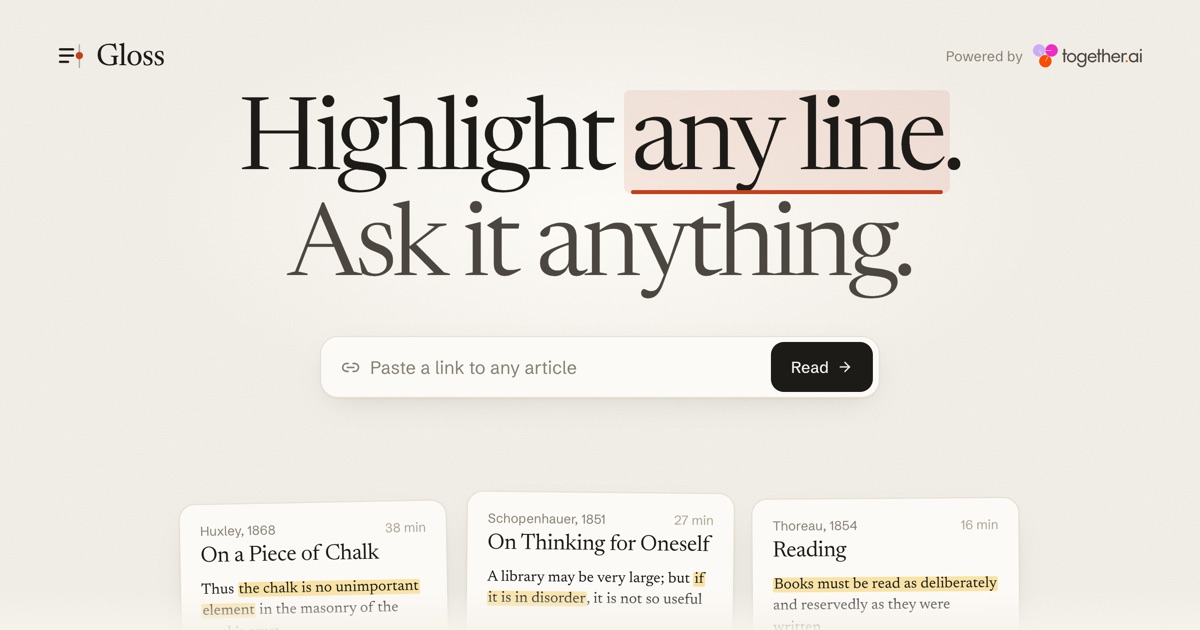
Image: Gloss
Why it mattersA reader stops copying passages into a separate chat window and forgetting which paragraph the answer was about, and a team gets a working open source example of passage-grounded answers that cite the paragraphs they quote.
A reader who has pasted a paragraph into a chatbot, read the answer, scrolled back to the article and forgotten which paragraph the answer was about has met the problem Gloss is trying to solve. Hassan El Mghari, the developer behind several Together AI showcases, has published Gloss: an open source reader that keeps the answer beside the text the reader asked about.
The code is at github.com/Nutlope/gloss, with 92 stars in its first five days. The live site is at usegloss.io. It is a Next.js 16 app in TypeScript, built on React 19, Tailwind v4 and Zustand, running against Together AI for the model calls.
What the reader does
Open an article, chapter or PDF, select a line, start typing. An open model on Together AI writes the answer in the margin beside the selection, with references to the paragraphs in the text written as [¶n], each one a link that scrolls the article to that paragraph. Pressing / asks about the whole text instead of a selection, j and k step through paragraphs, B glosses the whole text in one pass, and ? lists every key.
The whole text goes into the system prompt with [¶n] numbers on every paragraph, so follow-up questions hit Together's prefix cache and the model has the full source to cite from. Two models are available in the UI: DeepSeek V4.1 Flash as the Quick option, Kimi K3 at low reasoning effort as the Deep option. The model also gets a web_search tool through Exa for anything it needs that is not in the text, such as a named person or an event newer than the article; the Web toggle turns that off, and Fact-check always uses it.
How the content gets in
Three paths. Links come through @mozilla/readability on linkedom, keeping figures and data tables. Pasted text and uploaded .txt or .md files work the same way. Posts and videos (X, Threads, Bluesky, YouTube) are turned away with a pointer to Paste text.
PDFs are read in the browser by LiteParse, a Rust-to-WebAssembly build of @llamaindex/liteparse-wasm, which reads the text layer, columns, headings, lists and tables in milliseconds. Pages whose text layer is unusable (scans, garbled glyphs) are rendered and read by Qwen3.8 Flash on Together. Over twenty pages needs the reader's own Together key, because every question sends the whole text to the model.
The library, the review, the MCP server
Every imported text lands on a shelf arranged by topic, recency, colour or length, with a 3D book view off the shelf. One DeepSeek V4.1 Flash call per text picks a topic from a fixed set of 24 and a few tags, at about $0.0001 a text. A daily review on the home page returns five of the reader's highlights, spaced like flashcards, and the whole set of highlights and notes exports as Markdown files ready for Obsidian.
The MCP server at /mcp exposes four tools to agents the reader connects: save_articles, save_text, search_library and list_topics. The reader makes a token in the library and sends it as Authorization: Bearer gls_..., up to 25 links per call, one text per call and 1,000 saves per day.
Local-first by default: texts live in IndexedDB and highlights in localStorage, signed out. With a Clerk account, the shelf syncs to Postgres on Neon. The shared Together key is capped at ten cents per hashed IP per day signed out, twenty cents signed in, and $1,000 total per day.
Source
Nutlope/gloss on GitHub and the live site at usegloss.io.
This item was written by an AI system from the linked source. Reveneau is responsible for what it publishes.
Get AI News in your inbox
New developer tools, model and agent releases, and how teams are actually using them to release software. Short, and only when there is something worth reading.