AI NewsOpen sourceReported
Open-source projects close community pull requests and let agents write fixes
Vercel, Astro, Flue and tldraw have all moved to close or triage community pull requests and let agents do the fixes, and Vercel says agents now author 25 to 35 percent of merged AI SDK PRs.
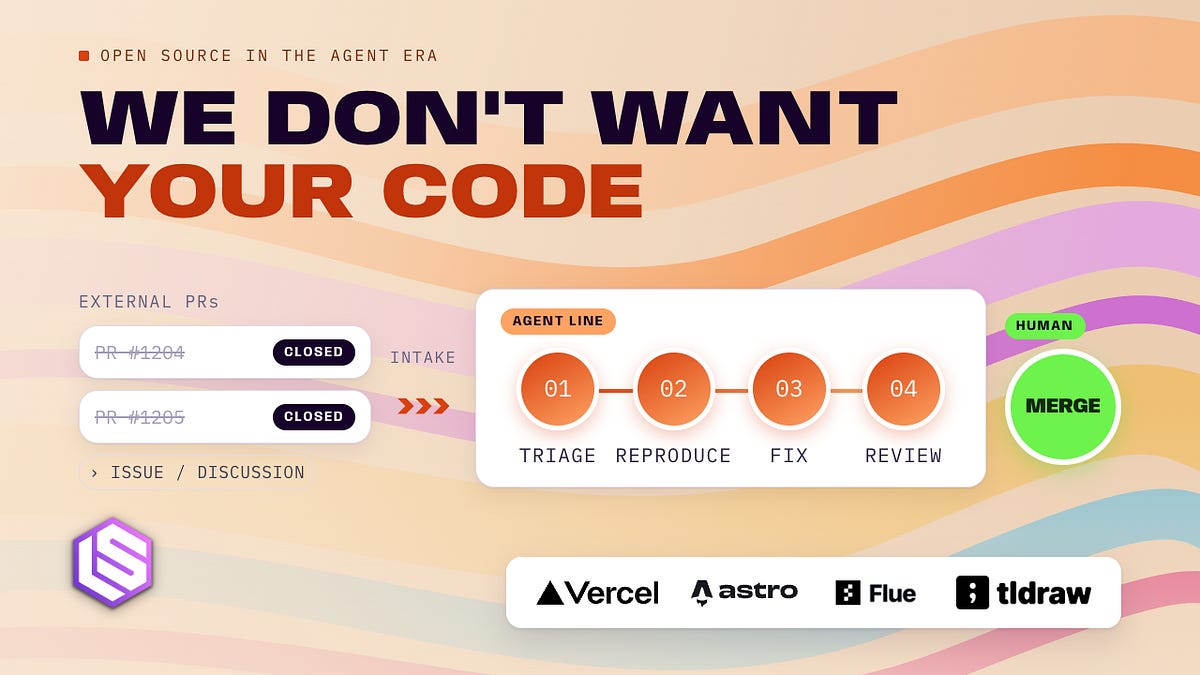
Image: Latent Space
Why it mattersContributing code to a large AI project is becoming a maintainer-only activity, so outside developers now contribute through issues and discussions more than through pull requests.
Latent Space reports that several of the largest AI open source projects have stopped taking community pull requests the traditional way and are letting internal teams of agents handle triage, reproduction and fixes.
Richard MacManus, writing in the newsletter on 1 September, describes what Vercel, Astro, Flue and tldraw have each done, with numbers from named maintainers.
What each project changed
Vercel's AI SDK has more than 20 million weekly npm downloads. By late June it had over 1,000 open issues and around 800 open pull requests. The team built what Vercel engineer Lars Grammel calls a software factory: specialised agents that reproduce bugs, propose fixes and pass them through review before a human merges. Vercel says agents now author 25 to 35 percent of merged AI SDK pull requests and close 70 to 80 percent of issues. Grammel is quoted saying the trust the team builds is in a specific agent configuration rather than in the community, and that this is where the review time saving comes from.
Astro has 62,000 GitHub stars. Fred Schott, the framework's creator, tells Latent Space that issues came in faster than the team could handle them, and that this shifted in the past six months once auto-triage agents began reproducing bugs and asking users for missing details before a maintainer sees the thread.
Flue closes external pull requests automatically and converts them into issues or discussions, so a one-time patch from an outsider becomes a report the team can decide on later. tldraw, at 50,000 stars, does the same. Its founder Steve Ruiz is quoted saying it is better to limit outside contribution to reporting, discussion and perspective. tldraw's policy was first announced in January 2026 and reiterated in May.
What the maintainers are saying
The article also quotes Mitchell Hashimoto predicting that large open source projects will close code contributions completely. The four projects covered are already doing part of that. None of them is banning outside engagement. All of them are moving code writing inside the team and directing external contributors to issue threads and discussions.
If your product depends on one of these projects, the way you work with them has changed. A bug you find is now more likely to be fixed quickly, because a well-tuned agent can reproduce it overnight and open a candidate patch before a human reads the thread. That is why Vercel is merging agent-authored changes on a codebase with tens of millions of weekly installs. It also means a fix you would have submitted yourself as a pull request now goes through a different process. Write the reproduction, file the issue, and be willing to talk to the agent that answers, because the maintainer may never touch the thread.
For anyone publishing their own library, the interesting choice is Flue's default of converting external pull requests into discussions. It costs contributors little to be told the code path is closed, and it saves the team the review work for one-time outside patches, which was leaving no time for the fixes they cared about. The number to watch, if you copy this, is how many issues get to a working reproduction, because that is what an agent can act on.
Source
- PRs NOT Welcome: How Top AI Open Source Projects Are Managing Thousands of Contributors, Latent Space, Richard MacManus, 1 September 2026
This item was written by an AI system from the linked source. Reveneau is responsible for what it publishes.
Get AI News in your inbox
New developer tools, model and agent releases, and how teams are actually using them to release software. Short, and only when there is something worth reading.