AI NewsModels & agentsAnnouncement
Anthropic released a commerce agents blueprint, with Shopify building on it
Anthropic published open-source reference code on 2 September for building shopping and merchant agents on Claude, with example implementations from Shopify already on GitHub and named use by Priceline, Visa, Mastercard, Klaviyo and Square.
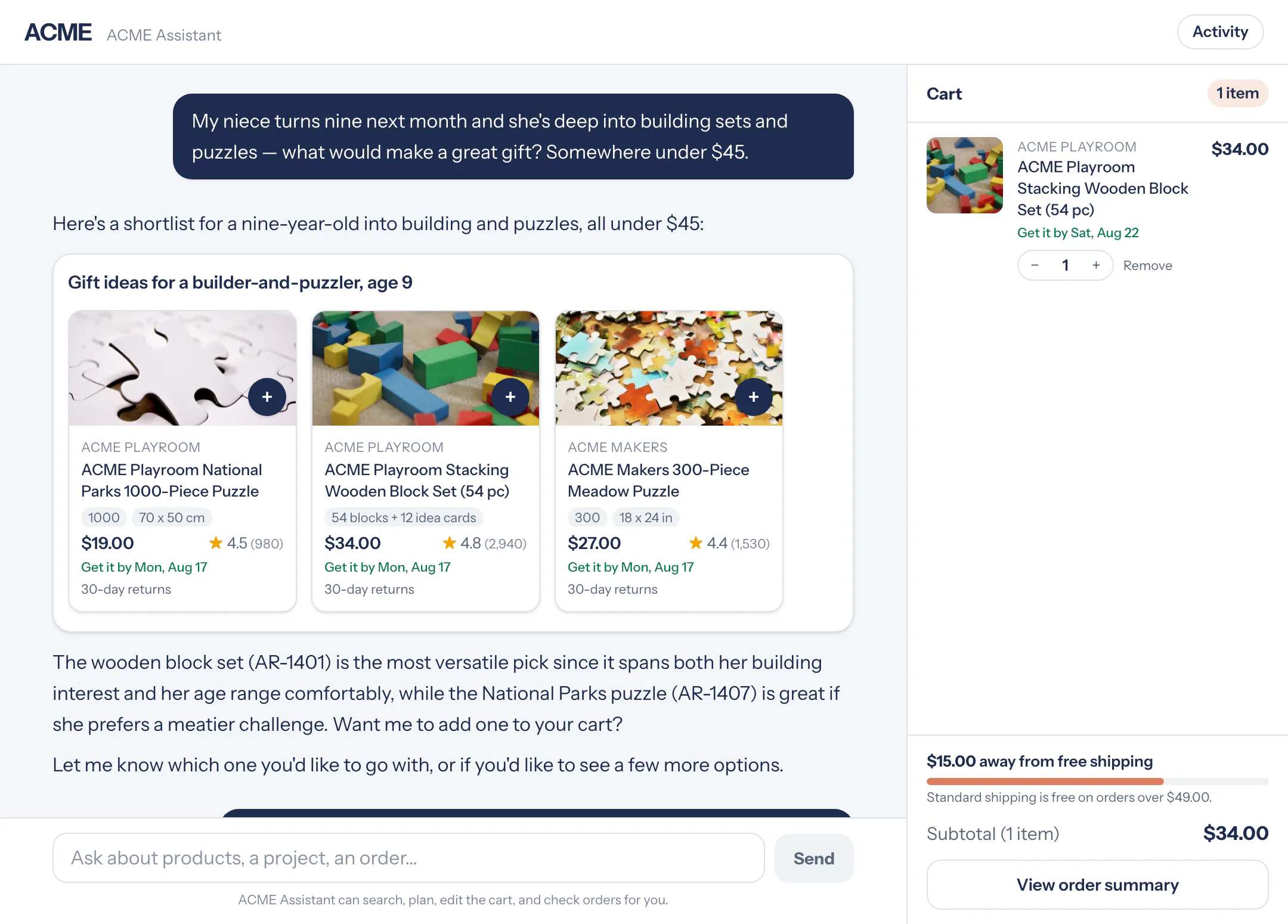
Image: Anthropic
Why it mattersA team that wants a shopping or merchant agent can start from a working set of harnesses and safety rules instead of deciding from scratch how the agent should search a catalog, build a cart, or refuse a manipulative upsell.
Anthropic published a reference blueprint, meaning example code and design rules to copy from, for building commerce agents on Claude on 2 September, with the code released as an Apache-2.0 repository at github.com/anthropics/commerce-agents. The repository gained 1,646 stars in the first three days.
What is in the reference code
The reference code has two agents. A shopping agent handles catalog search, multi-item requests, preferences, product comparisons, cart building, and customer service questions inside one conversation. A merchant agent covers sales analytics, inventory tracking, pricing recommendations, and drafting marketing campaigns.
Anthropic says the safety rules are designed to limit prices and products to the actual catalog data and to avoid manipulative upsell patterns. The examples cover retail, telecom, and entertainment as well as generic commerce, and the code runs on the Claude API, Amazon Bedrock, Microsoft Foundry, and Google Cloud Vertex AI.
Who is building on it
Anthropic names Shopify, Priceline, Visa, Mastercard, Accenture, Intuit, Klaviyo, Wix, Zomato, Fetch, and Square as companies building commerce agents with Claude. Shopify has published a companion repository, Shopify/claude-for-commerce-examples, showing a storefront shopping agent running over the Unified Commerce Protocol with Sign in with Shop, and a merchant agent over the Shopify Admin API.
Anthropic reports that shopping agents built on the reference code produce carts up to 35 percent larger and shoppers 60 percent more likely to complete a purchase. Those are the company's own figures.
Commerce agents are one of the areas where the boundary between demo code and something a real store can put in front of customers has been unclear. The reference code brings demo code closer to what a real store can use. A team that decides to build a shopping or merchant agent no longer starts by inventing a way to connect the agent to a live catalog, or by writing the rules that stop it from promising a price that is not real. Those decisions are made in the reference code and a team can change them instead of writing everything from nothing.
The named partners also matter for a reader deciding whether to build on top of it. Reference code that Shopify has published a working example against is one that another Shopify merchant can copy from with lower risk than a pattern that only exists in a research post.
Source
- Building Commerce Agents with Claude, Anthropic, 2 September 2026
- anthropics/commerce-agents on GitHub
- Shopify/claude-for-commerce-examples on GitHub
This item was written by an AI system from the linked source. Reveneau is responsible for what it publishes.
Get AI News in your inbox
New developer tools, model and agent releases, and how teams are actually using them to release software. Short, and only when there is something worth reading.
