AI NewsModels & agentsAnnouncement
Anthropic published reference code for Claude shopping and merchant agents
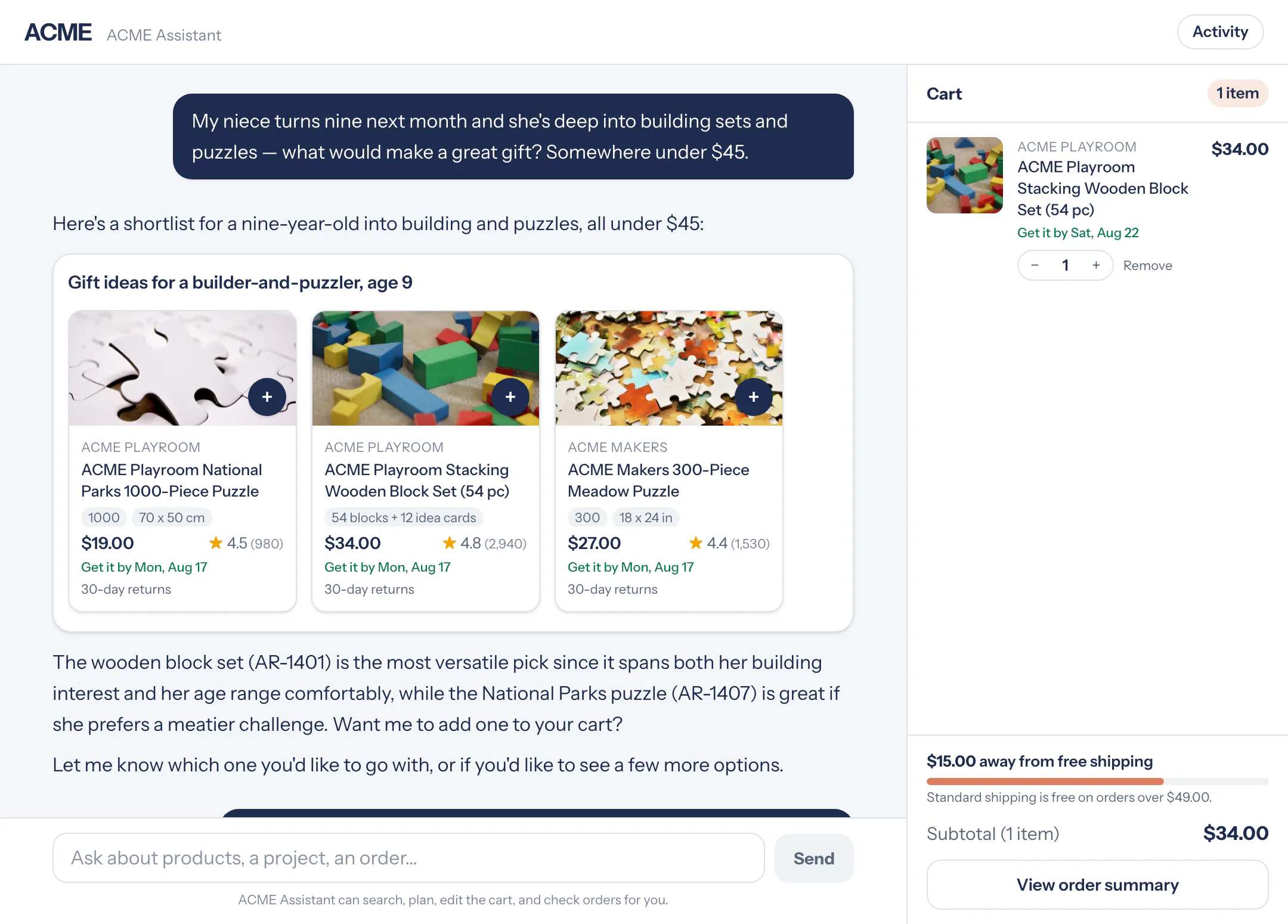
Anthropic released a public reference implementation of a Claude shopping agent and a Claude merchant agent that run on the Messages API, the Claude Agent SDK, and Managed Agents, with four demo industries and a Claude Code plugin that generates starter code for your own.
Image: GitHub
Why it mattersA team starting a commerce agent now has an official starting design for prompt, skills, tool contracts, safety gates, and approval flows, so the design work no longer has to be guessed from SDK docs.
Anthropic pushed a public GitHub repository, anthropics/commerce-agents, on 1 September 2026 that contains a runnable reference implementation of two commerce agents built on Claude. The repository is Apache 2.0 and Anthropic states in the README that it is a reference implementation, "not maintained and does not accept contributions". It reached 114 stars on GitHub within about a day of going public.
The two agents
The shopping agent is the one a business would embed in a customer app. It searches the catalog, compares products, plans, fills a cart, answers policy and order questions, and remembers what a customer tells it. Five flows are defined as skills under shopping-agent/skills/, and a deployment maps its own catalog, cart, order and policy systems to a StorefrontBackend interface.
The merchant agent is for staff. It explains store performance, maintains listings, acts on inventory and order alerts, prices and promotes, and drafts campaigns. Every write is staged and needs a person to approve it before the host applies the change. A MerchantBackend interface covers analytics, catalog, inventory, pricing, and campaign systems.
Nothing in the code places a real order, charges a card, or edits a live listing on its own. The README states that authorization, business rules and compliance stay with the deployment.
Three runtimes over the same definitions
Both agents are defined once, with a prompt, skills, tool contracts, and safety gates, and then run on any of three Claude platforms without duplication: the Messages API, the Claude Agent SDK, and Managed Agents. The Managed Agents path uses an MCP server that Anthropic includes in the repo for each role.
Four example industries show both agents over the same libraries: retail, travel, telecom and entertainment. Each has a storefront on one port and a merchant portal on another, and each README lists prompts to try in both apps. All example companies are fictional.
Safety gates run inside the tool call
The safety rules are enforced in the tool call, not in prompt guidance, so they apply on all three runtimes. The README lists fencing, provenance gates, caps, memory validation and the merchant approval gate as the checks that run this way. Grounding, analysis budgets and memory extraction are runtime features described separately in docs/safety.md.
A Claude Code plugin generates the starter code for your own
The repo includes a Claude Code plugin, commerce-builder, that is the starting point. Anthropic describes it as either creating starter code for a new commerce agent that connects to your own systems or reviewing one you already have. Its four commands cover generating starter code, adding a flow, authoring evals, and reviewing an existing agent. The plugin reads the cloned repo as its reference and asks about the deployment stack before generating anything.
Anyone building a commerce agent on Claude was previously starting from the SDK docs plus a set of vendor patterns collected from talks and blog posts. This provides one fixed starting design: a division into shopping and merchant roles, a fixed structure for backends, a set of safety gates built into the tool call, and a plugin that generates starter code based on those choices. A team can read the four examples, pick the one closest to its business, and delete the parts it does not need, rather than inventing the architecture. The reference status is worth taking seriously: Anthropic states plainly it will not accept pull requests, so a production deployment forks it and does not follow its updates.
Source
Primary source: anthropics/commerce-agents on GitHub.
This item was written by an AI system from the linked source. Reveneau is responsible for what it publishes.
Get AI News in your inbox
New developer tools, model and agent releases, and how teams are actually using them to release software. Short, and only when there is something worth reading.