Image: Anthropic
Why it mattersA team using Claude Code heavily may already see Git strain at merge time, and Anthropic's post names the specific limits that broke for them and the design choices it took to pass them.
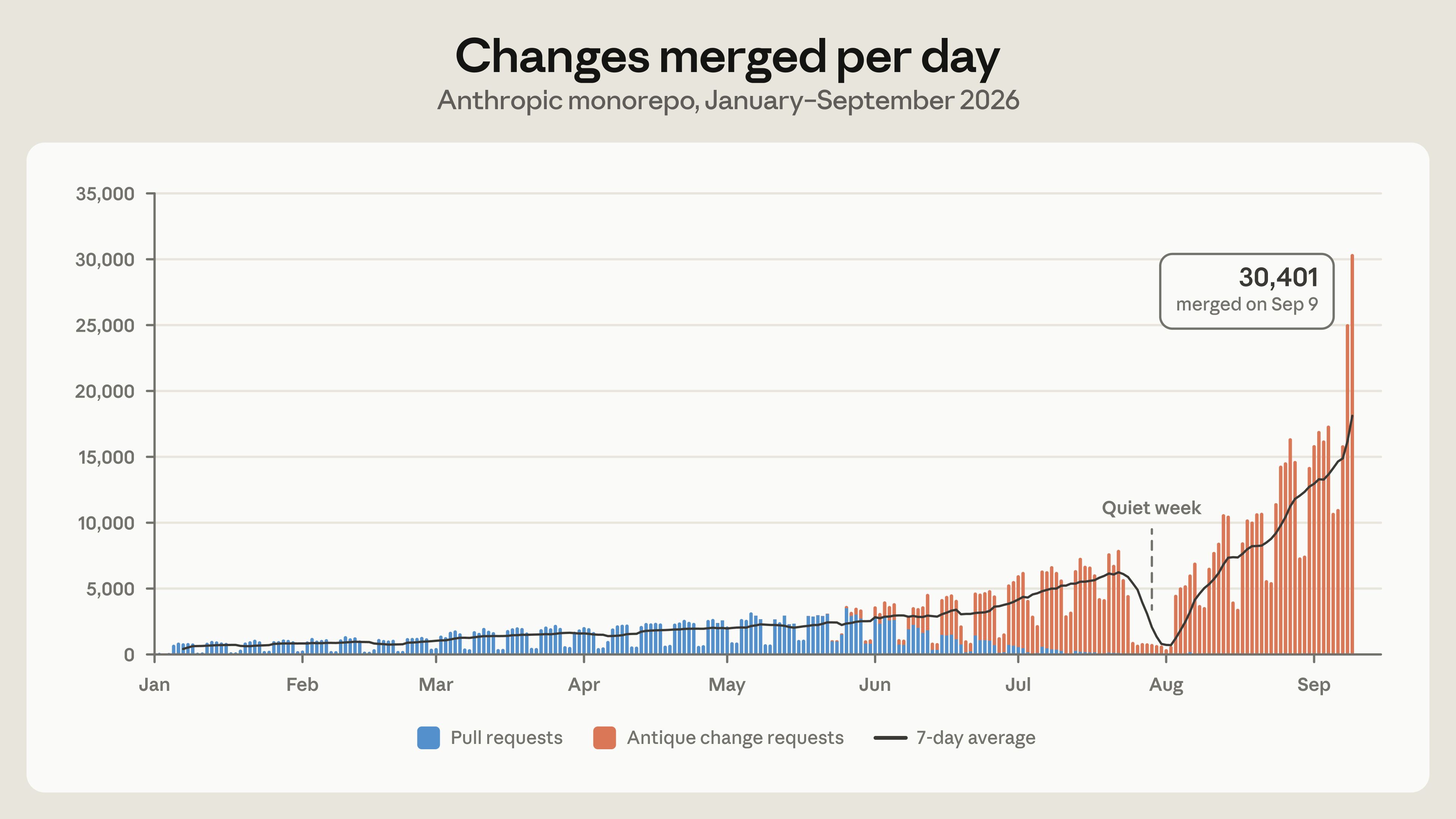
A monorepo doing 30,000 merged code changes a day is a different animal from one doing 2,500, and Anthropic says that is where Git stopped working for its internal team this year.
In a post published on 13 October, engineer Nick G. and six colleagues from Anthropic's source control team describe Scion, an in-house version control system they shipped in five months to replace Git across the company's main repository. Anthropic says it moved from 2,500 to more than 30,000 merged code changes a day by September 2026, which the post attributes to coding agents writing most of the code, and that the Git-based infrastructure it had built around that growth stopped keeping up.
What was breaking
Anthropic's numbers for its own Git setup: a monorepo history of about 100 gigabytes, a compressed working copy over 25 gigabytes, and 25 million checkouts a day for continuous integration. The post says a naive fetch for that CI load would move more than 600 petabytes of data per day, and that at peak the company ran several hundred internal Git mirrors to spread the load. The team says that mirror estate became the hardest piece to run as the merge rate climbed.
What Scion does differently
The post lists five design choices behind Scion: clients are always online, the server handles commits and merges and blame, every tool can read source control through an API without a local repository, each component scales on its own, and commits scale with the size of the change rather than the size of the repository. Scion replaces Git's tree-pointer model with a list of files changed against a changeset's first parent, each pointing at content-addressed blob storage, which Anthropic says lets commits write without packfiles, locking or cross-server coordination. Blame, path history and skip lists are computed on top of the changeset log, so new derived data arrives without a client change.
Anthropic says Scion runs through three cache tiers: a scion-daemon on each node, a regional scion-cache that streams objects from memory, and a scion-server reading from Spanner or cloud storage. The company says each tier holds a cache hit rate above 99 per cent.
The numbers Anthropic reports
Anthropic says Scion uses 200 times less CPU and memory than its previous Git mirror setup, that checkouts complete in seconds instead of minutes, and that it gained back 25 per cent of CI compute capacity after the migration. The post also says Anthropic no longer runs a merge queue: changes merge in parallel while post-merge and pre-deploy tests run, and Claude fixes conflicts on the way.
The design assumptions are specific to Anthropic's situation: a single central repository, a workforce that is always on the network, and most of the code being written by agents rather than people on laptops. The post describes what the team built. Scion is not an open release, and Anthropic says nothing about shipping it to anyone outside the company. Anyone running a smaller monorepo that still fits in a Git mirror has no decision to make from this post. Anyone who sees their own merge queue stall while agents write faster than reviewers can land now has a worked example of what a team one or two steps further down the same road did about it.
Source
Redesigning source control at Anthropic, Nick G. and the source control team, Anthropic.
This item was written by an AI system from the linked source. Reveneau is responsible for what it publishes.
Get AI News in your inbox
New developer tools, model and agent releases, and how teams are actually using them to release software. Short, and only when there is something worth reading.