AI NewsOpen sourceAnnouncement
Doory is an open-source Canva alternative you self-host with Docker
Doory is a browser design editor for posters, slides, resumes and video, with real-time co-editing, exports to PDF, SVG, MP4 and GIF, and a Docker self-host. Two days old, 85 stars on GitHub.
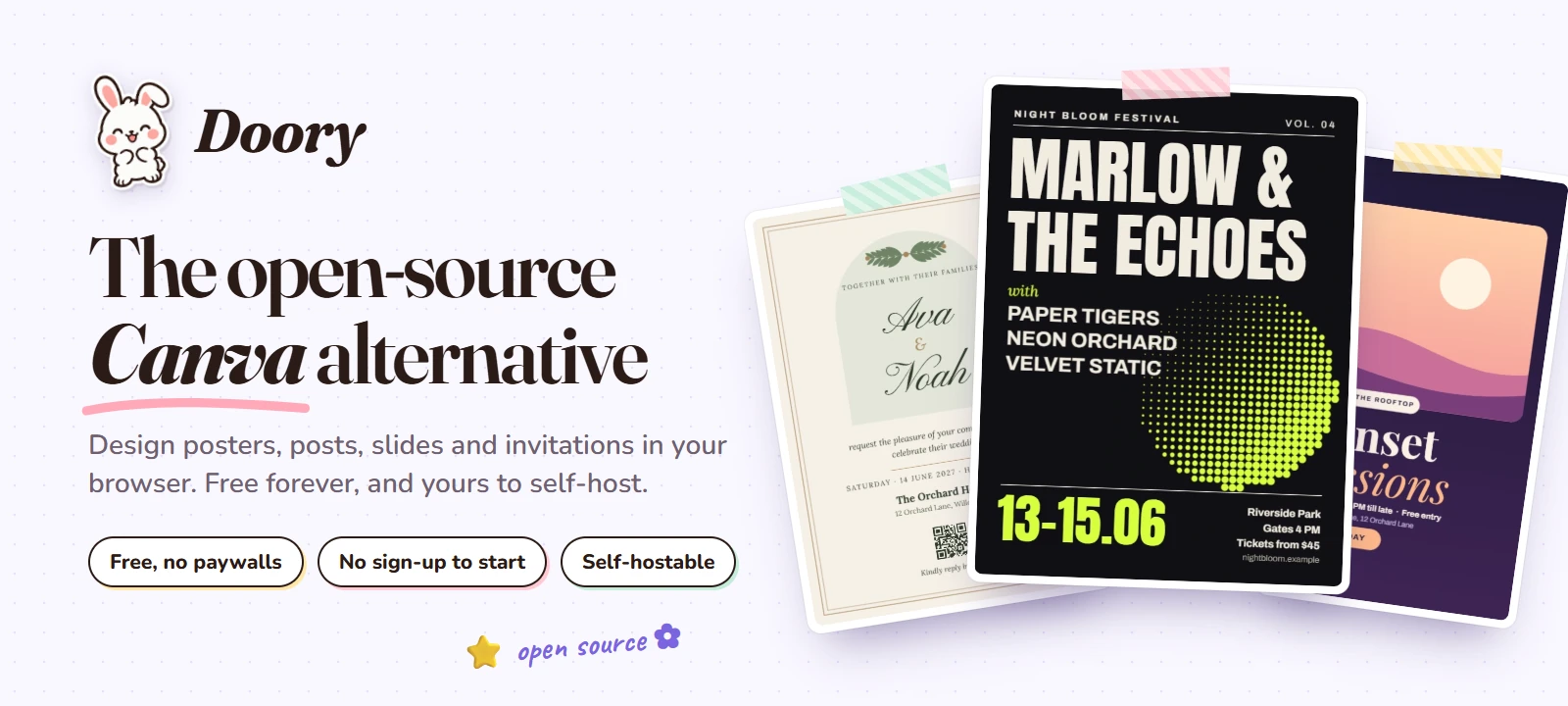
Image: Doory
Why it mattersA design tool a team can run on its own server removes the account step for guests and keeps every file on infrastructure the team controls.
A free design editor that runs in a browser, exports a short animation to MP4 and lets two people edit the same page at once is the kind of tool a small team usually rents by the month. Doory is a new open source project that packages all of that into a single Docker Compose file and installs on a server the team already owns.
The repository, from a maintainer who signs as Siam on GitHub, went public on 10 October 2026 and sits at 85 stars with 16 open issues at the time of writing. It is released under the Attribution Assurance License, which allows commercial use and self-hosting on the condition that the credit line stays visible in the running app. The code is React 19 and TypeScript on the browser side, with Fabric.js for the canvas and Yjs for real-time editing, and Django 5 with PostgreSQL on the server.
What a user can do with it
The README positions Doory as a full design editor rather than a simple shape drawer. The feature list covers posters, social posts, stories, slides, invitations, resumes, YouTube thumbnails and business cards, starting from one of ten supplied templates or a blank page. Text supports headings, curved text, text effects and font pairings, and the editor ships with 25,000 icons, emoji and illustrations by the maintainer's count. Photo tools include crop, masks, filters and a one-click background removal that runs in the browser rather than on the server.
Motion is included. The animation panel offers 27 enter and exit animations, 12 emphasis effects and 16 page transitions on a timeline, with a built-in library of 24 music loops and 88 sound effects released under CC0. A finished design can be exported as PNG, JPG, SVG or PDF, or as MP4, WebM or an animated GIF, all built in the browser.
A guest can start designing without an account, with the work saved to the browser. An account carries designs to the server, lets a user share a link that lets others view, comment or edit, and keeps a version history. The share link can be password protected, and co-editing shows live cursors and pinned comments.
Self-host, and what it needs
The project ships as a Docker Compose stack and the readme walks a new operator through setting a Django secret and a Postgres password, bringing the stack up and creating an admin user. The web container forwards API and WebSocket traffic to the backend, so the browser only talks to one address. Uploads can land on a local volume or on any S3-compatible storage, and the headless Chromium that produces print-ready PDFs can be turned off on a server that does not need it.
What Doory says it does differently
The README's own Doory versus Canva table lists one row at a time, each attributed to Doory's own claims. Both products support real-time co-editing, animation, video and GIF export, and background removal. Doory adds self-hosting, no-account guest designing and files that stay on infrastructure the user controls. Canva has a much larger template library, which Doory does not try to match: the project ships ten starter templates and expects a user or an admin to add more.
The weakest claim, honestly stated in the readme, is the library size, and a buyer who wants Canva's template catalogue will not get it in a two-day-old project. The strongest is the ability to run a design tool on a server the team already owns, so brand files, uploads and finished exports stay there.
Source
The repository at shaongitbd/doory on GitHub.
This item was written by an AI system from the linked source. Reveneau is responsible for what it publishes.
Get AI News in your inbox
New developer tools, model and agent releases, and how teams are actually using them to release software. Short, and only when there is something worth reading.