GitHub made agentic autofix for CodeQL alerts generally available
GitHub moved agentic autofix for code scanning alerts to general availability, replacing the free "Generate Fix" button with "Assign to Copilot," which reads across the repository, proposes a change, reruns CodeQL to check its own work, and opens a draft pull request.
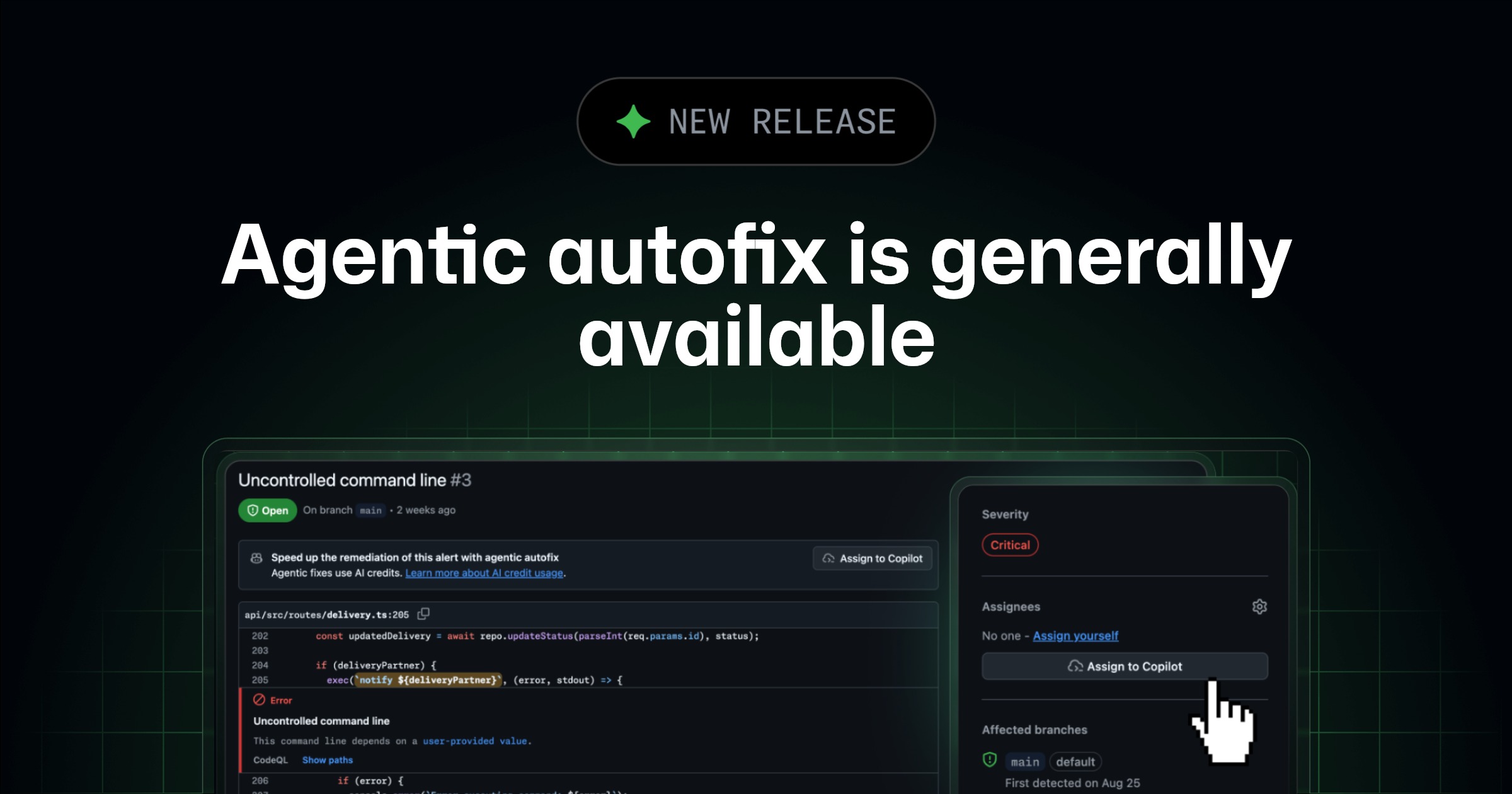
Image: GitHub
Why it mattersThe free quick-fix button that used to patch a CodeQL alert in place is gone, so every security finding a team wants fixed now costs AI credits from the Code Security budget, and the team has to decide which alerts are worth it.
A security team that used to click "Generate Fix" on a CodeQL alert and get a free patch in place now has to assign the alert to Copilot and pay for the fix. GitHub announced on 15 October 2026 that its agentic autofix for code scanning alerts has reached general availability, with the free quick-fix replaced by the paid agent.
In its changelog, GitHub says the agent "remediates alerts by working across your codebase the way a developer would: it explores relevant files, proposes a fix, validates the fix works by rerunning CodeQL, then opens a draft pull request." The feature is available only to repositories on GitHub Enterprise Cloud (including data residency editions) that carry a GitHub Code Security or GitHub Advanced Security subscription. An enterprise administrator has to switch it on in Advanced Security settings, under a policy called Agentic autofix, and a Copilot billing method has to be in place first.
What a run costs
Each autofix run spends AI credits from the Code Security budget and consumes GitHub Actions minutes to rerun the CodeQL analysis against the proposed change. GitHub says organisations can "set SKU level budgets for Code Security AI credits," which lets a team cap monthly spend on fixes before a single run exceeds a threshold.
That is a change from the public preview, where the free Generate Fix button lived alongside the agent and some teams used it to triage alerts cheaply. GitHub's wording makes the replacement explicit: the agent "replaces" the free option. Any workflow that assumed a free fix was always one click away stops working on 15 October.
What the agent actually does differently
A CodeQL alert is a path through a codebase: a source, a sink, and a chain of calls between them. The agent reads that path, proposes an edit that breaks it, and then runs CodeQL on the edited branch to confirm the alert disappears without introducing new ones. The pull request lands as a draft, which keeps the usual review step in the human's hands.
The design matters because a bad security fix is often worse than no fix. A patch that silences the scanner by sanitising at the wrong layer, or by narrowing the type where it should narrow the value, moves the vulnerability instead of removing it. Rerunning CodeQL against the proposed change is the test the agent has to pass before the PR goes up, and that test is where the agent earns the trust GitHub is now charging for.
For a team deciding whether to turn this on, the useful question is not whether the agent can fix a CodeQL alert. It is which classes of alert the team wants fixed by an agent at all. SQL injection with a well-defined parameterisation pattern is a different conversation to a reflected cross-site scripting path through a templating layer the agent has never read. A team that writes down the first and the second before enabling the policy will spend its AI credits on the alerts where a draft PR is the right starting point.
Source
Agentic autofix for code scanning alerts general availability, GitHub Changelog.
This item was written by an AI system from the linked source. Reveneau is responsible for what it publishes.
Get AI News in your inbox
New developer tools, model and agent releases, and how teams are actually using them to release software. Short, and only when there is something worth reading.