AI NewsModels & agentsAnnouncement
MiniMax says M3.1 Flash cuts agent cost 70 percent against M3
MiniMax released M3.1 Flash with input at $0.15 per million tokens and output at $0.60, claiming overall agent cost 70 percent lower than M3, though Artificial Analysis measured a 57 percent cut on its own workload.
Image: MiniMax
Why it mattersA team paying for M3 should test whether M3.1 Flash finishes the same tasks in fewer tool calls, because the price cut only reaches the bill if the agent also loops less.
A per-token price that halves does not halve the invoice. An agent that calls more tools, or runs more loops to finish the same job, can leave the total bill unchanged.
MiniMax released M3.1 Flash and says overall agent cost is 70 percent lower than its predecessor M3. The company lists $0.15 per million input tokens, $0.60 per million output tokens and $0.015 per million cached input tokens, and says inference runs nearly three times faster than M3. Per-token prices fell by half, so the rest of the 70 percent would have to come from the agent finishing in fewer loops. The launch post does not say which workload MiniMax measured.
What an independent tester saw
Artificial Analysis ran its Intelligence Index tasks and reported an average cost of $0.22 per task on M3.1 Flash, down from $0.51 on M3. That is a 57 percent drop, below MiniMax's own 70 percent figure. The two numbers come from different workloads, which is a reason to measure on your own tasks first. The New Stack cites a study of token use in agentic coding showing that repeated runs of the same job can use up to 30 times as many tokens, with input tokens doing most of the spending.
The benchmarks the model leads on and the one it does not
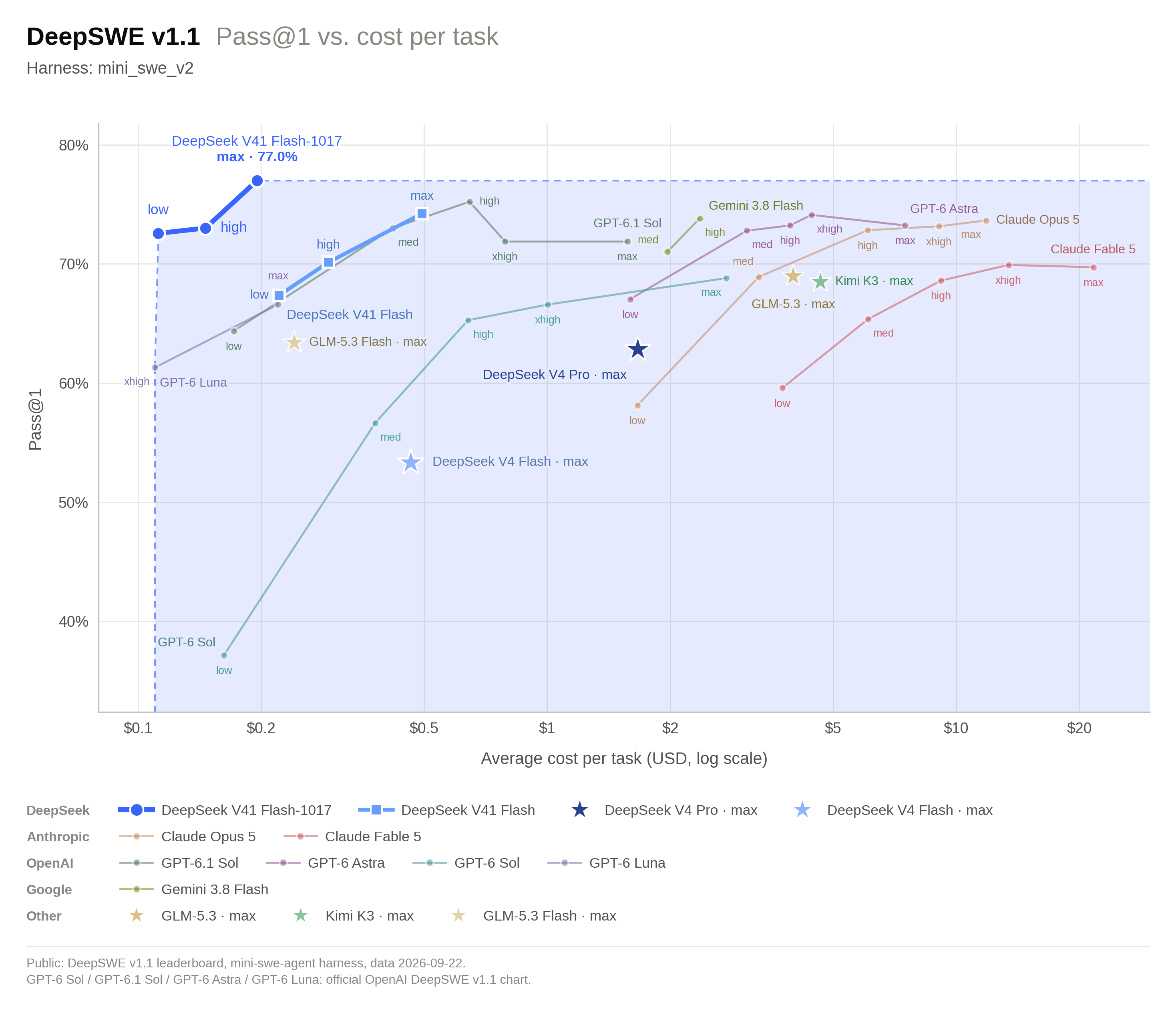
On DeepSWE v1.1 M3.1 Flash scores 73.7, a point behind the 74 MiniMax quotes for Claude Opus 5 and a point ahead of GPT-5.6 Sol at 73. VentureBeat places DeepSeek V4.1 Flash 1017 at 77 in the same table, and Anthropic's Opus 5.5 is not listed, so a buyer comparing against the current Opus has to run their own evaluation. On Artificial Analysis's Intelligence Index the model scores 42, tied with GLM-5.3 Flash, ahead of Gemini 3.8 Flash at 41 and behind DeepSeek V4.1 Flash 1017 at 45.
Computer use is the weakest result. MiniMax reports 61.7 on OSWorld V2 and calls it the top score among Chinese models, which The New Stack notes still trails the strongest Anthropic and OpenAI entries. The company also reports 82 percent on CyberGym and says its internal security team rates the model strong at code auditing, patching, penetration testing, malware analysis and reverse engineering. The launch post does not say how any of that was measured.
The hallucination finding
Artificial Analysis's AA-Omniscience benchmark is the most useful finding of the set. M3.1 Flash answered 56 percent of factual questions correctly, ahead of DeepSeek V4.1 Flash at 43 percent, and attempted almost every question. About 93 percent of its non-correct responses were wrong answers rather than abstentions. The overall Omniscience score came out at 16. Artificial Analysis described the result as high accuracy with a high hallucination rate. A team pointing M3.1 Flash at knowledge-heavy work should add retrieval, verification or a human review step, because the model does not know when to stop.
DeepSeek V4.1 Flash is the natural comparison. Its off-peak rate matches MiniMax's at $0.15 input and $0.60 output, but peak hours (01:00 to 04:00 and 06:00 to 10:00 UTC on weekdays, excluding Chinese public holidays) double those rates. DeepSeek's cached input costs $0.003 per million tokens, against MiniMax's $0.015. If most of an agent's spend is input tokens, the cache rate decides the bill more than the headline. The context window is one million tokens. MiniMax says weights are coming later, with no licence yet, and VentureBeat reports a release on 23 October.
Source
MiniMax M3.1 Flash launch, MiniMax, and MiniMax just halved its token prices. Your AI agent bill may not follow, The New Stack.
This item was written by an AI system from the linked source. Reveneau is responsible for what it publishes.
Get AI News in your inbox
New developer tools, model and agent releases, and how teams are actually using them to release software. Short, and only when there is something worth reading.