AI NewsModels & agentsAnnouncement
DeepSeek released V4.1-Flash-1017, retiring the older Flash name
DeepSeek released V4.1-Flash-1017 on 17 October and the older `deepseek-v4-flash` name now serves the new model at the Flash price, while the Search and Fetch APIs opened to every API user at $0.75 per 1,000 calls each.
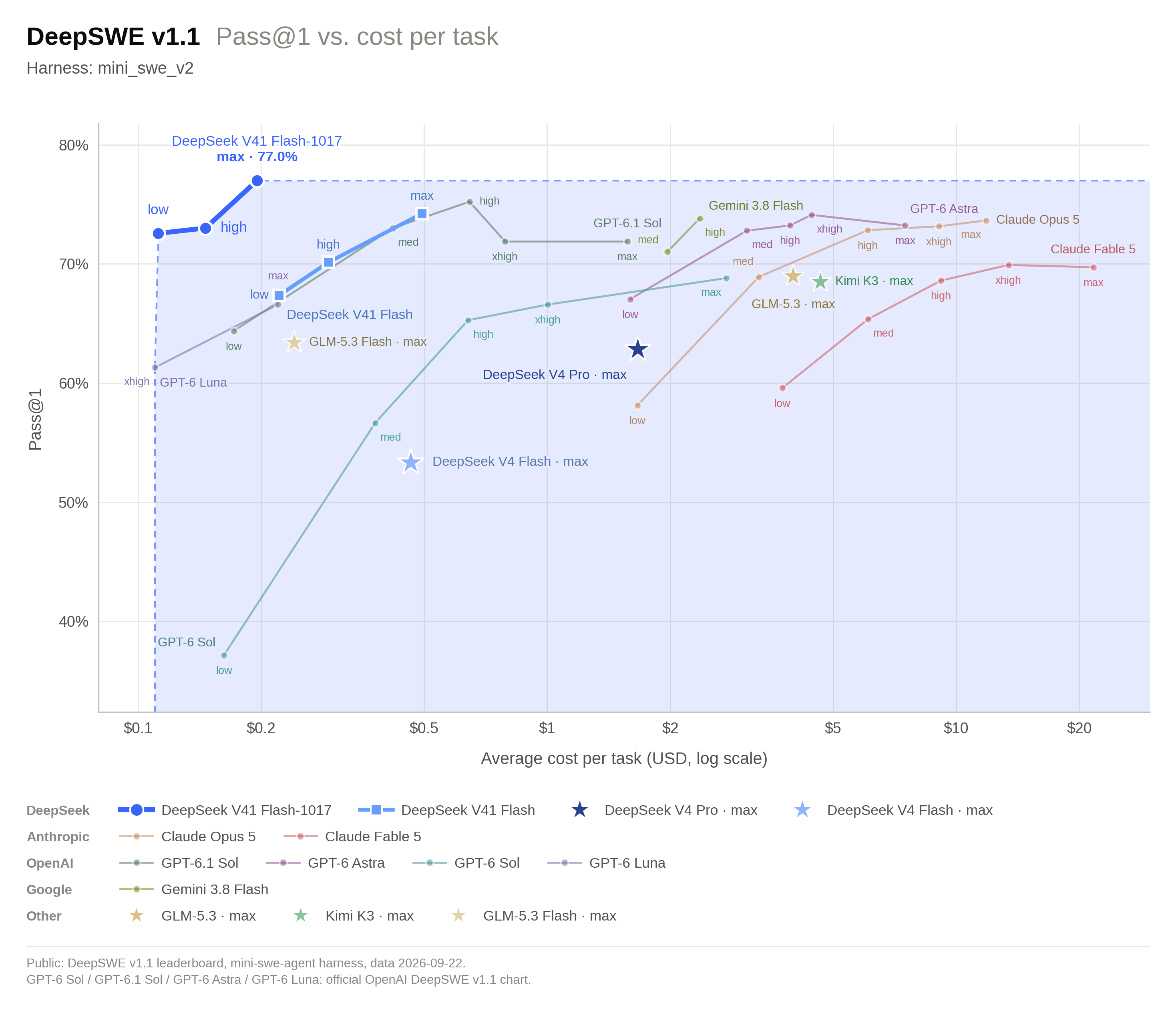
Image: DeepSeek
Why it mattersA team using the deepseek-v4-flash API alias has already been moved onto a different model, which is the kind of transparent swap that warrants a short regression run against the behaviour the previous model produced.
A developer using deepseek-v4-flash through the DeepSeek API is now talking to a different model. DeepSeek's own documentation says V4.1-Flash-1017 shipped on 17 October 2026, that the alias deepseek-flash points at it, and that the legacy names deepseek-v4-flash and deepseek-v4-flash-vision-exp are retired, with their requests served by the new model at the Flash price.
What DeepSeek claims about it
The release note calls the update "a Pareto improvement in performance and cost", with stronger benchmark results, shorter outputs and faster task completion than the earlier V4.1-Flash. The one chart in the post plots DeepSWE v1.1 Pass@1 against cost per task under the mini-swe-v2 harness, with no numerical table in the public write-up. DeepSeek says the model uses "reinforcement learning with self-feedback" to improve "end-to-end project development", and the post shows four short demonstrations: a 3D model of the Forbidden City, a web racing game, a Portal 2 recreation in Godot, and a 3D scene called "Valley of Ages". These are the vendor's own demonstrations, and no independent reproduction appears in the note.
Search and Fetch APIs leave the preview
The second announcement in the same release note is that DeepSeek's own Search and Fetch APIs are open to every API user. Each endpoint costs $0.75 per 1,000 calls, and DeepSeek says the search runs on its in-house engine, which it describes as "serving hundreds of millions of requests daily worldwide". The company does not break down what the latency or recall of that engine is.
Server-side use of the same two tools inside DeepSeek Harness, Claude Code and Codex is listed as free for every DeepSeek API user through 16:00 UTC on 31 October 2026, after which it begins to be charged. That gives agent operators a short window of unmetered search for every tool call that routes through the Harness, Claude Code or Codex server plumbing.
What is open and what is a swap
The weights for V4.1-Flash-1017 are on Hugging Face at deepseek-ai/DeepSeek-V4.1-Flash-1017 and on ModelScope at the same path, so a team that wants to self-host can pull the new release and avoid the alias behaviour. The retirement of the older Flash name is the quieter part of the release: a request to the API that still says deepseek-v4-flash returns a completion from a new model with new training signal, a new size profile, and new behaviour on long tasks, with no change to the client's code and no name change in the response.
That kind of transparent swap is the sort of change that a team with an eval suite notices before the field does. A regression a current V4.1-Flash workflow accumulates against its own expected outputs shows up as a slow drift in a report built against the vendor's own alias, with no error returned by the API itself. The practical response is to pin to the dated name deepseek-v4.1-flash-1017 when the behaviour matters, and to run the usual acceptance checks against the alias before the next untracked change arrives.
Source
DeepSeek-V4.1-Flash-1017: Wish-Driven Programming Made Real, DeepSeek API Docs.
This item was written by an AI system from the linked source. Reveneau is responsible for what it publishes.
Get AI News in your inbox
New developer tools, model and agent releases, and how teams are actually using them to release software. Short, and only when there is something worth reading.