AI NewsOpen sourceAnnouncement
OpenDesk is a self-hosted alternative to Intercom and Zendesk, Apache 2.0
OpenDesk is an Apache 2.0 helpdesk by Mindroot Ltd that bundles a shared email inbox, a live chat widget, a knowledge base and an AI drafter, running the same code on its cloud and on a one-command self-hosted install.
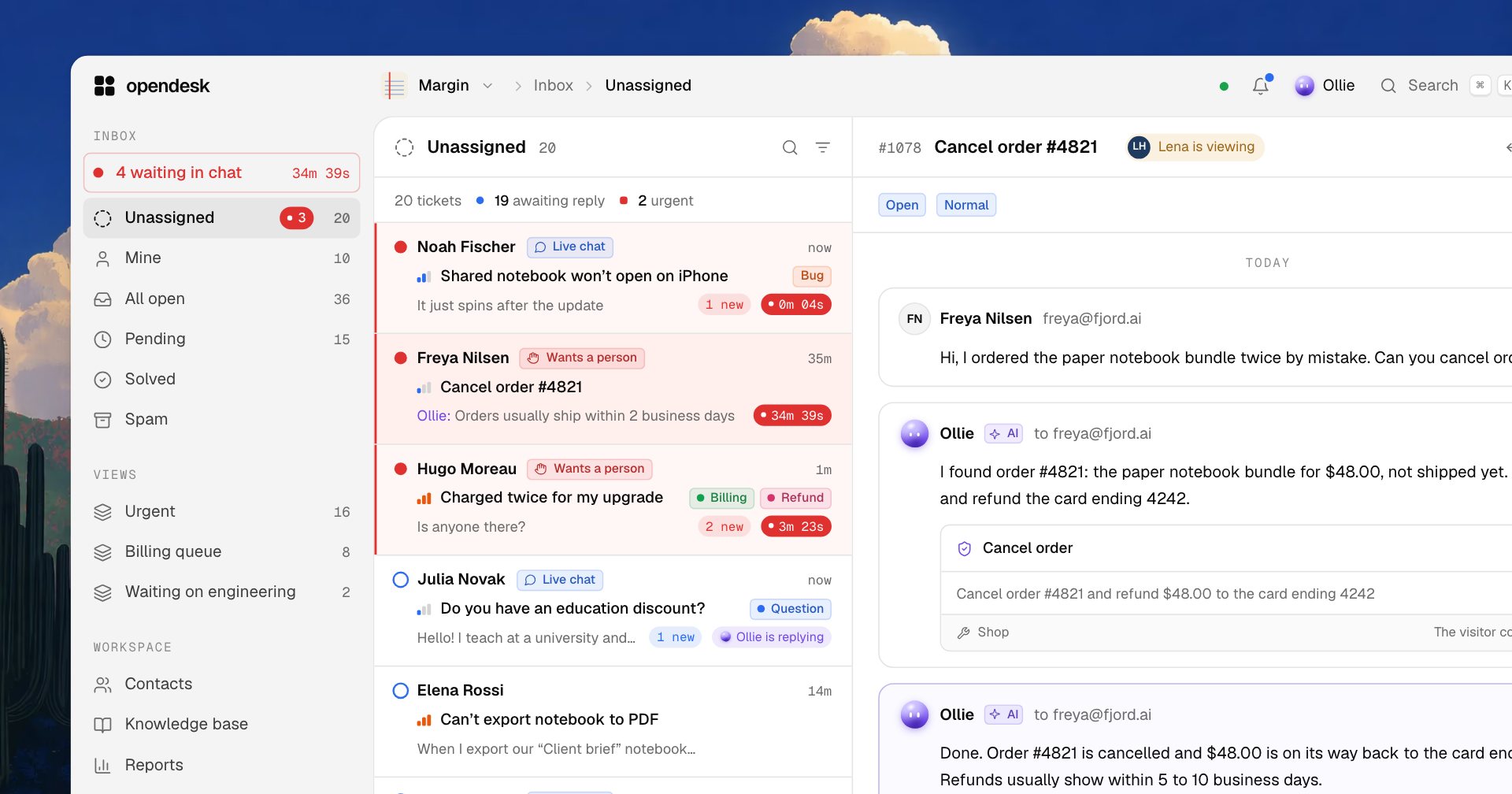
Image: OpenDesk
Why it mattersA founder or support lead paying for Intercom or Zendesk can swap in the same shared inbox, live chat and ticket AI on their own servers, with no closed edition and no feature behind a licence.
The software a small team pays for every month to answer its customers is often more expensive than everything else the website runs on. OpenDesk is a new Apache 2.0 helpdesk from a company called Mindroot Ltd that puts the main features of Intercom and Zendesk into one project and runs the same code on its own cloud and on a one-command self-hosted install.
The repository is at useopendesk/opendesk and had 117 stars six days after its first public commit on 11 October. The code is Go on the server, an Elixir real-time gateway, and a Node.js web client, with PostgreSQL as the only required database. The README states that OpenDesk "replaces Intercom and Zendesk" and that there is no closed edition: "opendesk Cloud runs the same code that is in the repository."
What is in the box
A shared inbox holds email tickets and live chat messages in one queue, with status, priority, assignment and SLAs. Email comes in over Gmail, Microsoft 365 or any SMTP server, and replies go out from the team's own address. The embeddable chat widget supports identity verification so a signed-in customer is matched to their account, and the help center is a public knowledge base with articles that the inbox can quote from.
An AI assistant called Ollie drafts replies, summarises long threads, and triages new tickets. Ollie reads from either an Anthropic or an OpenAI-compatible provider, which means a self-hosted install can point it at a local model running under Ollama or vLLM instead of a hosted API. Admins can turn Ollie off for the whole workspace, and the project's FAQ states that customer content is never used to train models.
The platform also ships with automations, CSAT surveys, dashboard reports, a public REST API with webhooks, native apps for macOS, Windows, Linux and iPhone, and integrations with Linear, GitHub, Jira, Sentry, Slack and Stripe. The widget and help center come in thirteen languages, and the AI translates agent and customer messages so each side reads its own language.
Pricing and the self-hosted path
OpenDesk Cloud is free for one mailbox and one team member and $18 per user a month for unlimited everything. The self-hosted edition is free and unlimited on the team's own servers, with its own AI key or a local model. OpenDesk's commercial side at opendesk.sh offers paid support and migration help.
The design choice under the project is that cloud and self-host run the same code, so a team can move between them without changing anything about the data model, and the self-hosted edition has no external services it depends on. OpenDesk uses an embedded NATS message bus instead of Redis or Kafka, so a one-command install starts the whole stack from a single container.
Six days is early for a 117-star repository, and the version is 0.1. A team weighing OpenDesk against Intercom or Zendesk needs to decide whether to buy stability from a vendor now or run an early codebase on its own hardware for free. The AI assistant and the data-export API make that trade smaller than it looks: OpenDesk commits to running the same code everywhere, so the migration path out of OpenDesk Cloud, and out of OpenDesk entirely, is readable Postgres schemas and a REST API.
Source
- opendesk on GitHub (Mindroot Ltd, Apache 2.0)
- opendesk.sh (the project's own site, with pricing and the FAQ cited above)
This item was written by an AI system from the linked source. Reveneau is responsible for what it publishes.
Get AI News in your inbox
New developer tools, model and agent releases, and how teams are actually using them to release software. Short, and only when there is something worth reading.