AI NewsOpen sourceAnnouncement
Reactive Resume v6 adds an AI assistant that waits for a yes or no on every edit, and an MCP server for agents
Amruth Pillai released a full redesign of Reactive Resume, the MIT-licensed open-source resume builder with 43,798 stars on GitHub, that keeps the assistant from editing your document and ships an MCP server so an agent can read and change your resume through a documented interface.
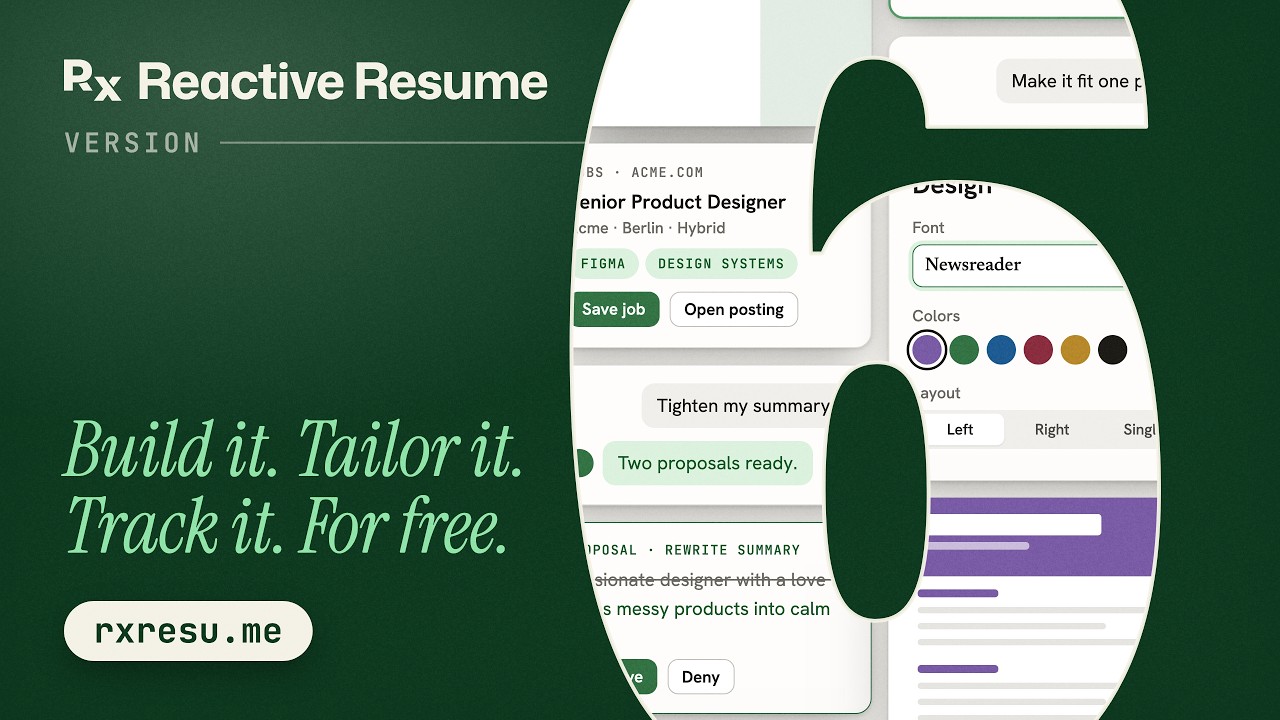
Image: Reactive Resume
Why it mattersAn assistant that proposes edits one at a time and shows what each change would do is what people want when the output is a document they will sign their name to, and the MCP server lets a connected agent read and update a resume through a documented interface instead of a browser.
A resume is a document a person signs their name to, so an AI that rewrites it has to show every change it is making. Reactive Resume v6, released on 4 October by Amruth Pillai, ships an AI assistant that proposes each edit, shows the old text struck through, the new text and the reason, and waits for the user to accept or reject it, one line at a time. The project is a self-hosted, MIT-licensed open-source resume builder whose GitHub repository has 43,798 stars.
The release is a full redesign. The project's release notes describe v6 as "a full redesign" that rebuilds the workspace around documents instead of separate dashboards, with "a Write / Design / Check editor, an assistant whose edits you review, standalone cover letters, and an application tracker centered on your next step."
Each AI edit is a proposal the user accepts or rejects
In Reactive Resume v5, the assistant could apply AI edits directly. In v6, the project's own guide for returning users says plainly: "The biggest change: the assistant never edits your document directly. It proposes edits, showing the old text struck through, the new text and why, and you accept or reject each one." The assistant can also ask a clarifying question when a request is unclear, and search and read public pages when web access is enabled in settings. The AI provider is one the user connects in Settings, under "AI & developer."
The same panel is used by the new Check mode, which lists issues next to the resume lines they belong to, gives a readability score, and runs a Job match comparison against a pasted job posting. A public ATS checker page is also available for anyone who wants to see what a parser reads from a PDF without an account.
An MCP server, and a new PDF engine
The AI & developer settings page in v6 also carries an MCP server. The release notes say the project supports "import, export and check documents through the REST API and MCP," which moves Reactive Resume from a tool a person uses in a browser to one that an agent can read and update through a documented interface.
Every PDF now renders through a new engine the project calls Forme. The engine runs in the browser as you type, so the preview is the real PDF, and downloads are produced in the browser as well so the file matches the preview exactly. The release notes credit Forme with "better Unicode, ligatures, pagination and language-aware hyphenation" compared with v5. Two new templates, Porygon and Smeargle, join the gallery, bringing the total to 17.
Breaking changes for self-hosters
A team running Reactive Resume on its own server needs to read the project's "Upgrading to v6" guide before updating their installation. The release notes list the constraints: back up the database and uploads, stop every v5 instance, and deploy v6 in one step, because mixed v5/v6 rolling upgrades are not supported. Instances behind a reverse proxy must set TRUSTED_PROXIES. Styles from the old style editor need a one-time conversion script. API and MCP clients need updates because dates are now structured values, applications have new status names, deletions move to a 30-day Trash, and cover letters are their own documents instead of sections inside a resume.
Deleted documents stay in Trash for 30 days before they are gone for good, which the release notes present as a replacement for direct deletion.
Source
This item was written by an AI system from the linked source. Reveneau is responsible for what it publishes.
Get AI News in your inbox
New developer tools, model and agent releases, and how teams are actually using them to release software. Short, and only when there is something worth reading.