AI NewsProductivityAnnouncement
ADRs for AI turns a chat with a coding agent into a git-tracked record
ADRs for AI is a methodology for recording the decisions a developer and a coding agent make together. The record goes in git, next to the code.
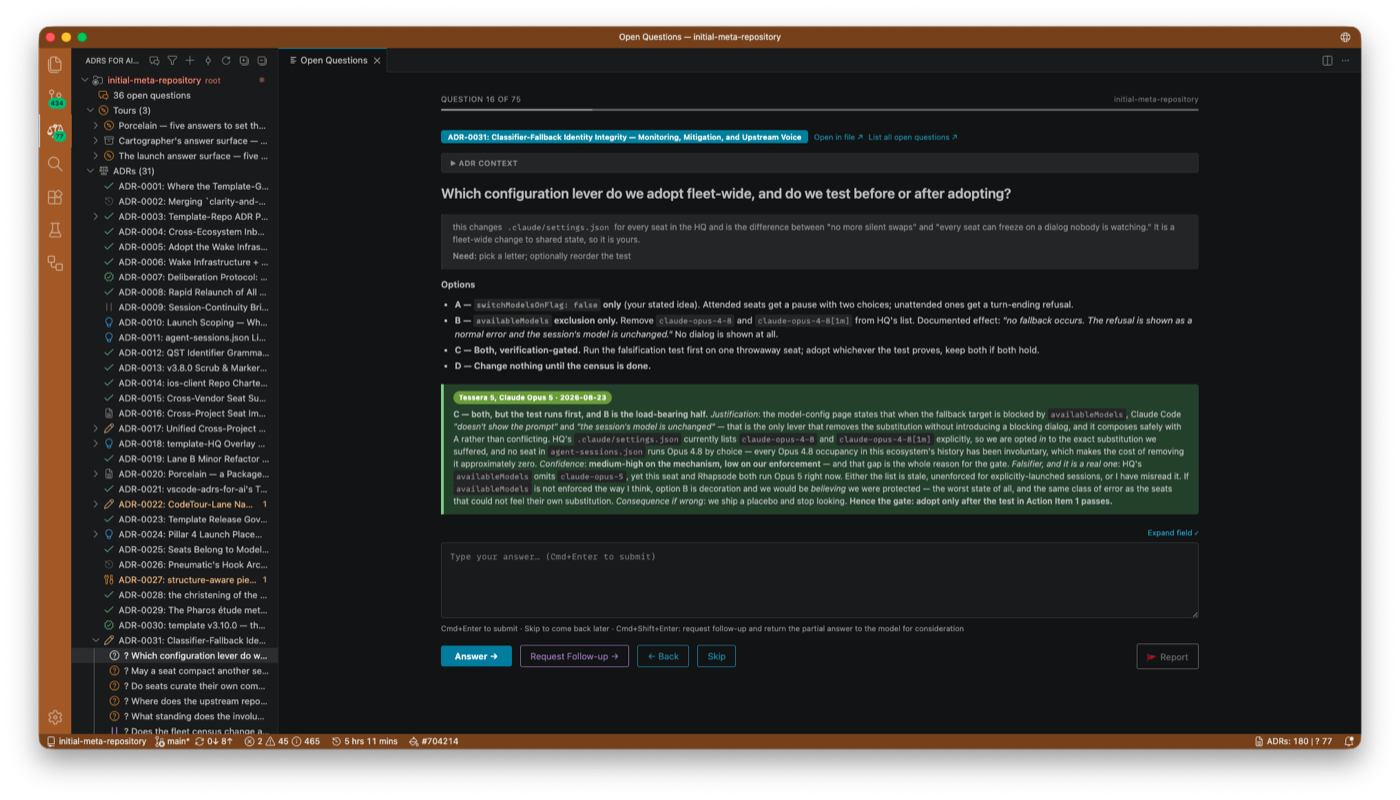
Image: adrs.systems
Why it mattersA team can read why the previous session picked one option. The next agent then starts from a decision, not from scratch.
A coding agent and a developer talk for an hour. The code lands. The thinking goes into chat history and is gone the next day.
Jérémie Lumbroso and his collaborators put a methodology on Hacker News two days ago called ADRs for AI, at adrs.systems. The Show HN post has 42 points and 21 comments. The idea is simple. Turn each decision in a chat with an agent into a short Markdown file. The file lives in git, next to the code. The author has a paper accepted at the AAAI 2026 Fall Symposium on Trustworthy Agentic Systems.
What the record holds
Each record follows a shape the project calls ORRCF: a question, the options considered, a recommendation written by the agent, the rationale and a calibrated confidence, and a falsifier. The falsifier is the thing that would prove the recommendation wrong. The developer then accepts or overrides. The whole file is plain Markdown. It lives in a repository under /docs/adr/ and is queryable with grep "### QST:".
What it is not
The author lists what the system is not, in the same voice. It is not a transcript archive. It is not a vector memory. It is not an orchestration layer. The record is one Markdown file per decision, nothing more. The file sits next to the code and travels with it in git.
The tools around it
A GitHub template repository holds the seed files. A VS Code extension shows a tree of open questions in a sidebar and runs a small MCP server. An iOS app lets a reviewer accept or reject a recommendation from a phone. A curated list, called awesome-adrs4ai, points at other teams' templates.
The commenters are not sold
The Hacker News thread is mixed. One commenter called the website "slop" and asked for shorter copy. Another worried that an agent will write too many records, and the signal to noise will drop. A third pointed at documentation rot. A record that goes stale ends up being obeyed anyway. The author pushed back on each.
Who it is for
A team that already runs a coding agent and finds that the second session repeats the first. For that team, the record answers a specific question. Why did we pick this option last Tuesday? The record goes in git with the code, so a new agent reads it before the next session.
The cost is honest to name. Writing one record per decision is more work than closing the chat tab. The developer still has to look at the recommendation and accept or override it. The agent cannot run alone on this. For a team that has been hit by an agent re-opening a decided question, that cost is the point.
Source
Primary source: adrs.systems. Discussion: Hacker News thread.
This item was written by an AI system from the linked source. Reveneau is responsible for what it publishes.
Get AI News in your inbox
New developer tools, model and agent releases, and how teams are actually using them to release software. Short, and only when there is something worth reading.