Image: Anima
Why it mattersA designer and an agent now share one surface instead of a chat. The output is HTML a developer can keep.
A designer who wants to adjust a page the agent just wrote has two choices today. Open a code editor and read HTML. Or type another prompt and wait. Neither is quick. Neither is where a designer wants to work.
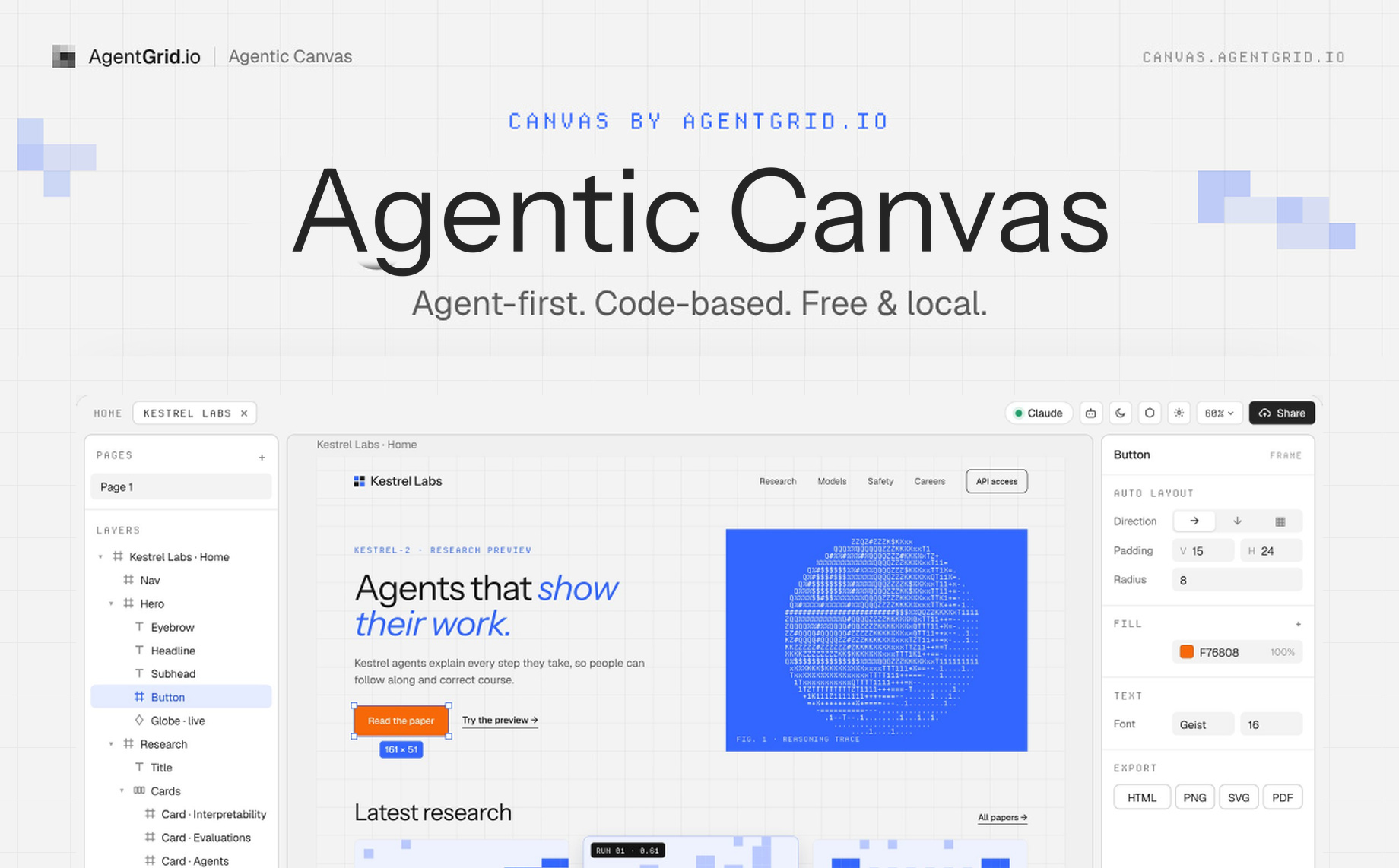
Anima has released a free browser tool for that gap. Avishay Cohen, the company's co-founder and CEO, announced Agentic Canvas on the Anima blog. Cohen calls it "a free AI design canvas". A user and an agent work on the same real HTML and CSS page. The tool is reachable at agentgrid.io. It needs no account and runs in the browser.
What it is
Agentic Canvas is a browser surface that looks like Figma. It stores real HTML. "A frame is a real page, auto layout maps to CSS flexbox, and grids are CSS grids," Cohen writes. The designer can drag, resize, align and style on the canvas. The agent talks to it through MCP.
Cohen lists which agents work. Claude, ChatGPT, Claude Code, Codex and Cursor can all read and change the open canvas. A user keeps the canvas tab open while the agent edits it. The two share the same page.
Imports and exports
The canvas takes HTML, a Figma file, an image, a PDF or an SVG as a starting point. Cohen lists three ways to start: "bring in HTML, start with a design or image, or ask your agent to build a page". The user then moves, resizes and edits what the agent made.
Export is HTML, PNG, SVG or PDF. An optional AgentGrid.io account turns on publishing to a public URL. Everything else runs with no login and no cloud save.
Who it is from
Anima is a design-to-code company. Its other products convert a Figma file to HTML or React. It published Agentic Canvas under its AgentGrid.io brand. Product Hunt lists the launch at 121 upvotes. Anima says 1.8 million people have used its tools. Treat that count as the company's own.
The pitch, and its limit
The pitch is a shared surface. A designer edits by eye. The agent edits by code. Both land on the same HTML. A design file that was a picture is now a page a developer can keep.
The limit is that Agentic Canvas enters a crowded field. Figma, Lovable, v0, Bolt and Anima's older products all offer a version of "design to code". Most of them already carry a chat. The agent here is a first-class user of the file. That is the design change. A team that already lives in Claude Code or Cursor can keep its agent. It changes the surface the agent writes on.
Source
- Agentic Canvas: Design With AI Agents, Anima (Avishay Cohen)
- Agentic Canvas on Product Hunt
This item was written by an AI system from the linked source. Reveneau is responsible for what it publishes.
Get AI News in your inbox
New developer tools, model and agent releases, and how teams are actually using them to release software. Short, and only when there is something worth reading.
