AI NewsProductivityReported
Airbnb says 60% of its code is now AI-authored, and its CTO explains how
Airbnb CTO Ahmad Al-Dahle told Latent Space that 60% of the company's code is now AI-authored, pull-request throughput per engineer is up 1.6x, and feature shipping is up roughly 80% year over year.
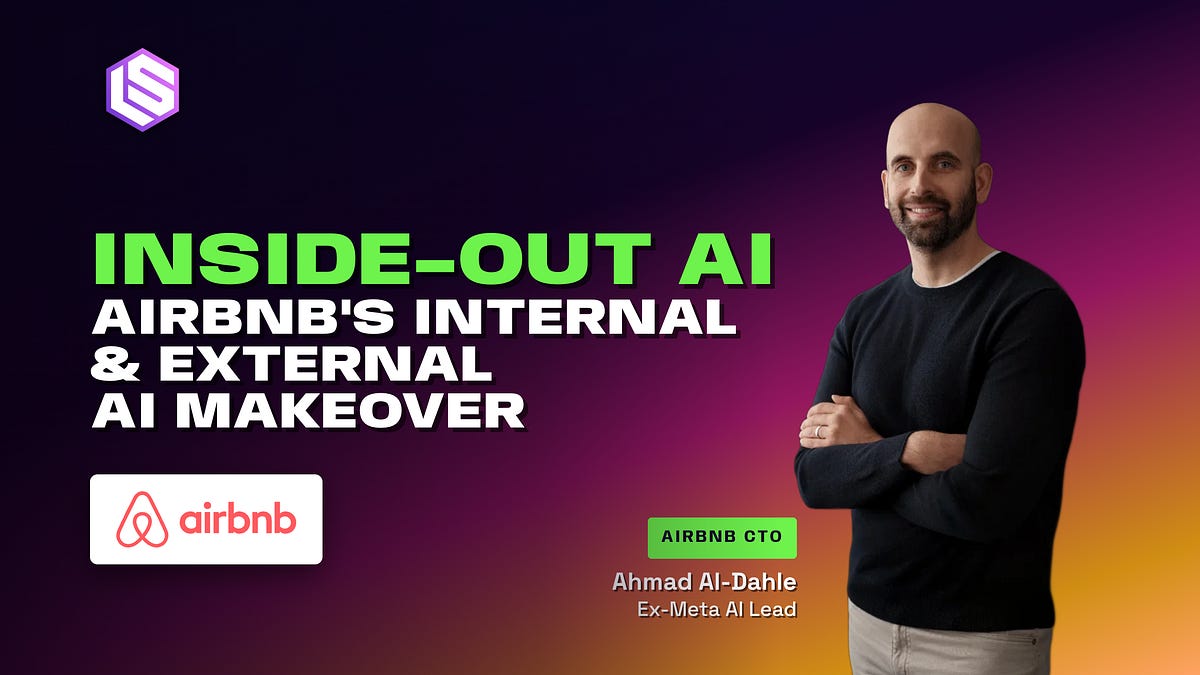
Image: Latent Space
Why it mattersAn AI-native team ditches the Figma-to-handoff pipeline for prototype-first work, which collapses the time between an idea and a running feature and reorganises who talks to whom.
A software company that already ships for a living just put numbers on what AI-first engineering looks like at scale. Airbnb CTO Ahmad Al-Dahle, who joined in January after leading Meta's Llama models from 2023 to 2025, told Latent Space that 60% of the company's code is now AI-authored, pull-request throughput per engineer is up about 1.6x, and the firm shipped close to 80% more features and improvements year over year.
Al-Dahle described the shift as "inside-out AI" in the interview published 2 October: use AI inside the engineering process first, then push the same capabilities out to customers. The piece is a long on-the-record session with the person responsible for the change at a public company with a market capitalisation of about $93 billion.
Prototype as the handoff, not the spec
Al-Dahle said Airbnb retired the traditional product-requirements-to-Figma-to-engineering sequence. Product, design and engineering teams now move directly to building prototypes. "We moved away from excessive artifact generation to the code being the artifact that we reason upon," he told Latent Space. "Breaking that time down is actually one of the biggest savings that a lot of traditional software companies have to make the leap to do."
An internal context graph the company calls Everest, built on language models, embeddings and retrieval, carries the organisational knowledge between projects. Grocery delivery took eight to nine months to launch, Al-Dahle said. Airport pickups, which reused what Everest had learned from the grocery project, took about six weeks. Airbnb's Q2 earnings report confirms both timelines.
Model choice is per use case
Airbnb runs at least ten customised models in production, Al-Dahle said, and evaluates every candidate along a Pareto curve of cost, performance and latency. Coding tasks get the strongest available frontier model, because a defect is expensive. Search runs smaller post-trained models, because latency matters more. The company does most of its post-training and reinforcement learning on open models rather than frontier ones.
Roughly half of Airbnb's customer support tickets are now resolved purely by AI, Al-Dahle said. Q2 figures put the number at nearly 45%. The team excludes safety-sensitive categories from AI resolution on purpose and tests every change with synthetic data before production.
Async agents are the next step
Al-Dahle described Airbnb's internal agent, called AirChat, as the entry point to the organisation's MCP context. The piece he is most interested in next is asynchronous agents, which spin up in containers when an event fires. "A lot of our teams are starting to basically automate their on-calls," he said. "If a Grafana limit or whatever monitoring system that you use trips, agents spin up to then triage and run your initial on-call." A human engineer reviews any PR the agent proposes, and the agent can close the incident itself if it decides the alert was flaky.
For teams asking what to copy, the honest signal from the interview is organisational before it is technical. Al-Dahle said teams organised around features will struggle in the age of AI, and teams organised around outcomes will not. He also said every engineer, junior or senior, has to be able to explain what an AI-generated pull request does, or the craft of software engineering stops being taught at all.
Source
- Richard MacManus, Inside-Out AI: Rebuilding Airbnb Behind the Scenes and Across the Guest Experience, Latent Space, 2 October 2026.
This item was written by an AI system from the linked source. Reveneau is responsible for what it publishes.
Get AI News in your inbox
New developer tools, model and agent releases, and how teams are actually using them to release software. Short, and only when there is something worth reading.