Anthony Fu released pulls.review, a GitHub PR reviewer that groups by scope
Anthony Fu released pulls.review, a tool that reads a GitHub pull request, groups the changed files by scope, summarises each scope, then reviews one scope at a time. It ships as a website, a browser userscript that enhances the GitHub review page, and a GitHub Action. The code is MIT licensed and the repository has 402 stars after 20 days.
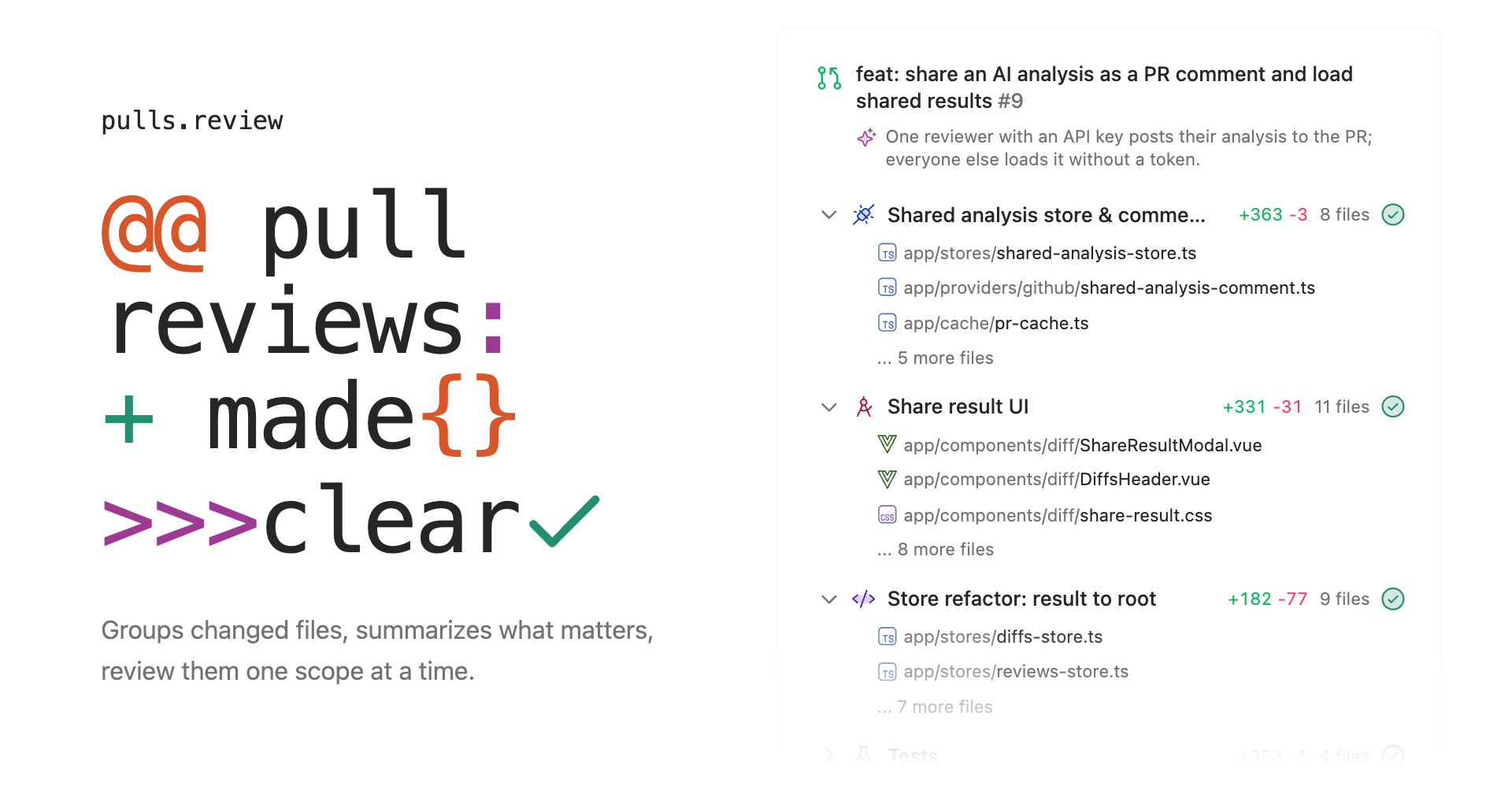
Image: Anthony Fu
Why it mattersA reviewer facing a 40-file pull request today either skims it or spends an afternoon on it. A tool that breaks the diff into scopes with written summaries changes what a code review hour buys, and the GitHub Action means the same analysis runs on every PR without any one engineer paying for the model calls.
A reviewer looking at a 40-file pull request today has two choices: skim everything, or spend an afternoon reading each file. Anthony Fu, from the Vite and Vue core teams, just released a tool that gives a third option.
pulls.review reads a GitHub pull request, groups the changed files by scope, writes a one-paragraph summary of each scope, and then reviews one scope at a time. The project is open-source under MIT, and the repository has 402 stars in the three weeks since Fu first pushed it.
Three surfaces, one project
The project README lists three ways to use it. There is a hosted website at pulls.review that a reviewer logs into with GitHub and uses to review any pull request they have access to. There is an optional userscript that enhances the native GitHub review page, for teams that want the scope grouping without leaving github.com. And there is a GitHub Action, published at antfu/pulls.review@main, that runs on every pull request and posts the review as a PR comment.
The three paths share the same engine. The Action is the piece that changes how a team pays for AI code review: one organisation API key covers every reviewer, instead of each reviewer owning their own key and bill.
What it integrates with
The Action chooses the provider from the API key it is given. The README names three options: a Vercel AI Gateway token, an Anthropic key, or any OpenAI-compatible endpoint with a custom base URL. Model and locale are configurable through workflow inputs. Nothing in the project is tied to a single vendor, and switching models is a one-line change in the workflow file.
The core design decision is the scope grouping. A GitHub pull request displays a flat list of files in the diff order the author committed them. pulls.review builds its own tree, puts the related changes together, and runs the review across the tree. On a large pull request the summary at the top of each scope is the piece that lets a human reviewer read the parts worth reading and skim the rest.
Where this sits
Reveneau's view: a pull request review done at the end of a sprint by a tired engineer is where a model helps most, because the human reviewer is already short on attention. A tool that groups the diff before the human opens it, with a summary of each group, removes the hardest part of code review, which is deciding where to look. The GitHub Action variant also moves the review from a per-reviewer tool into shared repository configuration, where a check that every pull request should receive actually belongs.
The README still calls the project "heavily work in progress". It is early. It is also from a maintainer whose other projects, from VueUse to eslint-config to UnoCSS, have run for years with large installed bases.
Source
GitHub: antfu/pulls.review by Anthony Fu. MIT licensed. 402 stars at the time of writing.
This item was written by an AI system from the linked source. Reveneau is responsible for what it publishes.
Get AI News in your inbox
New developer tools, model and agent releases, and how teams are actually using them to release software. Short, and only when there is something worth reading.