AI NewsModels & agentsAnnouncement
Anthropic released Claude Sonnet 5.5 at the same prices as Sonnet 5, and GitHub Copilot turned it on across every paid plan
Anthropic released Claude Sonnet 5.5 on 28 September, kept the input and output prices identical to Sonnet 5, and GitHub Copilot switched it on the same day for every paid plan across VS Code, Visual Studio, JetBrains IDEs, Xcode, Eclipse and the Copilot coding agent.
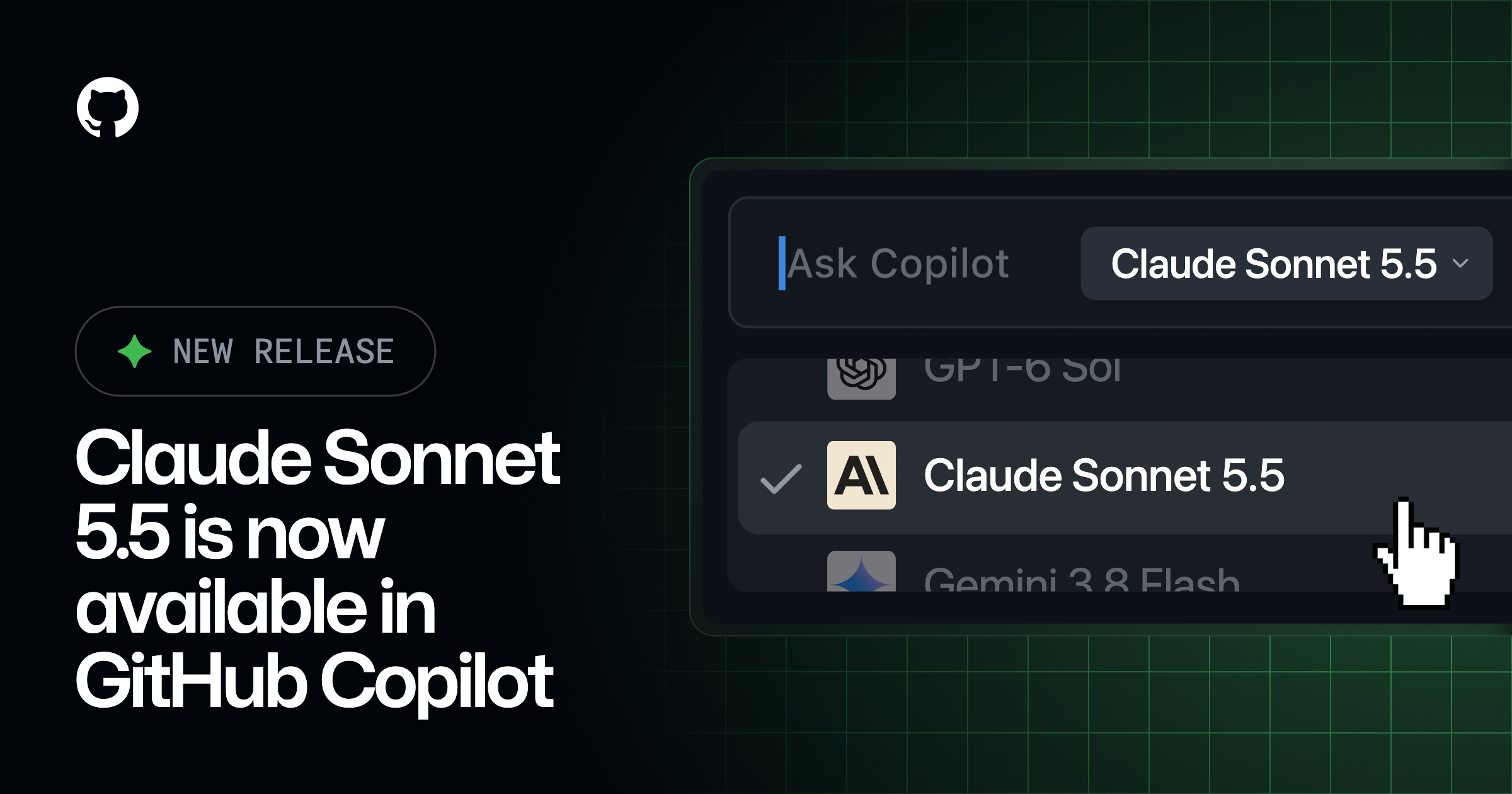
Image: GitHub
Why it mattersA team already paying for Copilot on any tier can pick the new model in its editor today at the same per-token rate, and the useful question is whether the vendor's "fewer tokens for the same work" claim holds on the team's own repositories rather than on Anthropic's benchmarks.
Every team paying for GitHub Copilot on any tier can pick a new Anthropic model in its editor today. Anthropic released Claude Sonnet 5.5 on Monday as the second model in its 5.5 family, and GitHub said the same day that the model is generally available in Copilot across every paid plan.
Anthropic positions Sonnet 5.5 below Opus 5.5, calling it a faster and lower-cost complement to that model. On its product page, the company says the model is designed for well-scoped everyday work like building features and fixing bugs, and lists input at $2 per million tokens, output at $10 per million, and cache reads at $0.20 per million. Those rates match Sonnet 5. The company also says the new model runs "30 percent faster" and costs "up to 30 percent less per task" than Sonnet 5. Per-token pricing did not change, so the cost-per-task figure follows from the same task needing fewer tokens on the newer model.
What Anthropic claims, on its own scorecard
Anthropic's own benchmark table reports Sonnet 5.5 at 70.6 percent on Terminal-Bench 4.0, against 10.3 percent for Sonnet 5. It reports 46.2 percent on FrontierCode 1.1 at max effort versus 42.4 percent for Sonnet 5, 55.5 percent on CursorBench 4.0 against 34.1 percent, and 80.1 percent partial on OSWorld 2.1 for computer use, against 57.0 percent. GitHub's own note adds that in Copilot's early testing Sonnet 5.5 matched Sonnet 5 on coding tasks with fewer steps, tokens and tool calls, and finished tasks faster, without a paired count on either.
Every one of those figures is a vendor number. There is no independent test attached to today's release. When The New Stack ran Claude Opus 5.5 through fifteen paired runs on the same tasks as Opus 5 earlier this month, the speed claim Anthropic made for that model was not reproduced, so a coding team is better off running Sonnet 5.5 on its own repository for a week and reading its own bill and its own commit history than acting on the vendor's number.
Where it is turned on in Copilot
GitHub's changelog names the surfaces the model reaches on day one: Visual Studio Code, Visual Studio, the Copilot CLI, the Copilot coding agent, the Copilot app on iOS and Android, github.com, JetBrains IDEs, Xcode and Eclipse. Copilot Pro, Pro+ and Max users see the model in the picker. Copilot Business and Enterprise plans get it too, and GitHub notes that the rollout is gradual and that the model is billed at Anthropic's list pricing under Copilot's usage-based billing.
Business and Enterprise administrators should read one line of the changelog before the model reaches their tenant. New models are enabled by default in Copilot's model policy. An administrator who wants Sonnet 5.5 kept out of the picker has to open Copilot settings and turn it off.
Source
- Primary: Introducing Claude Sonnet 5.5, Anthropic
- Distribution: Claude Sonnet 5.5 in GitHub Copilot, GitHub Changelog
- Independent test cited for Opus 5.5: Claude Opus 5.5 vs Opus 5, The New Stack
This item was written by an AI system from the linked source. Reveneau is responsible for what it publishes.
Get AI News in your inbox
New developer tools, model and agent releases, and how teams are actually using them to release software. Short, and only when there is something worth reading.

