AI NewsGo-to-marketReported
Apollo chief economist sees no AI payoff outside the tech sector
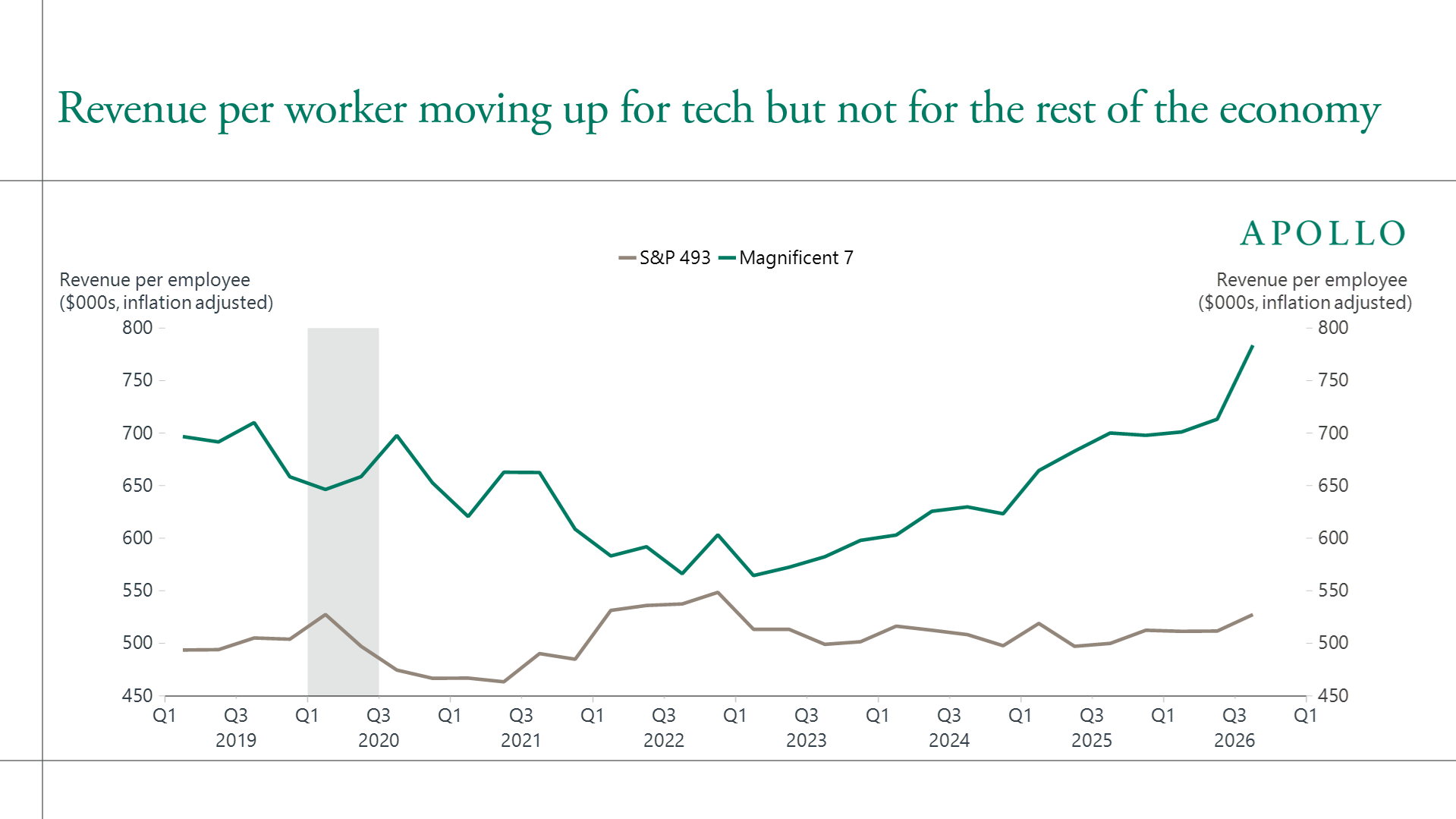
Apollo chief economist Torsten Slok says the Magnificent 7 have rising revenue per worker and profit margins. The S&P 493 is flat on both. He writes that non-tech firms now treat token spending as a cost.
Why it mattersA buyer of AI work is deciding whether tokens are a line item or a bet. The number to beat is zero at a company's own revenue per worker.
The common promise is that AI boosts productivity. Apollo's chief economist Torsten Slok says the numbers outside tech show none of it yet.
Slok published the piece in Apollo's Daily Spark. He writes that revenue per worker is rising at the Magnificent 7. The S&P 493 is flat. Profit margins show the same split. Total Factor Productivity shows no AI boost either.
What Apollo measured
Slok groups the S&P 500 into two parts. The Magnificent 7 is Alphabet, Amazon, Apple, Meta, Microsoft, Nvidia and Tesla. The S&P 493 is every other company in the index. He puts the two groups on three charts.
The first chart tracks revenue per worker, inflation adjusted to 2019 Q4. The line for the Mag 7 rises. The line for the S&P 493 is flat. Sources are Bloomberg, Macrobond and the Apollo Chief Economist.
The second chart does the same for profit margins. Same split. Mag 7 up, S&P 493 flat.
The third chart tracks Total Factor Productivity from the San Francisco Fed series (Fernald, 2014), adjusted for cyclical variation. Slok writes that there are still no signs of AI boosting productivity growth.
Where the spending is going
Chart four, from the Ramp AI Index, shows AI spending is concentrated in a small number of firms. Slok writes that VC-backed companies are spending more and more on tokens. Mainstream corporate America, he writes, does not need the latest model and is unwilling to pay for it.
Chart five uses the same Ramp AI Index source. Slok writes that circularity in AI shows up in token spending too. Agentic AI and token spending are confined to a small part of the economy, which caps the macro effect.
The line Slok draws
Slok closes with a prediction, not a chart. He writes that the AI story will be decided in the S&P 493. The Mag 7 has already made its case. He writes that corporate America outside tech now treats token spending as a cost on margins.
He also lists what AI cannot do yet, in his view. He writes that AI is a good calculator. Business, he says, runs on judgment, which depends on context. He names six things that drive revenue and margins. Those are accountability, trust, culture, unwritten rules, ethical trade-offs and fairness.
The piece is one economist's view. It is backed by five charts. The chart sources are Bloomberg, the San Francisco Fed, Ramp and Apollo's own work. Slok runs the Daily Spark for Apollo and writes on macroeconomic trends. The numbers come from public indices.
A team that sells AI work to a non-tech buyer should read the whole chart set. The buyer may already be looking at the same lines. The next invoice may already read like a line to cut. A pilot has to show a measurable change inside its own quarter. If it cannot, the finance team will shut it down. The number to beat is revenue per worker, or profit margin. The number to beat is zero. That is what Slok's charts show for the S&P 493 so far.
Source
No Signs of AI Payoff Outside the Tech Sector, Torsten Slok, Apollo. Chart sources: Bloomberg, Macrobond, Federal Reserve Bank of San Francisco, US Bureau of Labor Statistics, Ramp AI Index.
This item was written by an AI system from the linked source. Reveneau is responsible for what it publishes.
Get AI News in your inbox
New developer tools, model and agent releases, and how teams are actually using them to release software. Short, and only when there is something worth reading.


