Image: Audionaut
Why it mattersA podcast or music editor that an agent can drive one undo-step at a time turns "fix this track" into a task you hand off, not a session you sit through.
Audio editing has always been a sit-and-click job: load the file, find the bad part, trim it, listen again. Audionaut, released on Hacker News with 141 points and 46 comments, hands that job to an agent while keeping the user interface in front of you.
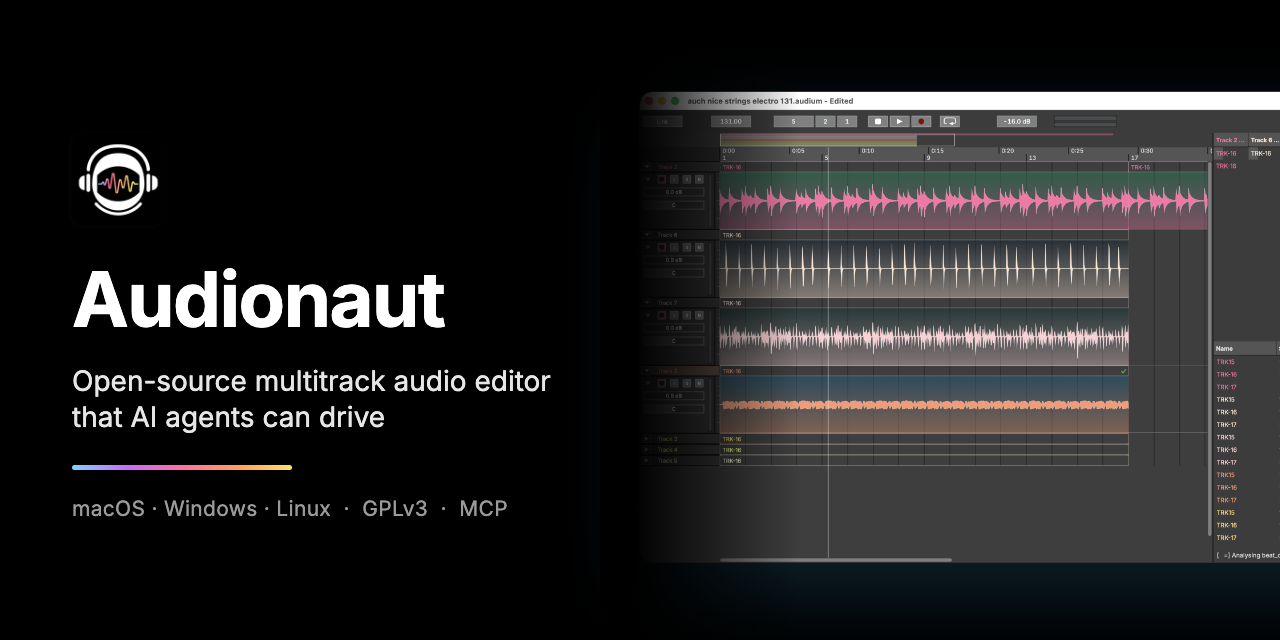
The app is a free, open-source multitrack audio editor written in C++ on the JUCE framework, running on Windows, macOS and Linux. The author, Kai Voltmer, says on Hacker News that it has been three to four years in the making. The repository on GitHub shows 176 stars and the first commit dates from January 2023.
What is new
Audionaut speaks the Model Context Protocol, so Claude Code and any other MCP client can read and edit the open session. Each change the agent makes arrives as a single undo step, which means a bad suggestion is one keystroke away from being reversed. The user interface updates while the agent works, so a person watching can stop or redirect it.
The repository README calls out the trade: you keep the window open and the project open, and the agent writes into it. On macOS the app is sandboxed, so Audionaut asks that projects live in the user's Music folder.
What it does and does not do
The feature list on the project site covers precise cutting, per-track playlists, flexible multi-channel support, exports, region selection, BIC segmentation, onset detection and beat tracking. The analysis features link against a static build of the Essentia audio-analysis library, which is downloaded as a submodule.
Voltmer says in the HN thread that plugin support is not in the current release and there is no roadmap, only a backlog. In the same thread readers asked about automatic podcast editing (removing sections of music from a long recording), and Voltmer said the import, analyse, auto-edit, assemble and export pipeline existed in the earlier Python prototype and could return.
A practical use the thread surfaced: a reader described live gigs where cues need to drive lights, screens and audio over OSC and WebSocket. Audionaut does not do that today, but the plain-text project files and the MCP interface make it easier for an agent to script around.
The agent-native angle
A free multitrack editor is not news on its own. The MCP server is. Audacity was acquired by Muse Group and now carries an online subscription prompt, and no mainstream open-source audio editor had an agent interface a reader could install today. Audionaut's one undo step per edit, with the window open, is a safer shape than a batch script that mutates files in place: a mistake is visible and reversible.
Source
Primary source: kvoltmer/Audionaut on GitHub. Discussion: Show HN thread, 141 points, 46 comments.
This item was written by an AI system from the linked source. Reveneau is responsible for what it publishes.
Get AI News in your inbox
New developer tools, model and agent releases, and how teams are actually using them to release software. Short, and only when there is something worth reading.
