Claude Mods let a team shape how its coding agent behaves
Dan McAteer wrote in Latent Space that Claude Mods are TypeScript plugins that let a human reshape how Claude Code presents its work. One example mod ran on 99 of 111 turns and spent an estimated 5,000 to 6,000 input-equivalent tokens on a 50,000-token session.
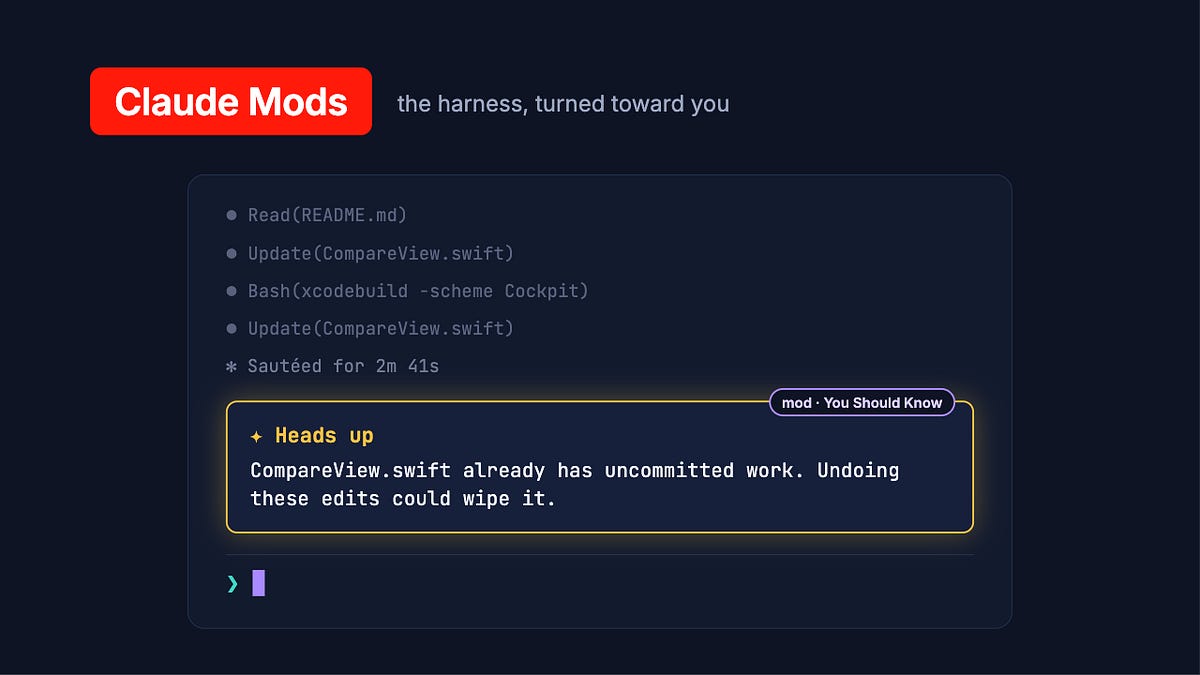
Image: Latent Space
Why it mattersThe reader who wants Claude Code to behave differently can now change the interface rather than the model. The cost is counted in tokens, so a team adopting a mod picks it the same way it picks any other extra context.
Dan McAteer wrote a long piece in Latent Space describing Claude Mods, a feature in Claude Code that lets a user drop TypeScript plugins into the agent harness and change what the agent shows and how the human replies. McAteer's framing is that the harness is now a human attention interface, programmable by the user, with the agent and the machine behind it.
What a Mod is
A Mod is a TypeScript or JavaScript plugin inside Claude Code. It subscribes to events, a new prompt, a tool call, a diff about to be written, a session about to end, and can decide what the agent surfaces to the user. The project ships with six built-in Mods: agents-md, diff, plugin-authoring, sec-default, telemetry, and you-should-know, which is off by default. The post also discusses one custom Mod called Next Steps Supervisor, part of McAteer's open-source ModSmith collection.
The number from one session
Next Steps Supervisor fires at the end of each agent turn and asks whether the next step the agent is about to propose matches the user's actual plan. In the sample session recorded in the post, 99 of 111 turns (89 percent) triggered it, and the Supervisor flagged 45 uncommitted files in one scenario. McAteer estimates the Supervisor spends 5,000 to 6,000 input-equivalent tokens per check on sessions that are already around 50,000 tokens. He states that number as his own estimate from the mod's prompt size, not a measured bill.
The direct quote from the piece is: "Claude Mods let you reverse the direction of the harness. Rather than the harness pointing from the agent to the machine, you point it from the agent to the human operator."
Where it sits in the current round of agent features
McAteer places Claude Mods beside two other recent features in the same category. GPT-6 shipped with what OpenAI calls Intelligent UI, which decides when to render a rich panel for the user. Cursor added PR Routing and Approval, which turns the pull request into a step a human has to clear before merging. All three put a layer of code between the agent and the person watching it, and all three let the team shape the interaction without touching the model.
What a team would do with it this week
A team that is already paying for Claude Code and has one habit it wishes the agent did not have, running a long shell command without saying so, writing to the wrong directory, bypassing a review step, can write a Mod that intervenes on that specific event and ships it as a single file to the rest of the team. The cost is in the extra tokens, which show up on the same bill. The gain is a per-team policy, in code, that the agent cannot forget.
Two things to watch, which the post is clear about. A Mod that calls out on every turn costs tokens on every turn. And a Mod that silently filters what the agent returns is one more place a bug can hide.
Source
Latent Space: Claude Mods: Flipping the Harness Inside Out, by Dan McAteer.
This item was written by an AI system from the linked source. Reveneau is responsible for what it publishes.
Get AI News in your inbox
New developer tools, model and agent releases, and how teams are actually using them to release software. Short, and only when there is something worth reading.