Image: JetBrains
Why it mattersEmbedded engineers can now give one of the most unpleasant jobs in their work, decoding a fault dump by hand, to an agent that can read the registers and disassembly directly.
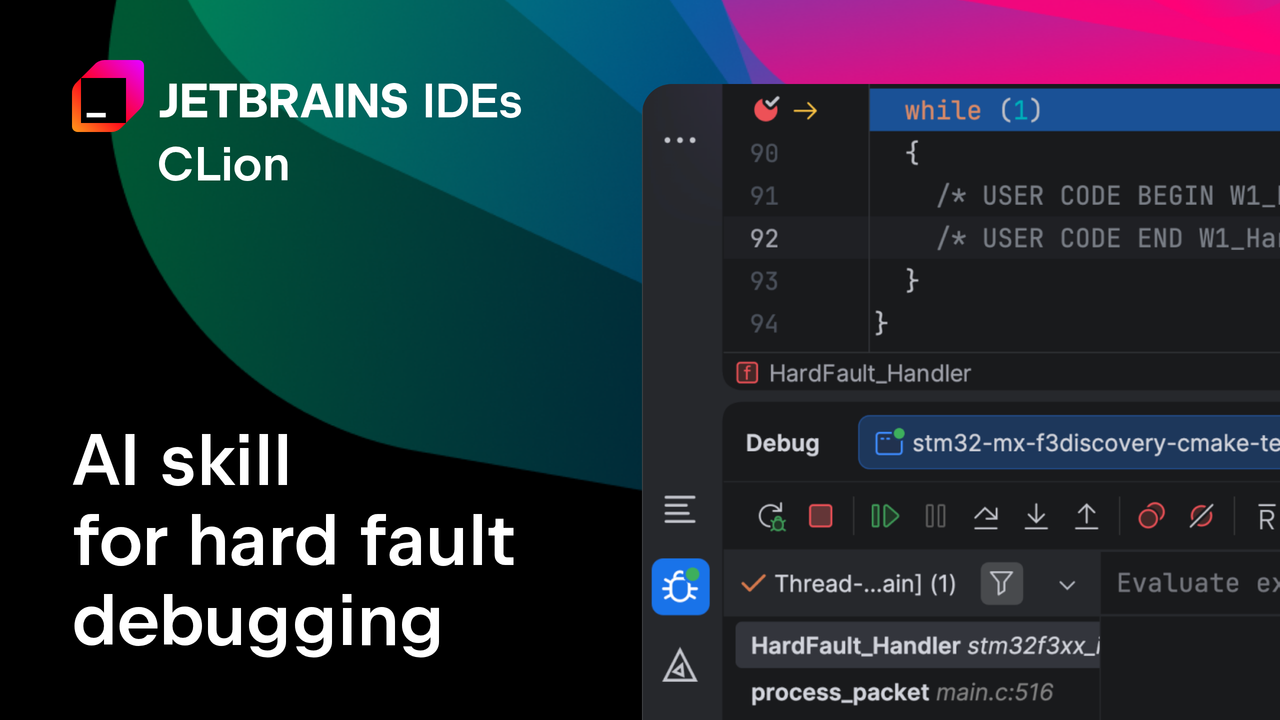
JetBrains has added an AI skill called clion-embedded-hardfault to CLion 2026.2.2 that automates the most unpleasant part of ARM Cortex-M debugging: working out why a hard fault happened. The company says the same skill is planned for the first 2026.3 Early Access build. It runs from CLion's AI chat or terminal and is enabled by default in the bundled skills settings.
What the skill does
On a hard fault, the ARM Cortex-M processor tells you the fault happened. It does not tell you why. Getting from there to the instruction that caused it has meant reading the Configurable Fault Status Register, the Hard Fault Status Register, the hardware-stacked exception frame, and the disassembly, by hand, in a debugger. The new skill turns that into an agent workflow. It reads the fault registers, inspects memory and disassembly, reads the stack frame, and reports what it found. It can also propose a fix and re-run the debug session to check that the fix works.
JetBrains describes it as vendor-agnostic and compatible with the common debug probes, naming Lauterbach TRACE32, Segger J-Link, and ST-Link. Anyone who has switched between those probes on the same board knows how much time that compatibility saves.
Requirements and agent support
The skill needs the MCP server enabled in the IDE settings. Once that is on, it works with Claude Code, Codex in both chat and CLI modes, and GitHub Copilot in CLI mode. Copilot's chat mode is not on the supported list in the announcement. The bundled skill is included with CLion, so no separate installation is needed.
Embedded work is one of the places where an AI agent has a clear job. The problem is limited, the data is stored in specific registers, and the correct answer is checkable by running the code again and checking that the fault does not happen. Handing that to an agent is a use of AI where the risk of a plausible but wrong answer is low, because the debugger will show when an answer is wrong.
The narrower point is about who can now debug a hard fault. Reading CFSR and HFSR by hand is a specialist skill that only a small number of engineers in a firmware team have. If a mid-level developer can now open the CLion chat, ask the agent what a fault means, and get a step-by-step explanation that also opens the right line in the disassembly, that is a real change in who can be on call for a board bring-up.
The wider point is about what a coding agent is supposed to do. Here an agent uses the debugger as a tool, through MCP, to answer a specific question about the running program. Most agent work has been moving in that direction, and the fact that it is now included by default in a debugger IDE is worth noticing on its own.
Source
Primary source: Stop Guessing at Hard Faults on the JetBrains CLion blog.
This item was written by an AI system from the linked source. Reveneau is responsible for what it publishes.
Get AI News in your inbox
New developer tools, model and agent releases, and how teams are actually using them to release software. Short, and only when there is something worth reading.