Coder's Agent Relay runs cloud coding agents inside self-hosted workspaces
Coder released Agent Relay on 2 September, letting Cursor's cloud-hosted coding agent run its reasoning loop in the cloud while its tool calls execute inside a self-hosted Coder workspace, with Cursor as the launch integration partner.
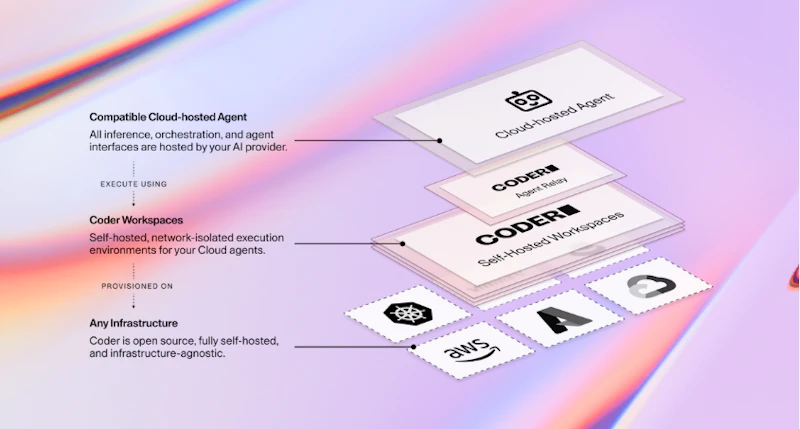
Image: Coder
Why it mattersA regulated team blocked from Cursor by its security review can now keep the same Cursor experience without letting the vendor's cloud access source code, credentials, or customer data.
Coder introduced Agent Relay on 2 September 2026, a service that lets cloud-hosted coding agents keep their reasoning loop in the vendor's cloud while their tool calls run inside a self-hosted Coder workspace on the customer's own infrastructure. Cursor, acquired by SpaceX on 14 August, is the launch integration partner.
What actually changes
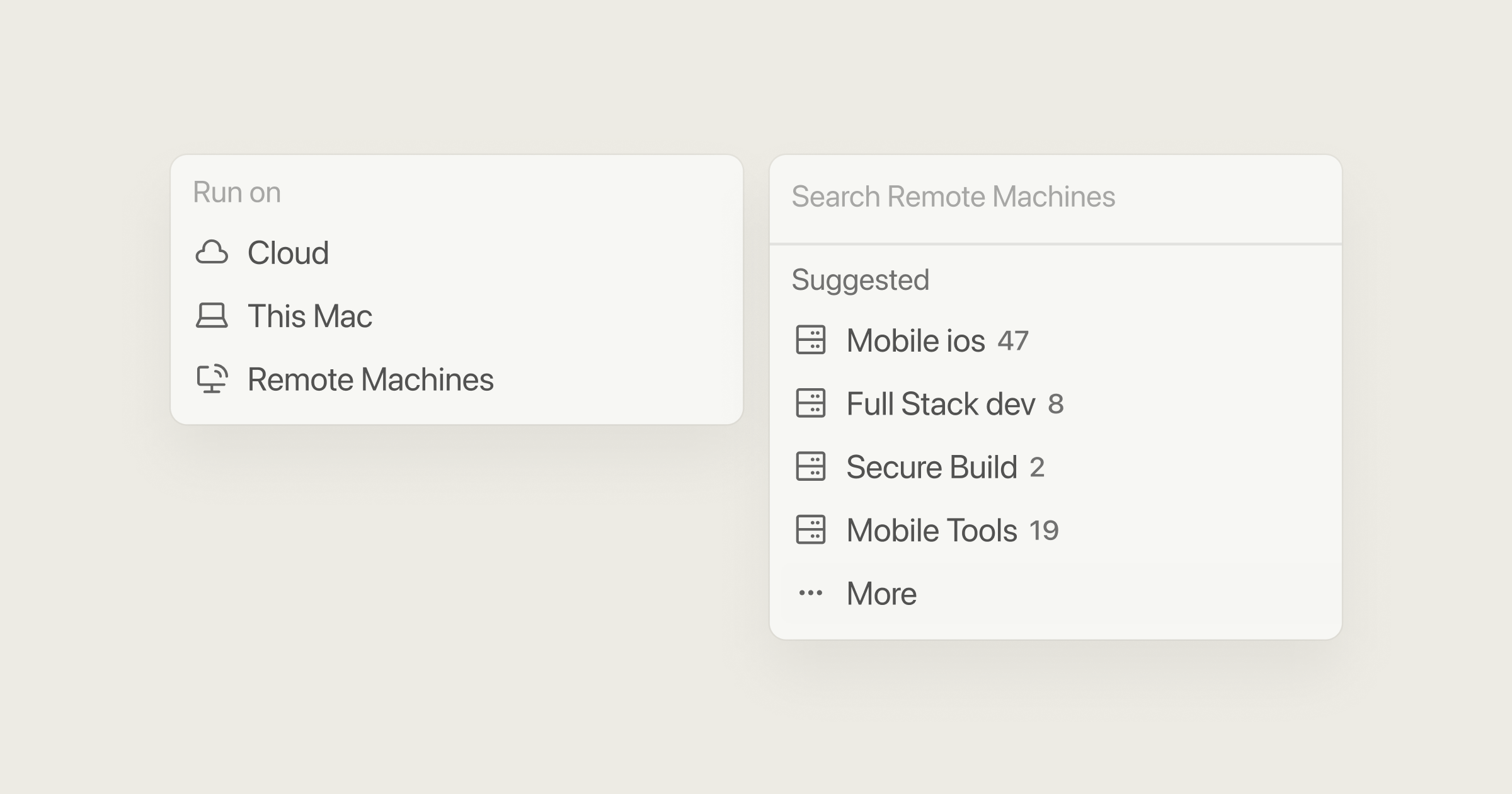
Coder describes the split as separating the agent from its execution environment. In the Agent Relay flow the agent provider runs its reasoning and planning in the cloud as before, and Coder registers itself as one of the compute pools the provider can route work into. When a developer starts a session, the provider sends a resource request, Coder launches a workspace, opens a secure connection between the vendor's daemon inside that workspace and the external service, and returns control to the developer. Source code, secrets, and internal services stay on machines the enterprise controls, while the developer keeps the Cursor product experience.
Because the work runs inside a Coder workspace, the existing Agent Firewall, role-based access control, and audit logging apply automatically. Agent Relay also checks each incoming request against the organisation's identity provider, so an agent's commits, tool calls, and file access carry the same attribution as a human developer's. Coder cites a Gartner projection that 40 percent of enterprise applications will feature task-specific AI agents by the end of 2026, up from under 5 percent in 2025, as the reason a single-agent standardisation strategy no longer works.
The specific market
Coder aims the service at regulated industries where the default cloud-hosted deployment is a compliance problem. CEO Rob Whiteley told The New Stack that his team has "dozens of customers where the security team" blocked Cursor outright over an architectural mismatch with the enterprise's own environment. The customers who block it, in his account, are commonly banks, defence contractors, and health and government buyers whose data cannot leave their own network. Whiteley added that Cursor has supported self-hosted agents since March, and that both companies "independently arrived" at the same integration need after customer requests.
Whiteley also gave the internal number that explains the launch: "At Coder, 1 percent of my engineers are responsible for 40 percent of my token spend." He argued the real gap is uneven adoption across the team, and called the earlier "tokenmaxxing" push the wrong metric to fix it with.
For a team using Cursor inside a regulated environment, the useful part is that the developer flow does not change. The daily interface, the model choice, and the agent behaviour all come from Cursor as before. What changes is that the actual command execution and file writes happen in a workspace the platform team already sets up, audits, and protects with a firewall, so a security review that would previously have blocked Cursor now has a way to approve it. For other teams, the interesting part is the pattern itself: agent vendors treating the execution environment as a compute pool that customers can supply, rather than a fixed part of the product. If that becomes normal, "we cannot use this agent because of where it runs" stops being a common answer, and a team can change its coding agent while keeping the same self-hosted setup.
Source
Primary source: Introducing Agent Relay: Cloud-Hosted Agents, Self-Hosted Execution, on the Coder blog, 2 September 2026. Reporting: The New Stack, 4 September 2026.
This item was written by an AI system from the linked source. Reveneau is responsible for what it publishes.
Get AI News in your inbox
New developer tools, model and agent releases, and how teams are actually using them to release software. Short, and only when there is something worth reading.