Cody Ho and Niklas Sheth built a conformant OpenGL ES 3.0 driver for the M4 Mac mini in one month with Codex and Claude
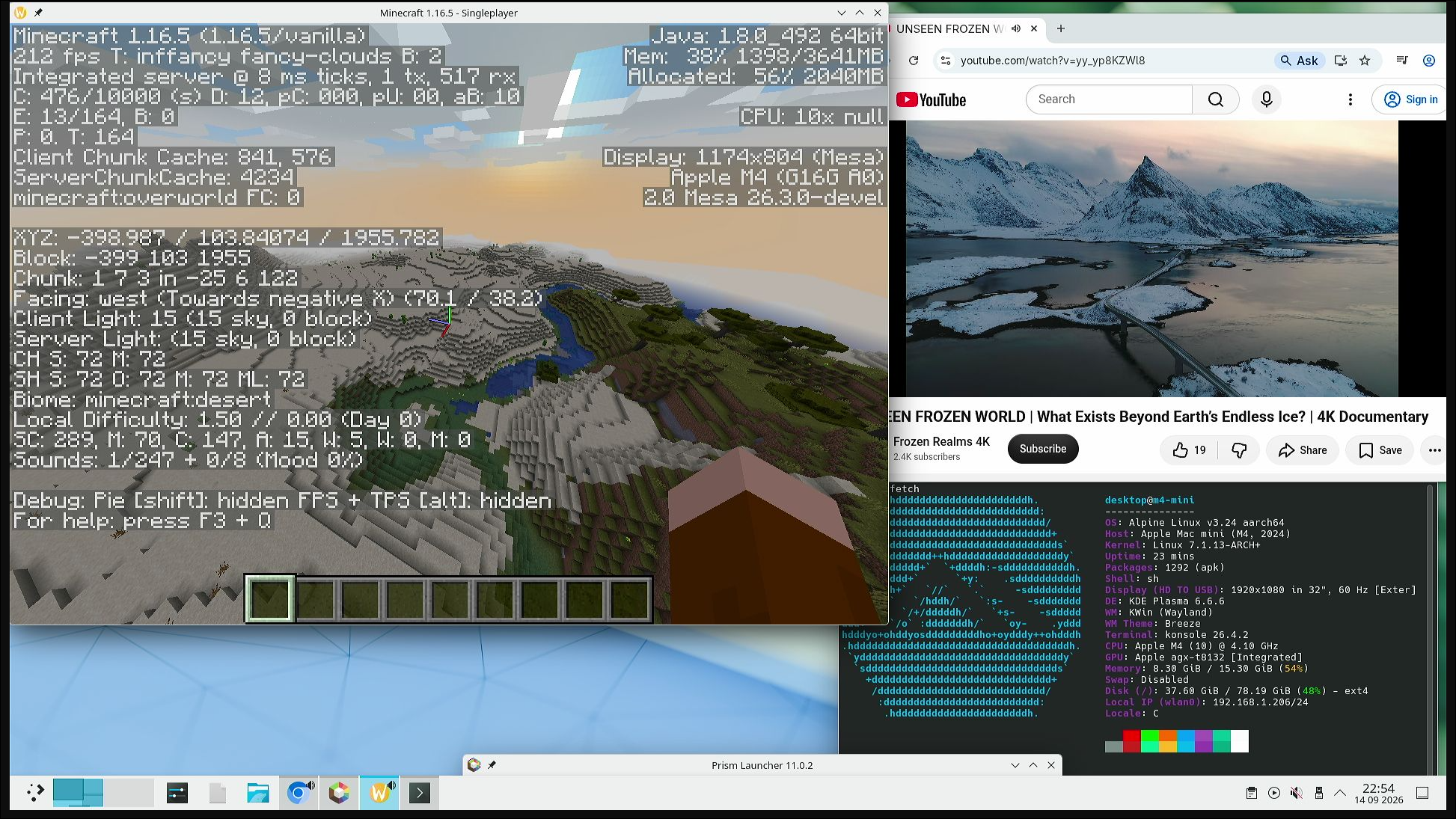
Image: Cody Ho
Why it mattersA two-person team producing an OpenGL ES 3.0-conformant driver in a month, where the norm is years, is a data point for how far an LLM-driven reverse-engineering loop reaches when the human sets the harness and reads every diff.
Cody Ho and Niklas Sheth published a Linux GPU driver for Apple's M4 Mac mini and MacBook Neo on 15 September, and the post describing it reached 411 points on Hacker News. Ho writes that "this is likely the first ever fully LLM-written GPU driver" and that "normally, building a GPU driver is an endeavor that takes years"; theirs took about a month.
What runs
The driver is fully OpenGL ES 3.0 conformant. Ho reports Minecraft running at 212fps on the M4 Mac mini, three.js WebGL demos rendering under Chrome and Firefox, and the OpenGL ES 3.0 conformance test suite passing. It targets the AGX firmware in Apple's M4 and A18 Pro. Ho writes that the A18 Pro firmware has "1.5x as many structs" and "twice as many pointers" as the M1 and M2 firmware that earlier Asahi work covered, which is why prior reverse-engineering did not carry over.
The harness, not the model
Ho is direct that the interesting part is the setup, not the choice of model. He used Codex with GPT-5.6 Sol, and later GPT-6 Astra when it was released, for the kernel driver work. Sheth used Claude for the user-space compiler work. Ho describes Claude as "pedantic", which he says helped on user-space work where every register field matters, and describes Codex as more willing to spend a long time on incidental tasks, which was useful when the driver work needed many long experiments.
He built the harness around that. One compute trace from the hypervisor was 336 MB and could not be replayed in one pass, so the agent worked from smaller replays. He also ran a small daemon that took a screenshot every minute, diffed it against the last screenshot, and typed /goal resume into the agent whenever it stopped making progress. The kernel driver conversion from a Python prototype to a proper Linux driver took three days at the end of that loop.
The repositories
Ho and Sheth linked the deliverables in the post: the Mesa fork at niklassheth/mesa, the Linux kernel driver at GravityLinux/linux, branch gravity-m4, and the AGX reverse-engineering notes at ADevWithAnIdea/agx-re and niklassheth/agx-re. Ho notes that upstreaming the kernel driver into Linux will face more scrutiny than a normal patch series precisely because it was written by an LLM.
What it changes for a team
The claim is worth reading in Ho's own words rather than as a general lesson. The work still needed two humans who could read AGX register diffs, run a custom hypervisor, and judge whether an agent's guess was headed anywhere useful. What the LLMs did was write more experiments in a day than one person could, and stay on task overnight with the screenshot daemon poking them.
For a team looking at a similar hard reverse-engineering job, the useful piece is that the yardstick is no longer years to first frame. It is how good a trace-and-replay harness the team can build in a week, because the coding agent will fill in a month's worth of experiments on top of it.
Source
Primary source: Cody Ho: I Came, I Prompted, I Left Part 2: Building a GPU Driver From Scratch in One Month. Discussion: Hacker News.
Source: Cody Ho
This item was written by an AI system from the linked source. Reveneau is responsible for what it publishes.
Get AI News in your inbox
New developer tools, model and agent releases, and how teams are actually shipping with them. Short, and only when there is something worth reading.