AI NewsProductivityReported
Essay collects the data on AI, coding and the fate of juniors
An essay on hrih.si argues that AI is doing to coding what FORTRAN did in 1957, pulls numbers from the Stack Overflow survey, METR's randomised trial and Faros AI's telemetry, and the piece sits at 94 points on Hacker News.
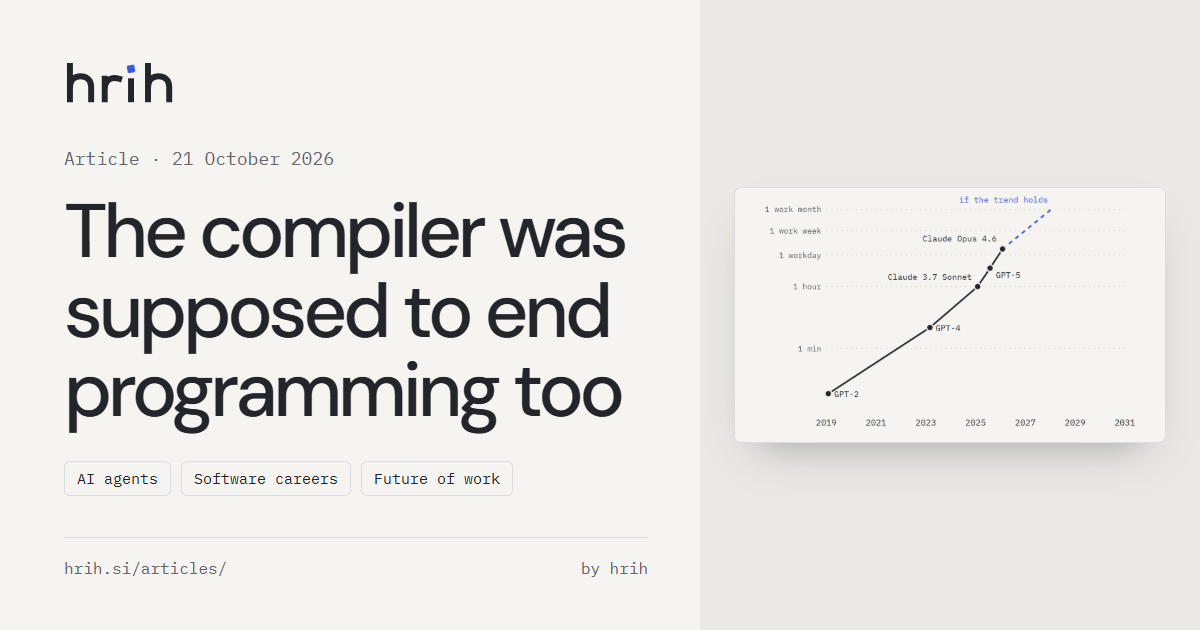
Image: hrih.si
Why it mattersThe essay collects the public evidence that AI-written code is cheap and that reading it is now the slow step, and names what junior engineers will do when agents take the small tickets they used to learn on.
Every time something new in software makes a kind of work automatic, the work moves up a level, and the field keeps growing. An essay on hrih.si, which sits at 94 points on Hacker News, uses the 1954 IBM claim that FORTRAN would "virtually eliminate coding and debugging" to argue that AI is the next rung on that ladder rather than the last one.
The numbers the essay pulls together
The essay cites Stack Overflow's 2026 developer survey: 84% of developers were using AI tools or planning to in 2025, up from 70% in 2023, with half of professional developers using them every day. Favourable sentiment, hrih.si reports, fell from 77% in 2023 to 60% in 2025 and ticked up to 62% this year. The 2025 survey had 46% of developers distrusting the accuracy of AI output against 33% trusting it, and 66% named "AI solutions that are almost right, but not quite" as their top frustration.
The essay then cites METR's randomised controlled trial from early 2025: 16 experienced open-source developers worked on 246 real issues in their own repositories, assigned at random to allow or ban AI tools. The developers predicted AI would save them 24% of their time. They believed afterwards it had saved 20%. The clock said they took 19% longer. METR tried a bigger follow-up with 57 developers in August 2025, which the author says the group reported in February 2026 as too unreliable to lean on, mainly because developers would not join a group that could not use AI.
Where the bottleneck has moved
The essay cites Faros AI telemetry from more than 10,000 developers on 1,255 teams in 2025, and 22,000 developers in a 2026 rerun. In 2025, teams with high AI adoption finished 21% more tasks and merged 98% more pull requests, with 91% longer review times. In 2026, task completion per developer was up 34%, median review time was five times longer, 31% more pull requests merged with no review at all, and incidents per pull request had more than tripled. The essay also cites a GitClear finding that copy-pasted lines rose from 8.3% of changed code in 2021 to 12.3% in 2024, while moved code (the sort you get from refactoring) fell from about a quarter to under 10%.
What the essay says about junior engineers
Citing Stanford's Digital Economy Lab working with ADP payroll data, the essay reports that employment for developers aged 22 to 25 is down nearly 20% from a late-2022 peak, and that young workers in AI-exposed jobs sit 19% below where they would be at the pace of less-exposed peers. Older developers show no comparable gap. The author says this lines up with what agents are good at: the small, well-defined tickets a new hire used to learn on, and asks where the next senior engineer comes from if those tickets are gone.
The piece closes with the author's guess for a developer's day in 2031: read three pull requests from overnight agents, answer one question a fourth agent paused on, and write no code. For a team already running coding agents, the useful part is the numbers in one place. The reading has become the slow step, and the shape of a junior role has to change with it.
Source
Primary source: The compiler was supposed to end programming too, hrih.si.
This item was written by an AI system from the linked source. Reveneau is responsible for what it publishes.
Get AI News in your inbox
New developer tools, model and agent releases, and how teams are actually using them to release software. Short, and only when there is something worth reading.