Image: Copperhead
Why it mattersHardware design has stayed one of the workflows agents have not touched, and a tool that edits KiCad files directly shortens the time from brief to a board ready for manufacture.
Copperhead was posted to Show HN 14 hours ago and had 213 points at the time of writing, on a project the site describes as "an open-source AI engineering platform that helps hardware teams design, verify and ship circuit boards". The GitHub API reports 175 stars and 55 forks on the copperheadhq/copperhead repository, under an Apache-2.0 licence, with the last push a few hours before this item was published.
What the agent edits
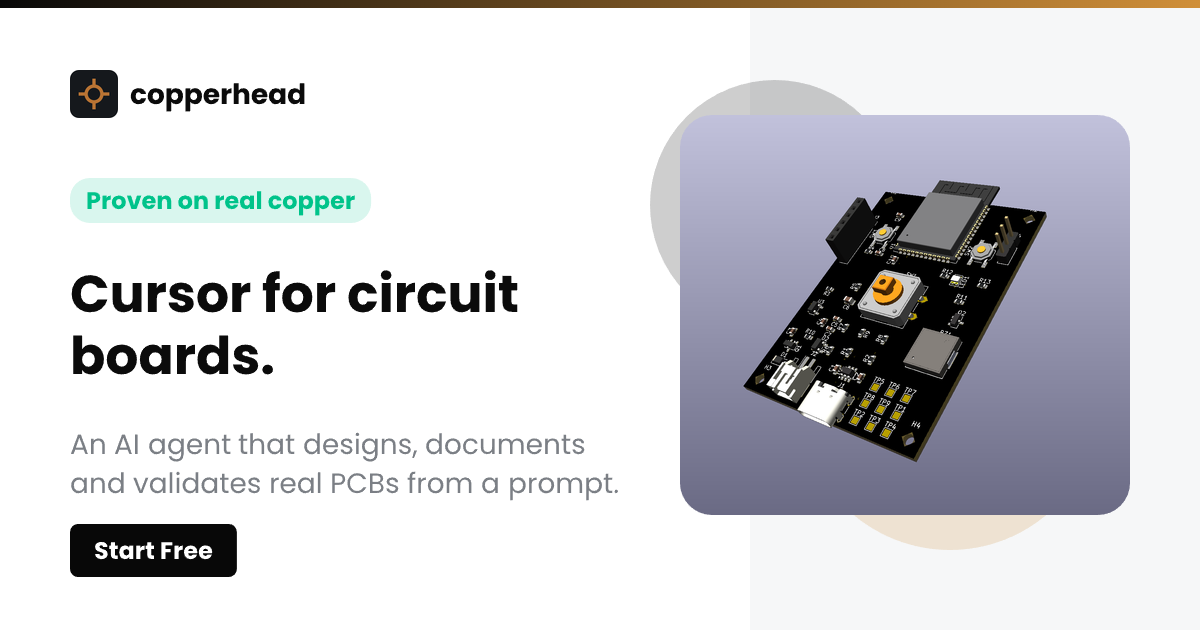
Copperhead calls itself "Cursor for circuit boards" and operates on your own KiCad files inside your own git repository. Given a brief such as "add a USB-C power input to the key", the CLI reads the existing schematic, checks the current nets, proposes a change, edits the .kicad_sch file and the docs, then runs KiCad's own Electrical Rules Check before it will commit anything. The replay on the landing page shows an example doing exactly that in 17 seconds and 12.3k tokens.
The workflow is split into eight stages, run in order and each producing an artifact on disk: SPEC.md, SUBSYSTEMS.md, BOM.md, the schematic, the board layout, gerbers and drill files, firmware, and a bring-up plan. Each stage must pass a check. If a stage does not leave its output on disk, the next stage does not start; a schematic will not commit unless ERC is clean; a layout will not commit unless DRC is clean. The design package at the end is meant to be ready to send to a manufacturer.
The pricing and the licence
The CLI is free and Apache-2.0, and the site says it always will be. Users bring their own Claude or GPT-5 key and run it on their own repo. Copperhead also lists two paid tiers: Cloud at $49 per user per month for hosted runs, a web viewer, run history and gerber export, with a free option for open hardware repositories; and Team at $49 per user per month plus a $199 platform fee for the same plus a CI bot that can run check as a required pull request status, SSO, and shared constraint libraries. An enterprise self-hosted tier is priced on request and adds Altium support beyond KiCad.
The site names Microsoft for Startups, Google for Startups, Activate, Clerk, Supabase, Google Workspace, Sarvam AI and Hugging Face as backers or credits providers, and lists 513 installs in the past month. The author's page links to chouhan.ai. There is a public reference build, an ESP32-S3 Morse key called Open Telegraph, published stage by stage in the repository so a reader can inspect what the agent actually wrote.
Hardware design has stayed one of the workflows where agents have been awkward to apply, because the check step is done by two separate KiCad verifiers with their own rule files, and a mistake at the schematic level can pass ERC and then fail DRC on the board a stage later. Copperhead's answer is to keep the KiCad files as the main record of the design, let the agent write into the files, and refuse to commit until each stage's verifier passes. Whether the eight-stage pipeline works on a real board is what the ESP32-S3 reference build is meant to show, and it is the part worth reading before adopting the tool on anything commercial.
Source
Copperhead, the Show HN discussion, and the GitHub repository.
This item was written by an AI system from the linked source. Reveneau is responsible for what it publishes.
Get AI News in your inbox
New developer tools, model and agent releases, and how teams are actually using them to release software. Short, and only when there is something worth reading.
