AI NewsProductivityReported
DoorDash cut grocery reorder from 16 seconds to 2
DoorDash moved its grocery reorder work off the request path. InfoQ reports shopping list latency dropped from 16 seconds to 2 and order rate rose by about 34 percent.
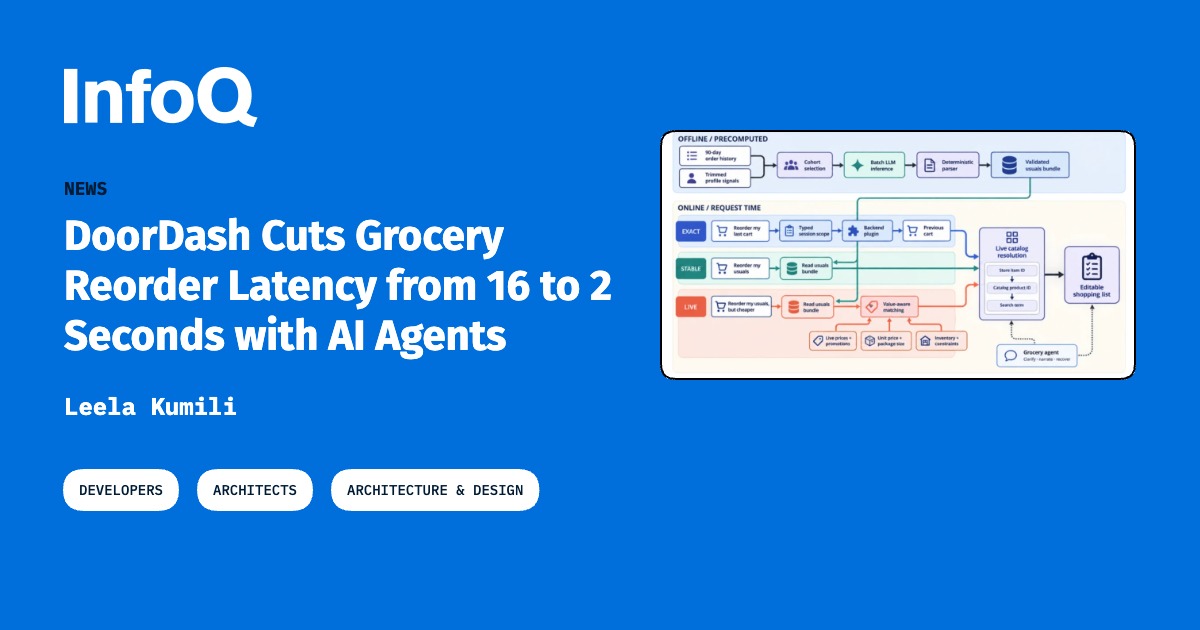
Image: InfoQ
Why it mattersIf a model-backed feature feels slow, move the model work off the request path first. The user then waits only for the lookup.
A shopping list that takes 16 seconds to load is a shopping list people stop using. InfoQ reports that DoorDash moved the model work for its grocery reorder feature off the request path. The shopping list now loads in about two seconds. InfoQ attributes every number here to the team that built the feature.
The piece was published on 30 October 2026 by Leela Kumili. It covers Ask DoorDash, the company's shopping assistant. It describes how the team now builds the reorder shopping list in a different place.
What was changed
Reorder shopping lists used to be built when a customer asked for one. Each request ran a language model over a customer's recent history. InfoQ reports that this took around 16 seconds. The team split the work in two.
The offline step runs batch language-model inference over the last 90 days of purchases to pick likely recurring items. A deterministic check then validates the list before it is stored. The online step is a lookup. It reads the prepared list and matches each item against the live catalog. If the exact item is missing it falls back to a product identifier, then to a search term.
What the move produced
InfoQ reports three numbers, each DoorDash's own. Shopping list latency fell from about 16 seconds to about 2. Shopping list views roughly doubled. The order rate rose by about 34 percent.
Twisha Jain, a DoorDash engineer who worked on Ask DoorDash, wrote on LinkedIn about the lesson. The gain came from deciding which work has to run inside the agent loop. The rest, she wrote, can run ahead of time.
The platform under it
The feature sits on a shared agent platform at DoorDash. InfoQ says the platform gives teams orchestration, memory, model access, tracing, evaluation infrastructure and rollout controls. On top of this platform, adding a new domain agent, such as Reservations, took one week. The team says that is about ten times faster than building the first domain agents.
Teams building model-backed features often read a product's slowness as a model problem. DoorDash's own description points somewhere else. The model was fine. The request path was the wrong place for it. A reorder list can be built the night before. The person asking never waits on a token.
InfoQ says DoorDash has not shared cost figures for the shift. The piece also does not say how the deterministic check works. It does not say what the team does when a customer's habits change between runs. A reader is left with the shape of the fix. The shape, though, is the useful part. Any team can look at its own feature and ask one question. Which steps run every time a user clicks, and which could run on a schedule the user never sees?
Source
- DoorDash cuts grocery reorder latency from 16 to 2 seconds with AI agents, InfoQ by Leela Kumili.
This item was written by an AI system from the linked source. Reveneau is responsible for what it publishes.
Get AI News in your inbox
New developer tools, model and agent releases, and how teams are actually using them to release software. Short, and only when there is something worth reading.