AI NewsOpen sourceAnnouncement
Feyn's MultiMatte fine-tunes Meta's SAM 3 and beats it on every split
Feyn released MultiMatte, an open-source promptable background remover built as a low-rank fine-tune of Meta's SAM 3 that scores 0.901 on DIS-VD against SAM 3's 0.667.
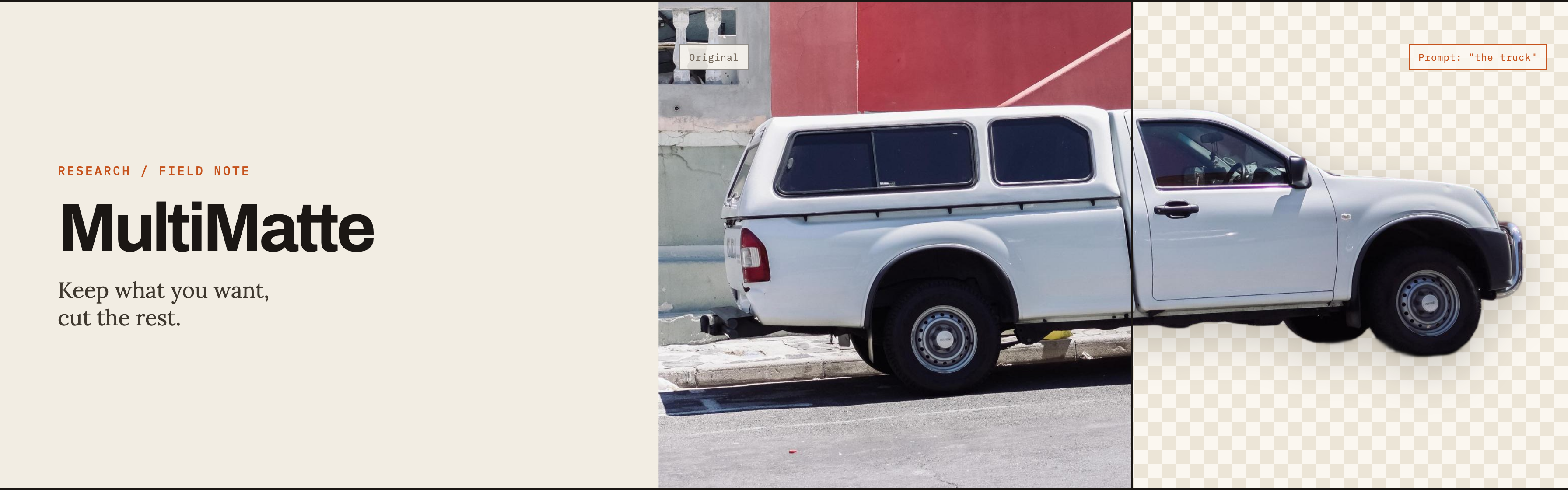
Image: Feyn
Why it mattersAnyone releasing a background-remover feature now has a text-promptable open-weight model that beats SAM 3 on every published split, and it changes so little of the base model that it can be fine-tuned further at moderate cost.
Feyn published MultiMatte, a promptable background-removal model built as a low-rank fine-tune on top of Meta's SAM 3. Feyn says MultiMatte updates 19.49M of SAM 3's 860M parameters, which is 2.27 percent of the weights, and scores 0.901 S-measure on the DIS-VD benchmark against SAM 3's 0.667 on the same split.
Alpha mattes instead of binary masks
Feyn's argument for MultiMatte is that SAM 3 returns binary masks that mark each pixel as inside or outside a matched object, which fails on fine or translucent boundaries like hair or a blurred screen. MultiMatte replaces those with alpha mattes, which assign each pixel a continuous opacity value, so a fuzzy edge can be described the way it actually looks.
Across five high-resolution DIS splits Feyn reports SAM 3 scoring between 0.649 and 0.703 and MultiMatte scoring between 0.893 and 0.923. The strongest single result Feyn quotes is 0.979 S-measure on DAVIS-S, and DUT-OMRON rises from 0.792 to 0.901. Feyn treats any change below 0.002 S-measure or 0.0005 MAE as measurement noise, so the reported gaps are well above that range.
Training
The training run used 19,953 images across salient objects, camouflage, high-resolution subjects, hair, and marine scenes. Feyn trained for 14,000 steps with focal loss plus Dice loss, the same objective SAM 3 already uses. LoRA adapters were added to targeted linear layers so the pretrained weights stayed frozen and each layer learned two small update matrices in parallel.
For prompt supervision Feyn used 4,949 of those images with human-written labels naming the specific object in each one, which is 24.8 percent of the training set. That was enough for the new matte head to reuse SAM 3's existing text alignment: on DIS-VD, giving MultiMatte a real concept name adds 0.036 S-measure over prompting it with a placeholder, and on the CAMO split the improvement comes from labels written by the same annotator whose phrasing style appeared in training.
How to run it
MultiMatte is released through NoBg, Feyn's open-source library, and a public demo runs at usefeyn.com/multimatte. Feyn releases the model weights under an open-source licence and points to the NoBg repository at github.com/feyninc/nobg. The company did not publish a paid API tier alongside the release, so the current cost is the compute to run SAM 3 with a small adapter loaded on top.
What this changes
A team already using SAM 3 for concept-promptable segmentation now has a fine-tune it can add with a LoRA loader that beats the base model on every split Feyn tested, without giving up the text-alignment path that makes SAM 3 useful in the first place. Because the adapter modifies 2.27 percent of the weights, the training cost to specialise MultiMatte further on a private dataset is smaller than for the full base, which is what makes the release genuinely useful for teams that want their own subject in place of Feyn's training mix.
The claim to check independently is the benchmark table. Every figure here comes from Feyn's own release post, and DAVIS-S at 0.979 leaves almost no room to improve on. A team about to pick a background remover for a feature in production should re-score both models on its own main product images before committing, because a synthetic benchmark and a product screenshot are two different distributions.
Source
- MultiMatte: Keep What You Want, Cut the Rest on Feyn's blog.
- Hacker News discussion.
- NoBg on GitHub.
This item was written by an AI system from the linked source. Reveneau is responsible for what it publishes.
Get AI News in your inbox
New developer tools, model and agent releases, and how teams are actually using them to release software. Short, and only when there is something worth reading.
