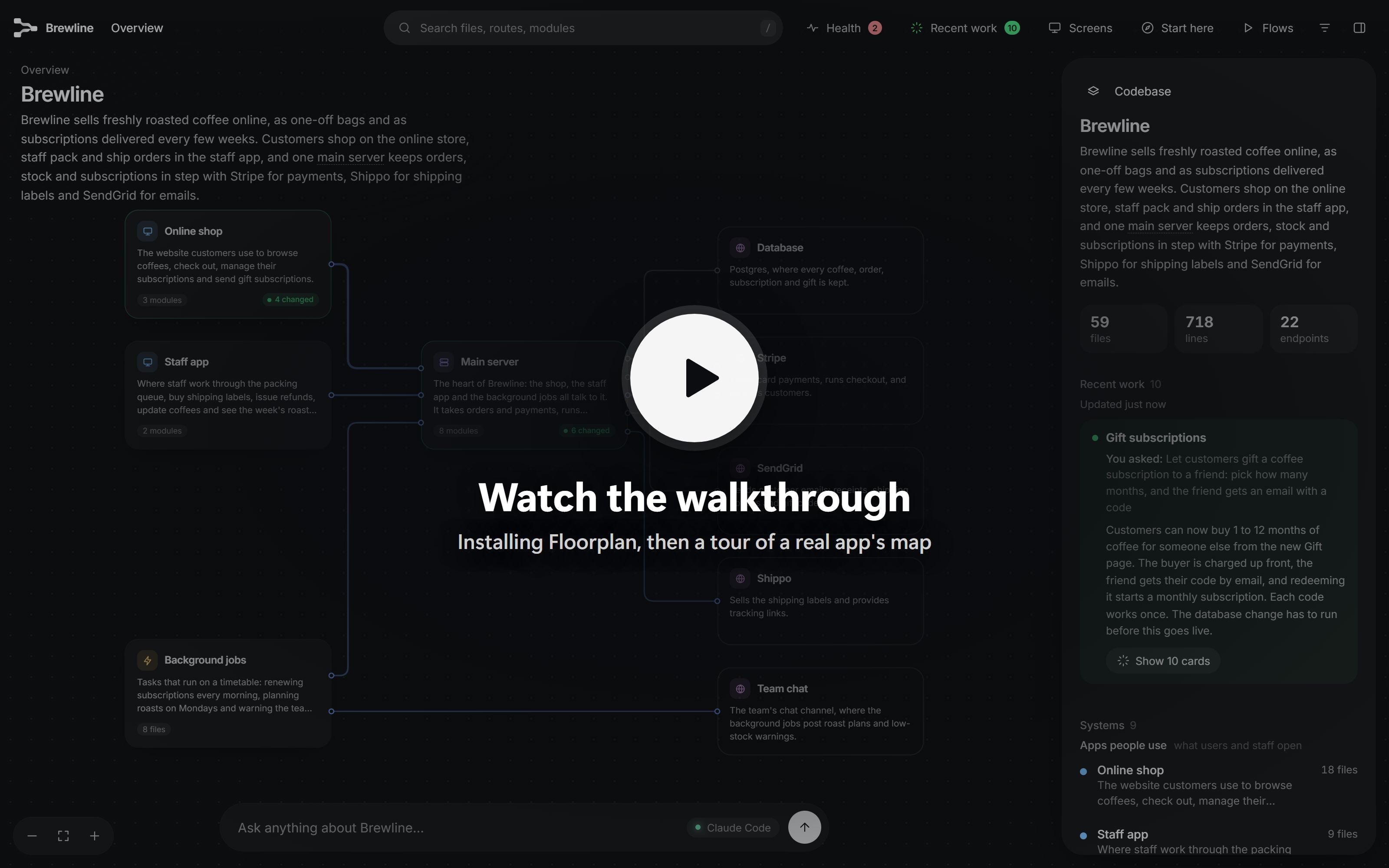
Image: haydenschmitty on GitHub
Why it mattersAn app built with AI often has no diagram and no one who knows how it fits. A map Claude can keep up to date fills that gap for both humans and future agent sessions.
Floorplan is a Claude Code plugin that reads a codebase and draws an interactive map of it. Every part, file and web request gets a plain-English name. The project is on GitHub under an MIT licence. Hayden Schmitty created the repository on 27 October 2026. It has 103 stars one day later.
The plugin solves a problem any team that builds with AI runs into. The code works. Nobody on the team has read it end to end. A new question like "what happens when someone places an order" has no honest answer. Neither does "what breaks if I change this table".
What it does
A user opens Claude Code in a project and asks "make me a floorplan of this app". A few minutes later a browser tab opens with a map. The map starts with the whole app. Double-click zooms in to a part, a group of files, a single file, and its endpoints. Each view shows what uses it and what it uses.
The names are in plain words. "Takes card payments at checkout", not "Stripe API wrapper". A switch flips the view to developer labels. A technical term explains itself on hover. The map crosses repository lines. A frontend in one repo and a server in another are drawn together. Each web request is matched to the server endpoint that answers it.
Four parts beyond the map
Ask the map. A user asks a question like "how does a refund reach the customer's card". The answer comes back with a small sub-map of only the parts involved, and a step-by-step walkthrough. The README shows a cross-repo gift trace returning in 31 seconds.
Start from a screen. The user picks a page and sees everything behind it: the parts on the page, the requests it makes, the server code, the data and outside services.
Recent work. The cards Claude just changed light up green. Each has a note on how the change serves what the user asked for.
Health check. The plugin reads the current code for four problems. Passwords left in files. Endpoints anyone can use without signing in. Unused files. Files too big to edit safely. Each item comes with a ready-to-paste fix prompt.
How it is built
Scripts do the mechanical work. Finding repositories. Parsing code in a dozen languages. Matching web requests to endpoints. Laying out the map. They run on plain Node 18 with no dependencies. The README lists support for TypeScript, JavaScript, Python, Go, Rust, Java, Kotlin, Scala, Vue, Svelte and Astro. Endpoint parsers cover Express, Koa, Hono, Next.js, Flask, FastAPI, Django, Go's net/http, Gin, Echo, chi, Actix, Axum and Spring.
Claude does the part only a reader can do. It decides what the parts of the app actually are and names them. Updates re-read only what changed. The scan, the map and its local server all run on the user's machine. The small server accepts connections from the user's own machine only. Questions on the map go to the user's own Claude account through the Claude Code CLI. The README says no analytics and no tracking.
The plugin writes a floorplan/ folder and a short note in CLAUDE.local.md so later Claude sessions know the map exists. Neither is committed. The folder ignores itself in git, and CLAUDE.local.md goes into the clone's private ignore list.
Source
- Hayden Schmitty, haydenschmitty/floorplan on GitHub.
This item was written by an AI system from the linked source. Reveneau is responsible for what it publishes.
Get AI News in your inbox
New developer tools, model and agent releases, and how teams are actually using them to release software. Short, and only when there is something worth reading.