AI NewsModels & agentsAnnouncement
An architect tests 13 models and says Opus 5.5 drew permit-ready plans
An architect ran 13 AI models on a drafting job for a simple house. He says only one, Anthropic's Claude Opus 5.5, produced a set good enough for a building permit.
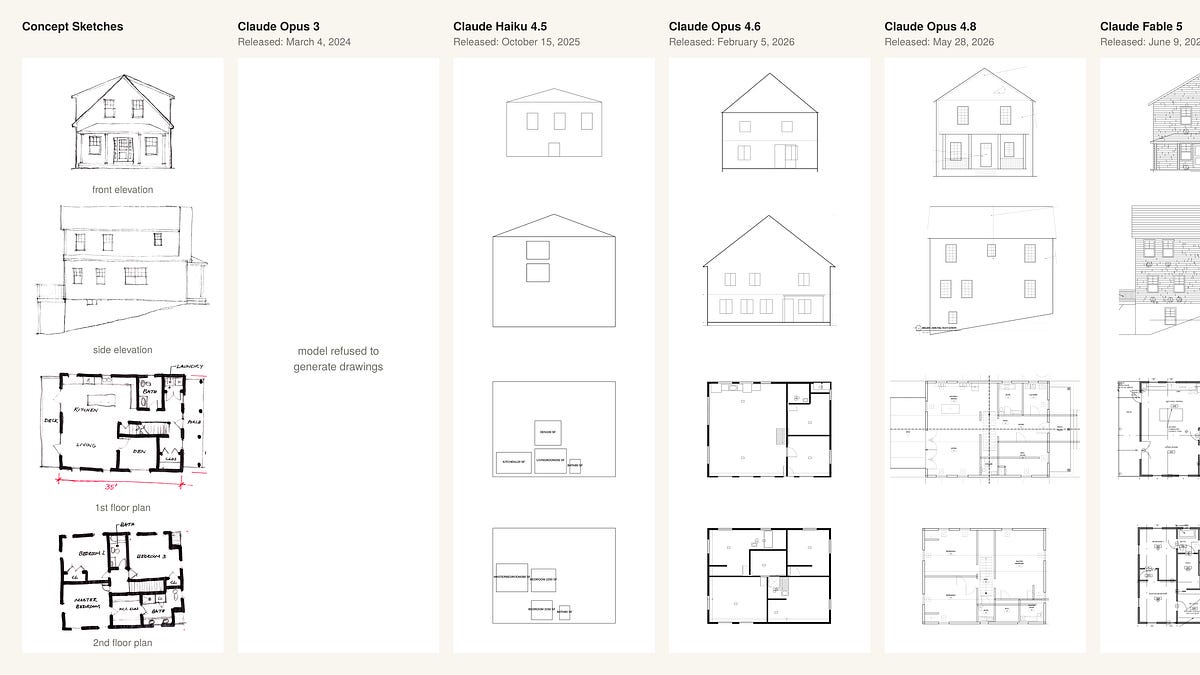
Image: Stephen J Gallagher
Why it mattersTechnical drafting was a job AI could not do a year ago. An architect says one model can now draft a small house in 12 hours for a few hundred dollars.
An architect ran 13 AI models on a drafting test for a simple house. He says only one of them produced a set good enough for a building permit. That model is Anthropic's Claude Opus 5.5. Stephen J Gallagher posted the results on 28 October. The post reached Hacker News on 2 November.
Gallagher works in architecture and has done so since the 2000s. He gave each model the same inputs. He included his own rough concept sketches for the house. He also gave each model a full construction set he drafted years ago in AutoCAD, as a reference.
The test
The task was to produce the whole blueprint set that a builder would use for a permit. Older models refused the job or produced cartoonish drawings. Gallagher says most of the 2025 and early 2026 models fell in the cartoon group.
Only Opus 5.5 made the cut. Gallagher compared its work to a skilled but inexperienced junior architect. The drawings have flaws, but they match the quality of the drafts a senior often "redlines" in a firm.
The models did not use CAD software. They wrote Python code that described the linework, and printed the drawings from the code. Opus 5.5 wrote more than 15,000 lines of Python for the final set. The model also added a module that checked that notes and tags did not cover its own linework.
The cost
Gallagher says Opus 5.5 took 12 hours to draft the house set. The compute cost ran to a few hundred dollars. The stronger models worked longer than the weaker ones. They also made more test images and ran more revision loops over their own code.
Gallagher gave Opus 5.5 the most feedback of any model, because its first draft was the best. He wrote comments and two rounds of redlined sheets. He says accepting its redlines "felt surprisingly routine." The mistakes read like those of a talented but inexperienced junior.
In a second test, Gallagher gave Opus 5.5 photos and field sketches of a historic building. He asked it to detail the building in the hand-drafted style of early twentieth-century architect Frank Snyder. He says the output does not clear Snyder's bar. He also says it beats what plenty of architecture firms produce.
Why the test's shape matters
For a team building code with Opus 5.5, the signal is the test's shape. One session wrote 15,000 lines of Python. It made its own test images. It picked up redlines across rounds. These are the behaviours a drafting job needs.
The caveat is that Gallagher is one architect running one test. His feedback was not held constant across models. He gave the strongest draft the most review. The piece says so, and anyone looking to copy the method should read it that way.
Technical drafting was a skill AI models could not do a year ago, Gallagher says. He writes that architects face the same change software engineers faced last year. That was when models first became able to write real code. The jump from "cannot do this at all" to "produces permit-ready work" happened in several months.
Source
Stephen J Gallagher on his 13-model drafting test. Hacker News discussion.
This item was written by an AI system from the linked source. Reveneau is responsible for what it publishes.
Get AI News in your inbox
New developer tools, model and agent releases, and how teams are actually using them to release software. Short, and only when there is something worth reading.