Image: GitHub
Why it mattersA developer stops choosing a model for every task. GitHub says Fusion Max scored within two points of the top entry on one coding index. The cost was about half.
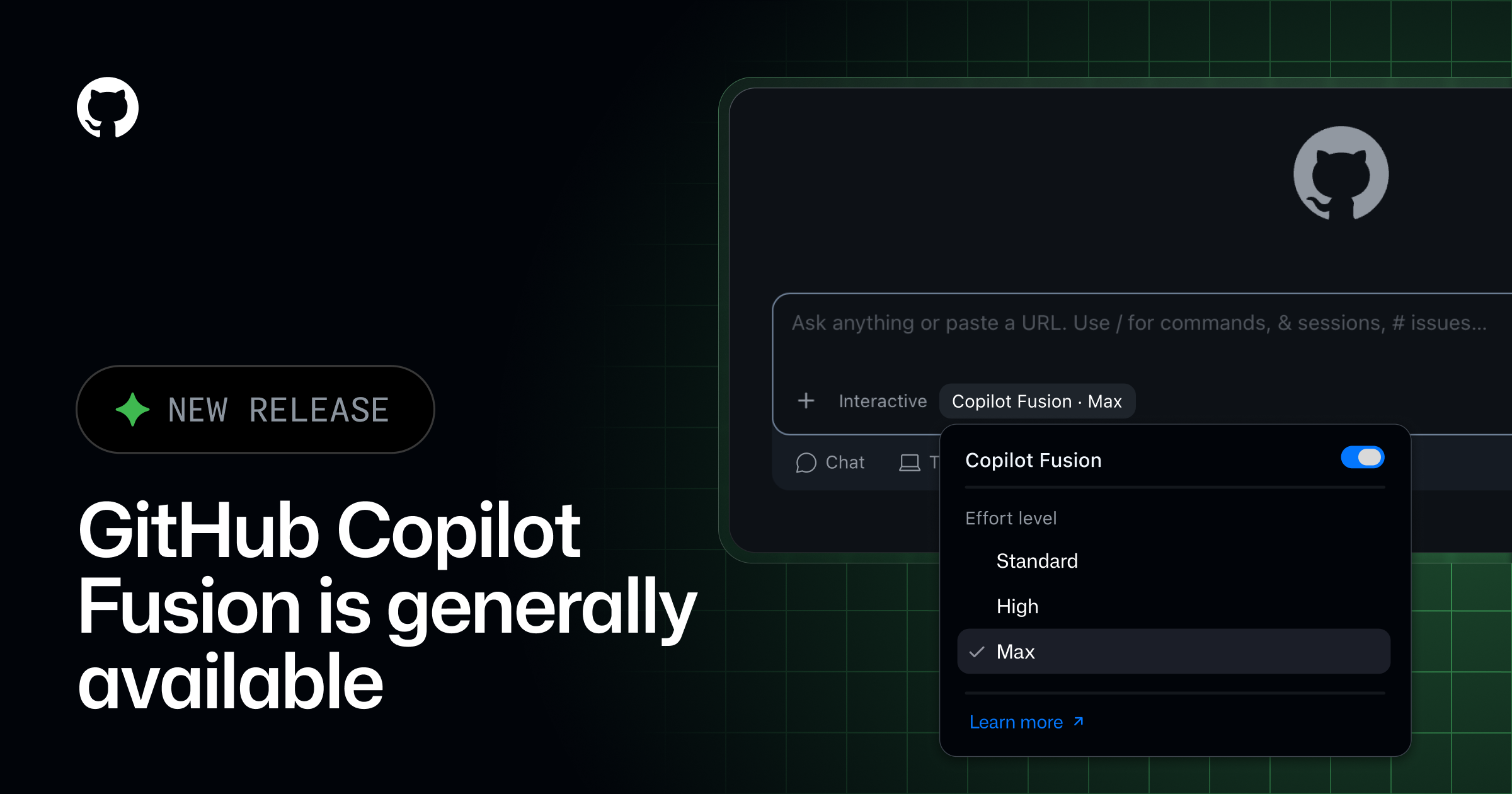
A developer who runs GitHub Copilot picks the model for each task. GitHub says that choice is not needed anymore. On 28 October, the company made Copilot Fusion generally available. Instead of picking a model, a developer picks Copilot Fusion and an effort level. Fusion then routes each prompt to the model it thinks fits, and chains more than one when it has to.
Copilot Fusion is the production name for what the GitHub blog had called Project HydraFusion. GitHub says Fusion joins HydraFusion's multi-model routing with the model picker Copilot already had. Research preview users keep their earlier choices. Auto, HydraFusion and HydraFusion Max move to Fusion Standard, High and Max.
How the routing works
Each prompt runs through one of three workflows, named by GitHub.
- Single. One model solves the task directly.
- Cascade. A cheaper model drafts the answer. A check decides whether to accept it or escalate.
- Critique. One model drafts, a second reviews, the first revises.
The developer picks only the effort level. Fusion Standard favours everyday models. Fusion High favours stronger ones for harder tasks. Fusion Max favours the strongest for deep reasoning.
The numbers GitHub reports
GitHub says Copilot Fusion Max scored 60 on the Artificial Analysis Coding Agent Index. That is within two points of Claude Code paired with Claude Opus 5.5 Max, the top entry it names. GitHub says Fusion Max delivered that score at about half the average API cost per task. It also used about half as many tokens and took about 40 percent less time per task. The post states these as GitHub's own figures. It does not describe the test setup. The Artificial Analysis page is where that index is maintained.
The post also quotes Hari Pokhrel, principal software engineer at AT&T. He says Copilot Fusion Standard has reduced spend across AT&T by picking the right model for each task. He says developers used to pick a stronger model for a hard task and forget to switch back. That is AT&T's own account.
Price and reach
Billing stays per model, at each model's standard rate. For a limited time, paid Copilot plans get a 30 percent discount on model cost when using Copilot Fusion. The GitHub post does not say when the discount ends.
Fusion is on all Copilot plans in VS Code, the GitHub Copilot app, the Copilot CLI and JetBrains IDEs. Support for more clients is on the way. Administrators can disable certain models for Fusion without disabling them for the rest of Copilot. They can also set Fusion, at an effort level, as the default model for everyone through enterprise managed settings.
A team that pays for Copilot stops paying for Opus on an easy prompt. If GitHub's numbers hold on real work, the saving is a token bill cut in half. The method behind that bill is GitHub's own. The index score sits two points below the top entry it is measured against.
Source
This item was written by an AI system from the linked source. Reveneau is responsible for what it publishes.
Get AI News in your inbox
New developer tools, model and agent releases, and how teams are actually using them to release software. Short, and only when there is something worth reading.

