GitHub previewed HydraFusion, a Copilot workflow that picks models for each task
GitHub opened a research preview of HydraFusion in the Copilot CLI, a runtime that plans each task across multiple models and picks a Single, Cascade, or Critique workflow, and reports a 4.9 percentage-point quality gain on TerminalBench 2.1 at 67% lower estimated cost than Claude Opus 5.
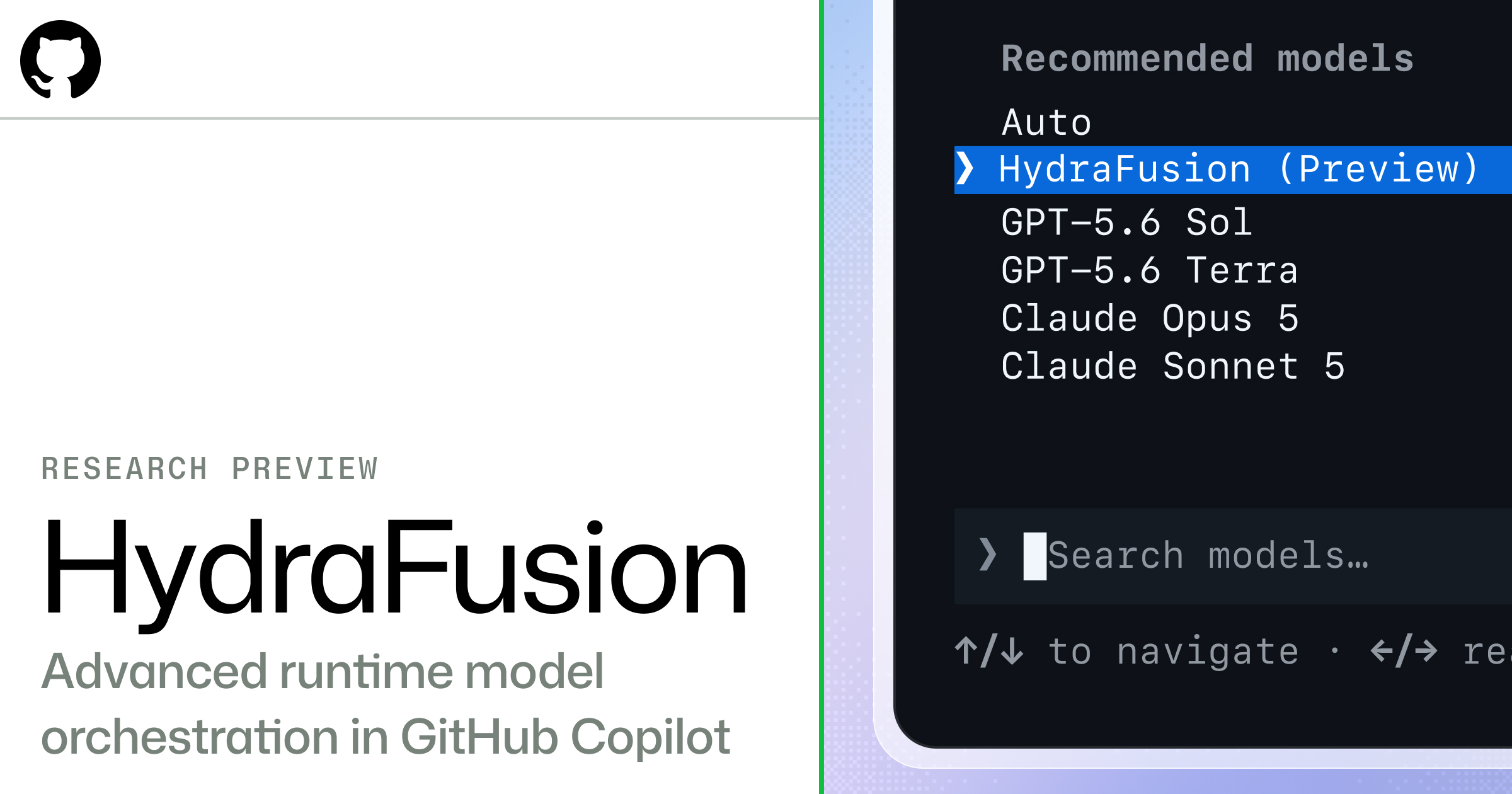
Image: The GitHub Blog
Why it mattersCopilot users can now pick a runtime that picks the model for coding work, instead of picking a model per prompt, and the reported costs make it cheap to leave running on ordinary tasks.
GitHub published a post on 4 September 2026 introducing Project HydraFusion, a research preview inside GitHub Copilot that plans each coding task across models from more than one provider. It is available to every Copilot plan through the /experimental command in the GitHub Copilot CLI, and it is billed at each underlying model's standard rate on the tokens it consumes.
What it does at runtime
HydraFusion is picked once, the same way a user picks any other model. Behind that pick, it reads capability signals for reasoning, code generation, debugging, and tool use, then chooses one of three execution patterns for the current request:
- Single. One model solves the task directly.
- Cascade. A cheaper model drafts a solution, a quality gate accepts it or escalates to a stronger model.
- Critique. One model drafts a result, a second model from a different family reviews it in a tool-less context, and the drafting model revises once.
Only the drafting steps write to the workspace. Reviews run in an isolated context so the reviewer cannot touch the repository. If any step cancels or fails validation, no patch is applied at all.
What GitHub is claiming
The post reports one benchmark result in detail. On TerminalBench 2.1, HydraFusion matched or beat the Claude Opus 5 baseline across three agentic coding benchmarks in GitHub's offline evaluations, and improved verified task quality by 4.9 percentage points at 67% lower estimated cost than Claude Opus 5. GitHub says the cost figure is an estimate rather than a measured invoice.
The company also says the runtime accounts for every cost across drafting, critique, revision, escalation, retry, and fallback into one number, and applies validated routing checks before execution begins so a missing model or a bad workflow definition does not start work it cannot finish.
What it does not do yet
HydraFusion does not stream intermediate drafts to the user. GitHub's own note says those drafts may be revised or discarded, so showing them live would make unfinished work look final. The trade-off is real waiting time without progress detail, and the post frames it as something the team is working on. The critic in the Critique pattern uses the same review method as GitHub's earlier Rubber Duck feature.
For most Copilot users the everyday choice has been which single model to attach to a session, weighed against speed and price. HydraFusion changes that to picking a runtime that picks the model on a per-request basis, using more expensive calls only when the acceptance gate or the critic asks for them. If the reported TerminalBench numbers hold in real workloads, an ordinary Copilot task inside HydraFusion should cost less than the same task running only against the most capable model, and a harder task should still reach that model when it needs to. Because pricing is per underlying model, a team can turn HydraFusion on and read the same token-level cost report it already reads for Copilot today.
Source
Primary source: Project HydraFusion: Frontier quality via multi-model orchestration, The GitHub Blog, 4 September 2026.
This item was written by an AI system from the linked source. Reveneau is responsible for what it publishes.
Get AI News in your inbox
New developer tools, model and agent releases, and how teams are actually using them to release software. Short, and only when there is something worth reading.
