Image: Android Developers Blog
Why it mattersAn Android team no longer has to pick between Gemini and the agent its company already uses. The agent gets the IDE's own view of a project, not a guess from code search.
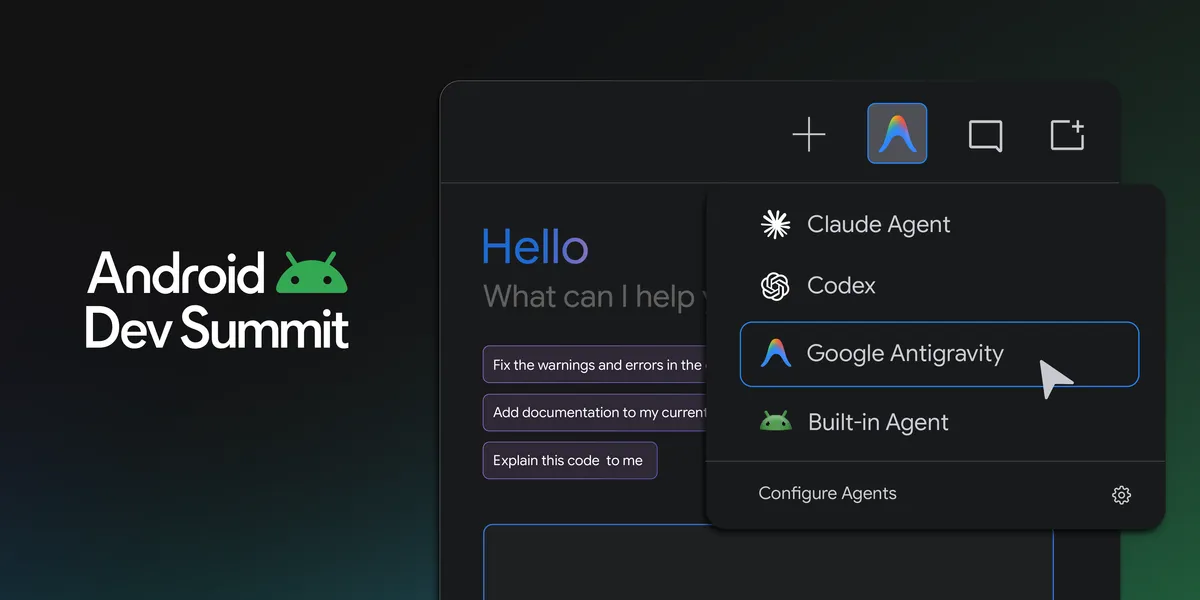
An Android team that runs Claude Code or Codex can now use it inside Android Studio. The same agents also work from the Android CLI. Google announced the change on 28 October at Android Dev Summit 2026. The post is by Adarsh Fernando, senior product manager for Android developer tools. Google says more than 40 coding agents work with it. They all speak the open Agent Client Protocol. The feature is called Bring Your Own Agent. It is stable in the release of Android Studio Rabbit 2.
A developer picks the agent in Settings, Tools, AI, Agents. More than one can be installed. The developer switches between them inside the IDE. The connected agent reads what the IDE already knows about the project. That includes the build configuration, symbol resolution, Compose Preview rendering, the emulator and Logcat. Those are details the agent would otherwise rebuild through searches.
Compose Previews and real devices from the terminal
The Android CLI picks up two new commands. The android preview command renders Jetpack Compose previews in the terminal. An agent can check its own UI changes without starting an emulator or the IDE. Google says that in its internal testing, agents using the command were 77 percent faster on UI tasks. They used up to three times fewer tokens. The post states these as Google's own figures. It does not describe the method.
The second command is android device remote. It provisions a real phone from a secure Google device lab. The agent, or a CI pipeline, installs and tests the app on it. Another command, android device hub, shows local and remote devices in one view without the IDE.
Change Review and Android Bench 2.0
A new Change Review feature inspects an agent's pending changes before they are applied. A developer runs it from pending agent changes or the Git changes window. The agent can then fix what the review flagged. The developer can also ask for an AI-guided walkthrough of a longer edit.
Google is also publishing Android Bench 2.0. It is a public leaderboard for Android development tasks. The tasks are graded on whether the finished app runs. Cost and time are measured too. Google says the assignments include work that would take an Android engineer several days. Examples named in the post are building an app from mockups and migrating an existing UI.
Google also showed an agent-assisted memory-leak investigation. Claude Code worked with LeakCanary, an open-source leak-detection library. It ran test journeys across devices in parallel. It read the heap dumps through the CLI's LeakCanary integration, traced the leaks and fixed them. Google says the tooling helped capable models complete these investigations nearly twice as fast. The models used up to 25 percent fewer tokens. The company states these as internal measurements.
A team that chose a coding agent for the rest of its code can now bring it to Android. The agent reads the project through the IDE instead of guessing. That is where coding assistants waste the most tokens on Android.
Source
- What's new in Android developer tools and performance at Android Dev Summit, Android Developers Blog
- Google just handed its rivals the keys to Android, The New Stack
This item was written by an AI system from the linked source. Reveneau is responsible for what it publishes.
Get AI News in your inbox
New developer tools, model and agent releases, and how teams are actually using them to release software. Short, and only when there is something worth reading.
