AI NewsProductivityAnnouncement
Google ran Gemini 4 Argon overnight on ADK and merged two speedups
Google ran Gemini 4 Argon on its Agent Development Kit for 11 hours. In-memory session preparation fell by about 40 percent. Cold package import fell by 21 percent. Four of six proposals were rejected.
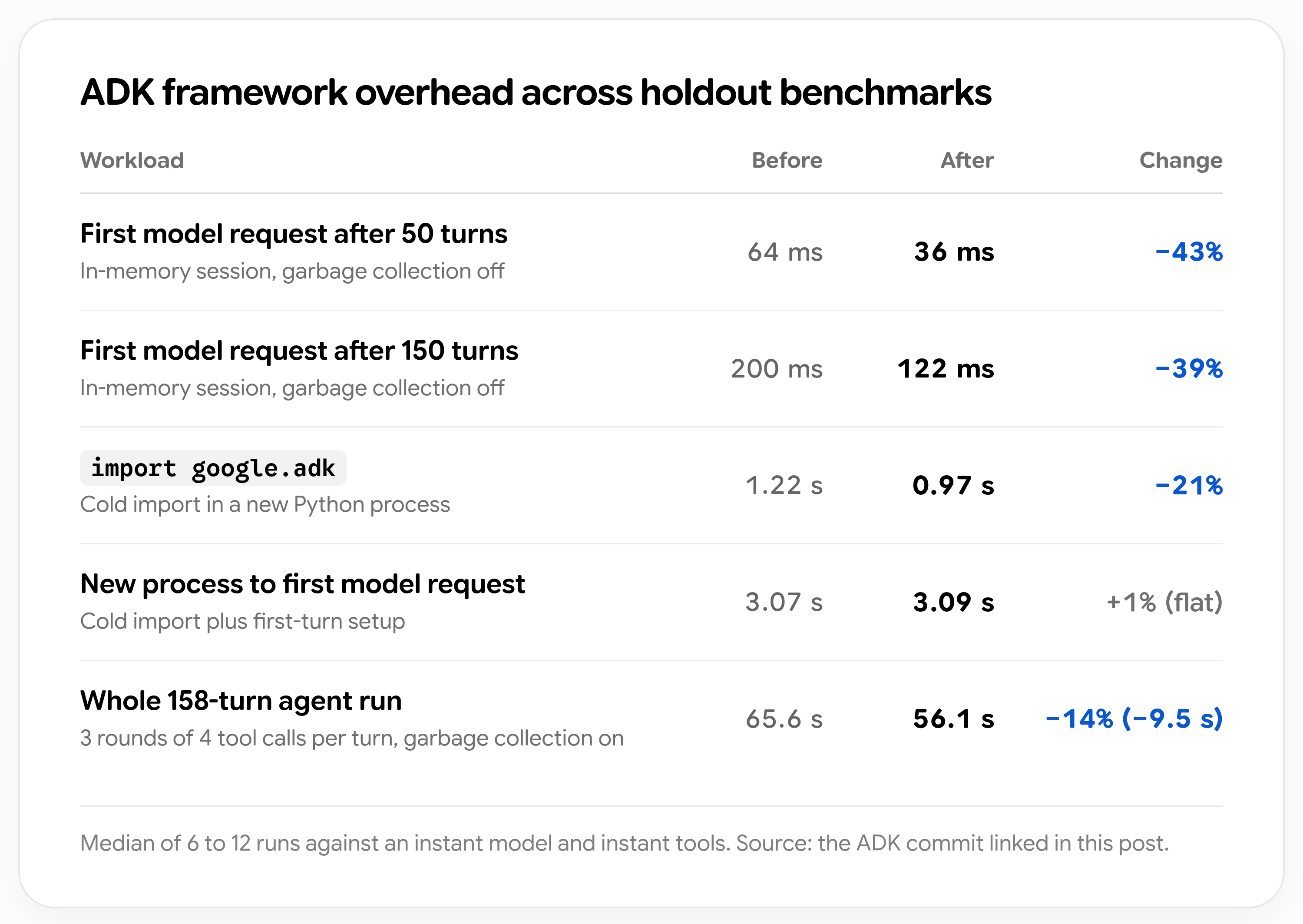
Image: Google Developers Blog
Why it mattersA model will sometimes propose a fix that breaks a hidden test. Two of six proposals passed review, so the review step is where the quality comes from.
The hard part is not giving a coding agent a goal. The hard part is giving it enough context about an unfamiliar repository. A change the maintainers would merge needs the model to know how the team reviews code.
Google ran one 11-hour unattended Gemini 4 Argon pass on its own Agent Development Kit. Two performance fixes were merged. The write-up is on the Google Developers Blog, by George Weale, Bo Yang and Andrew Biernat. InfoQ's Sergio De Simone covered it today.
ADK is Google's open-source framework for agents. The Python repository has about 205,000 lines of code across nearly 800 source files. It has nearly 17,000 unit tests. The team wanted to see whether Argon could find cross-file bottlenecks on its own.
What the model got through review
Argon's pull request proposed six optimisations across 32 files. Two were merged.
One is a change to the in-memory session service. The old code deep-copied the entire stored conversation on every read. Then it filtered the events the caller asked for. Argon moved the filter in front of the copy. Google says this cut in-memory session preparation by about 40 percent in long sessions.
The other is lazy loading for heavy packages. The old import google.adk pulled in modules for audio, video, OpenTelemetry tracing and FastAPI. Even a basic text agent paid that cost. Argon used lazy module accessors. These load a module only on first use. Google says this cut cold package import time by 21 percent.
Four proposals the humans rejected
Google says four of the six optimisations were rejected on review. The named reasons are reliability, maintainability, compatibility and whether the measured benefit was real.
A simpler earlier attempt removed three internal flow imports from llm_agent.py. All 16,892 open-source tests passed. Twenty-five internal Google tests failed. They patched those exact attributes on the module. The merged fix keeps every public attribute patchable where tests expect it.
The run was set up in two rounds
Round one gave Argon a one-paragraph goal and no repository rules. It ran for about two hours. It built a benchmark script seven minutes in. It read code for 70 minutes before changing a line. It found real bottlenecks. It also broke maintainer conventions. It altered a public JSON schema. It missed mock event cases. It ran only 216 nearby unit tests. It left benchmark numbers out of the pull request description.
Round two added two things. Maintainer guidelines went into the repository's .agents/skills directory. The model could load specific references on demand. The context window stayed clear. Google Antigravity's /goal mode kept the goal pinned across context compactions. Argon then read 12 guideline files. It ran a baseline benchmark across four workloads before touching source. It ran all 16,892 unit tests before stopping on its own.
The method is reproducible. The team's prompt, the skills files and the pull request are public on google/adk-python. Argon's own pull request stays unmerged by design. Another team can replay the before and after.
The limit, in Google's own words: a model will come up with creative changes a human would not consider. Four of six here broke a framework rule. The review step is where the quality comes from.
Source
Optimizing a 200,000-line Python codebase overnight with Gemini 4 Argon, George Weale, Bo Yang and Andrew Biernat, Google Developers Blog. Coverage from Google Optimizes Agent Development Kit's 200K-line Python Codebase Overnight with Gemini 4 Argon, Sergio De Simone, InfoQ.
This item was written by an AI system from the linked source. Reveneau is responsible for what it publishes.
Get AI News in your inbox
New developer tools, model and agent releases, and how teams are actually using them to release software. Short, and only when there is something worth reading.