AI NewsInfrastructureReported
Google Gemini stopped adding UTM tags to its cited URLs on 28 September
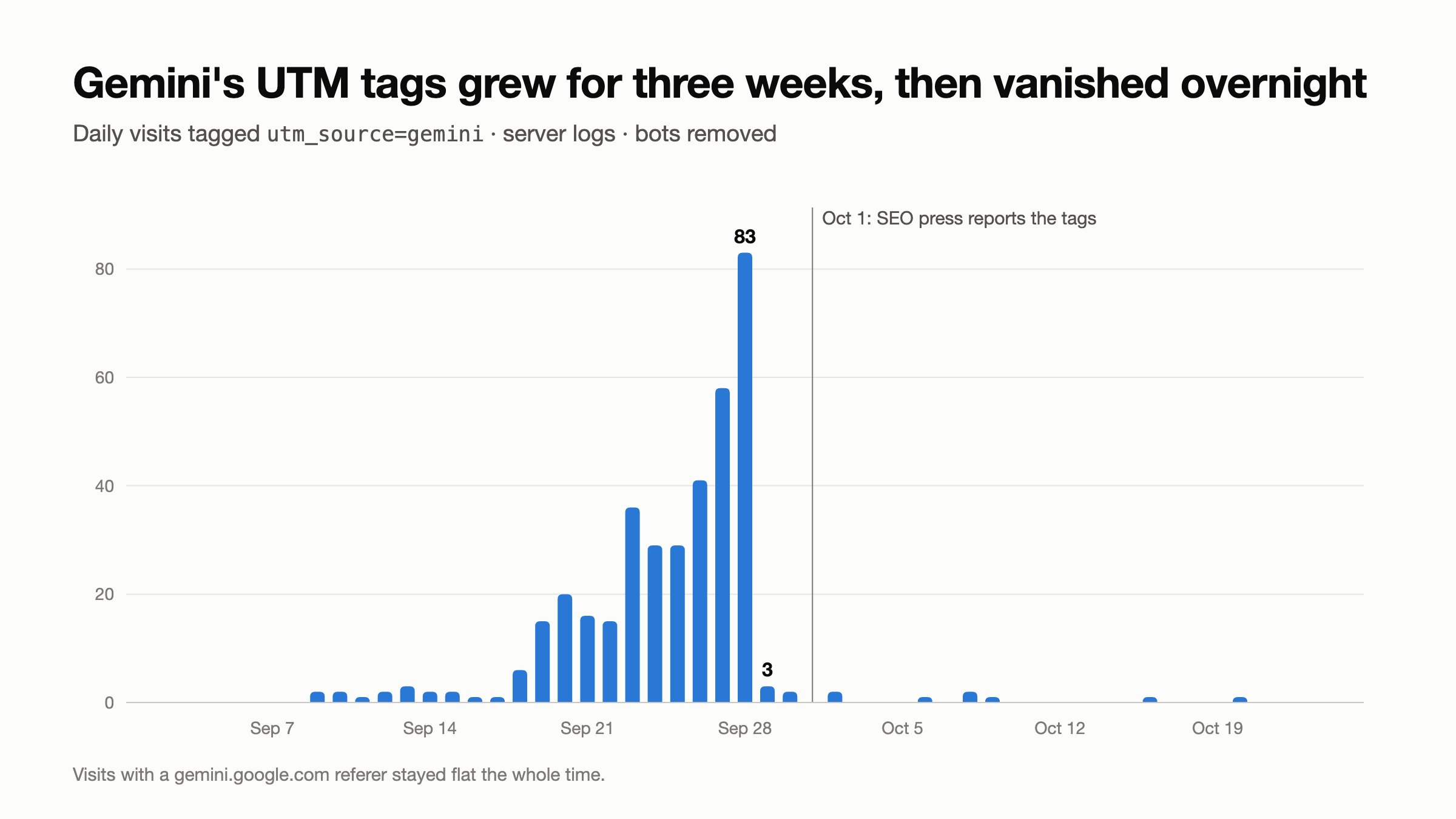
Google added UTM parameters to Gemini citations in early September. Around 28 September, the tags vanished. Search Engine Roundtable reports the change.
Why it mattersTeams measuring AI traffic lost their cleanest marker overnight. Any dashboard that counted Gemini by UTM is now undercounting it.
The one clean way to count Gemini traffic in a web analytics dashboard went away three weeks after it arrived. Search Engine Roundtable reports that Google has stopped adding UTM parameters to the links Gemini cites in its answers.
The site, run by Barry Schwartz, published the finding on 30 October. It names SEO analyst Natzir as the person who caught it first and shared the chart.
What changed, and when
Google started adding UTM parameters to Gemini citations in early September. The parameter was utm_source=gemini, Search Engine Roundtable reports. Around 28 September, the tags vanished.
Natzir shared a chart showing the pattern. Three weeks of growing UTM-tagged links, then a drop overnight. Search Engine Roundtable confirms that it does not see them on any Gemini link anymore.
What still works, and what no longer does
Google still passes referrer data from the desktop version of Gemini. Search Engine Roundtable quotes Natzir on this point. Visits with a gemini.google.com referrer stayed flat the whole time.
The iOS Gemini app behaves differently again. Natzir reports that it opens links in its own in-app browser and sends no referrer. Those visits land in GA4 as Direct traffic. The only trace is the GeminiiOS string in the user-agent, which only shows in server logs.
Why the change matters
A UTM parameter is the cleanest way to count visits from a given source in standard web analytics. Before the change, a team watching their Gemini traffic could filter on utm_source=gemini in GA4. The number was concrete. The source was named by Google itself.
After the change, that number drops to the floor of the referrer-only reading. Teams who built reports off UTM alone are now showing a drop that is not a drop. Teams on referrer data see the real level. Teams who did both have one series falling to zero while the other holds.
Google's John Mueller noted on Reddit that he had seen the UTM parameters a month or so ago. Search Engine Roundtable cites that comment too. Google has not commented in public on why they are gone now. The site stops short of giving a reason.
What to change in a reporting setup
A team that built an AI-traffic dashboard needs to look at it this week. Three quick checks name the pattern. First, a drop in utm_source=gemini on about 28 September. Second, a flat line on gemini.google.com referrer visits for the same period. Third, no change in the trend after that. A dashboard showing a crash in Gemini traffic likely does not have a crash. It has a measurement gap.
For the iOS Gemini app, the only workable path is server-log analysis for the GeminiiOS user-agent. Natzir covered that identifier in an earlier post. Search Engine Roundtable links to the full thread.
Source
Google Gemini Stopped Attaching UTM Parameters To Cited URLs, Search Engine Roundtable, by Barry Schwartz.
This item was written by an AI system from the linked source. Reveneau is responsible for what it publishes.
Get AI News in your inbox
New developer tools, model and agent releases, and how teams are actually using them to release software. Short, and only when there is something worth reading.