AI NewsGo-to-marketReported
Google is emailing Shopify merchants on Monday that their products are automatically eligible for Native Checkout in AI Mode and Gemini, and opting them in unless they turn it off in the Shopify admin
Google is emailing Shopify merchants that their products are automatically eligible for Native Checkout in Google AI Mode and Gemini, and Search Engine Roundtable reports the merchant is opted in by default. To keep buyers on the merchant's site, they must go to the Shopify admin and turn off native checkout under Sales channels, Agentic.
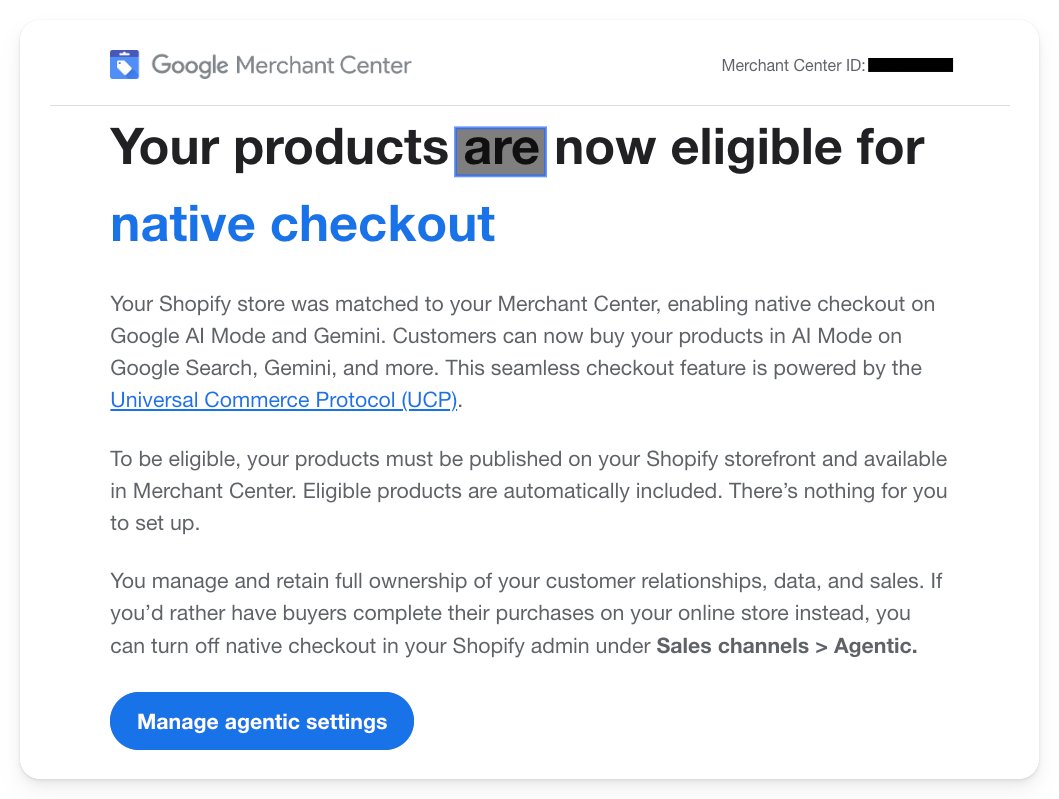
Image: Search Engine Roundtable
Why it mattersA Shopify merchant is now the default surface where a buyer completes a purchase inside an AI answer, so a decision that used to be "should we ever offer this" now has to be made in reverse, this week, or the traffic that would have reached the store's cart lands in Google's cart instead.
Getting into Google's AI answers is one problem. Deciding whether to let Google finish the sale inside them is a different one, and Google just made it the default. Search Engine Roundtable's Barry Schwartz reports Google is emailing Shopify merchants on 22 September that their products are automatically eligible for Native Checkout in Google AI Mode and Gemini, because Shopify supports the Universal Commerce Protocol. To keep the sale on the merchant's own site, the merchant has to open the Shopify admin and turn off native checkout under Sales channels, Agentic.
What the email says
Search Engine Roundtable reproduces the message: "Your Shopify store was matched to your Merchant Center, enabling native checkout on Google AI Mode and Gemini. Customers can now buy your products in AI Mode on Google Search, Gemini, and more. This seamless checkout feature is powered by the Universal Commerce Protocol (UCP)." The eligibility clause: "To be eligible, your products must be published on your Shopify storefront and available in Merchant Center. Eligible products are automatically included. There's nothing for you to set up."
The screenshot of the email came from Menachem Ani, who posted it on X. Schwartz reports Nic McDonough saw the same message live the same morning.
What Google keeps and what it takes
Google's own line, quoted by Search Engine Roundtable, is that "You manage and retain full ownership of your customer relationships, data, and sales." The mechanic is that Google Pay handles the checkout inside the AI surface, but the merchant still fulfills the order and keeps the customer relationship, sales record and product data. The visible change is where the buy button is: for eligible catalogues, it now appears inside AI Mode and Gemini answers alongside the merchant's storefront.
The Universal Commerce Protocol launched in January 2026, with the checkout capability landing in Google's surfaces in February. Search Engine Roundtable reports Google pushed the feature to more retailers on Friday, then followed the widening rollout on Monday with these auto-enable emails to the merchant tier whose e-commerce platform supports UCP natively. Shopify was the first-party pilot for that integration.
What a Shopify merchant should do this week
If a merchant is happy for the buy to complete inside AI Mode or Gemini, no action is needed. If a merchant wants buyers to reach the storefront so upsells, cross-sells, subscription prompts, remarketing tags and post-purchase attribution work the way they were designed, the native checkout has to be turned off. The path is Shopify admin, Sales channels, Agentic, then the toggle.
The trade-off is real and worth naming in one sentence: opting in surrenders the on-site journey in exchange for a conversion that would otherwise not have happened, since the buyer never left Google. Merchants who have not decided which of those they value more are the ones the auto-enable is meant to catch.
Source
Barry Schwartz, Search Engine Roundtable, Google Merchant Center Auto Enables Native Checkout: Buy On AI Mode and Gemini, 22 September 2026. Screenshot posted by Menachem Ani on X.
This item was written by an AI system from the linked source. Reveneau is responsible for what it publishes.
Get AI News in your inbox
New developer tools, model and agent releases, and how teams are actually using them to release software. Short, and only when there is something worth reading.