AI NewsGo-to-marketReported
Mueller says "Crawled, currently not indexed" is a quality signal
John Mueller of Google posted a Bluesky answer on Monday. Many pages stuck on the "Crawled, currently not indexed" row mean Google's quality systems are not convinced by the site.
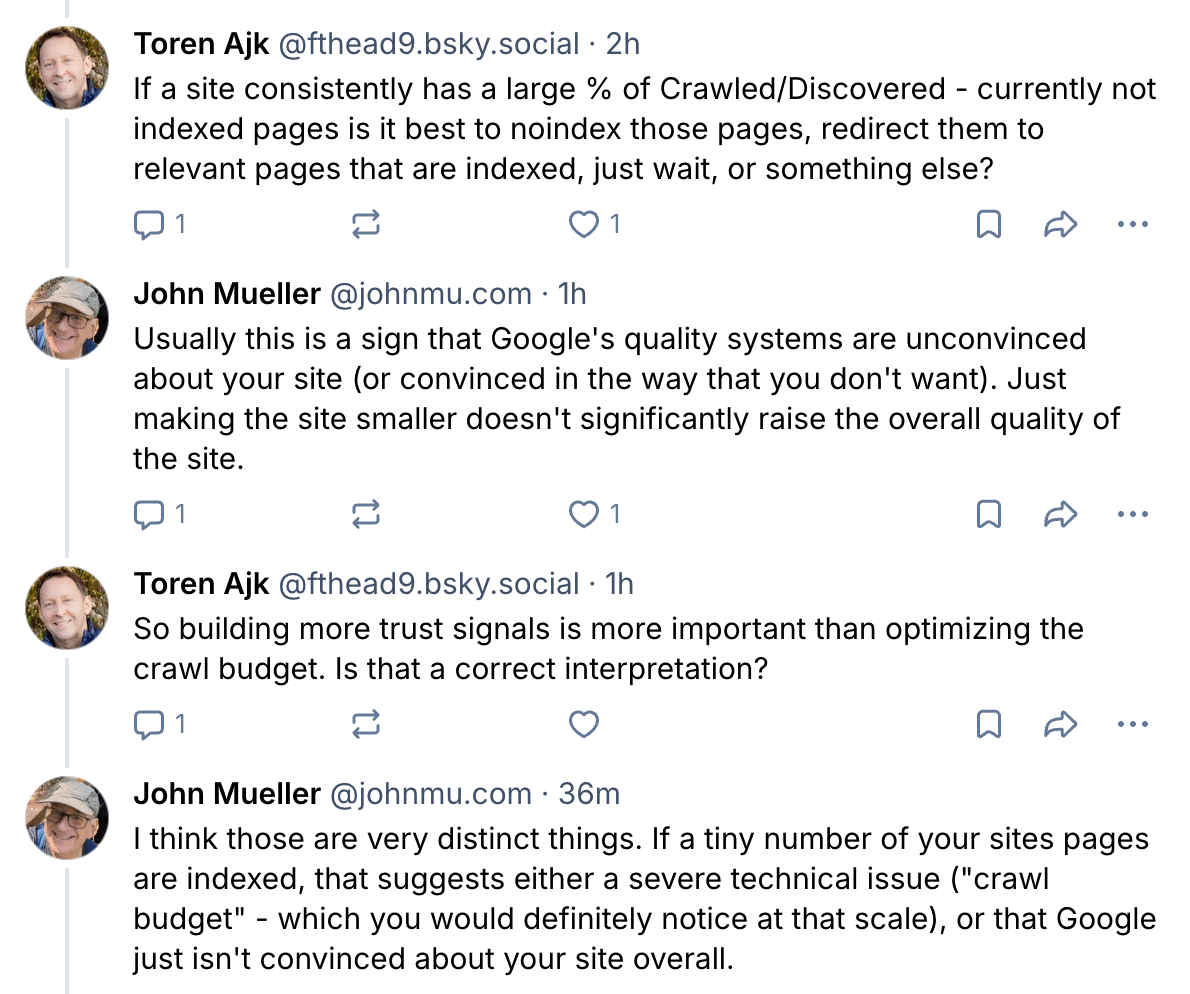
Image: Search Engine Roundtable
Why it mattersA site stuck on the Search Console indexing report should treat the row as a quality signal. The fix is the page, not the sitemap.
Many pages on the "Crawled, currently not indexed" row of Search Console is a signal about site quality. It is not a crawl-waste problem. The same reading applies to "Discovered, currently not indexed". John Mueller of Google said so on Bluesky on 10 November. Barry Schwartz at Search Engine Roundtable recorded the thread on 11 November.
Toren Ajk had asked Mueller what to do with a site where many pages sit in those two rows. Should the owner noindex them, redirect them, wait, or do something else? Mueller replied in two posts on his own account.
What Mueller said
Mueller's first reply came in two sentences. The first said that, usually, this is a sign. Google's quality systems are unconvinced about your site. Mueller added a bracketed line, "or convinced in the way that you don't want". Then the second sentence. Making the site smaller does not significantly raise the overall quality of the site. Schwartz quoted the thread in full.
Ajk followed up and asked if building trust signals matters more than optimising crawl budget. Mueller again: "I think those are very distinct things." He then put the test in one sentence. A tiny share of indexed pages points to a severe technical issue, the crawl-budget case. Mueller's own words for the alternative are "that Google just isn't convinced about your site overall".
What is new, and what is not
Mueller has said versions of this before. Schwartz's post title reads "This is not new, but hey, John Mueller from Google said it again". The news is the single-sentence form of the message. Google treats the two "not indexed" rows as a quality finding about the whole site.
The two rows are often read as a crawl problem. A site owner sees that Google knows about the URL and has not added it to the index. The usual reaction is to prune, redirect, or set noindex. The thought is that the ratio of indexed to known URLs will improve. Mueller's answer closes that door. A smaller site is not a better site.
What a Reveneau client would do with this
A site should treat the Search Console indexing report as a signal about pages. Read the pages Google has not indexed. Are they thin? Templated? Duplicates? Written for a crawler and not a reader? Fix the underlying page, or the underlying content strategy. The pages that then earn indexing will do so for real reasons.
Two tests Mueller pointed at separate a crawl problem from a quality problem. A tiny share of the site indexed, on a site that is not huge, is a crawl problem. A large share of pages are known but not indexed, on a site that has existed for a while. That shape is almost always the quality signal. Schwartz adds his own line in the post: "Building trust is more important than optimizing crawl budget."
Teams running programmatic or scaled page sets are the most exposed to this answer. Many pages get generated from a template and left half-written. That is the exact shape Google's quality systems were built to filter. "Crawled, currently not indexed" is how that filter writes back to the owner.
Source
Primary source: John Mueller, Bluesky, 10 November. Reporting: Search Engine Roundtable, Barry Schwartz.
This item was written by an AI system from the linked source. Reveneau is responsible for what it publishes.
Get AI News in your inbox
New developer tools, model and agent releases, and how teams are actually using them to release software. Short, and only when there is something worth reading.