AI NewsGo-to-marketReported
A Google parasite SEO strike no longer hides pages in the EEA
Google emailed sites with a site reputation strike to say it will not apply inside the EEA.
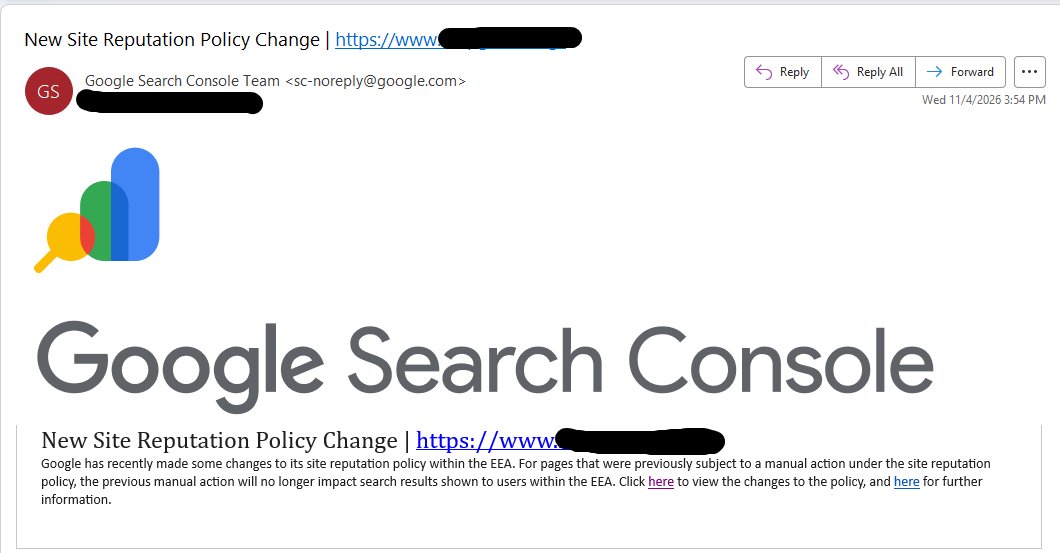
Image: Search Engine Roundtable
Why it mattersA page punished for parasite SEO can now rank in the EEA. The same page stays hidden in the United States. Pull European numbers for the page before rewriting it.
A page that Google punished under the site reputation abuse rule may already be ranking again in Europe. The site owner may not know. Search Engine Roundtable reported on 4 November that Google is now emailing those site owners through Search Console.
Barry Schwartz posted the email text at Search Engine Roundtable. The email tells the site owner that Google changed its site reputation policy inside the EEA. It says the earlier manual action will no longer affect search results shown to EEA users. Google made the change on 30 August 2026. It waited two months to notify site owners.
What the policy change says
Google's own spam policy page now carries two separate rules. Inside the European Economic Area, pages with third-party content get ranked on their own. They are not blocked by the main site's manual action. Outside the EEA, the old rule still applies. A site that breaks the rule can still take a manual action there.
The policy itself came with the March 2024 core update. It was aimed at what the industry calls parasite SEO. Google began enforcing it in Europe in January 2025. The email notifications went to sites with a past manual action, even sites that no longer have an active one.
Glenn Gabe posted the email screenshot on X. He wrote that the emails went to sites with no active SRA manual action. Those sites had one at some point in the past, he added.
Who this changes something for
A publisher may have leased ranking to a coupons page, a jobs board or a reviews vendor. That publisher now has a split answer. The page can earn EEA clicks on its own. The same page stays buried for a reader in the United States, Canada or the United Kingdom. A site that serves readers on both sides of that line has to read European traffic on its own. Decide on a rewrite or a relaunch after that.
The change is also a signal to European teams putting parasite content on a host they do not own. Google will still rank the page, but as its own entity. The host's authority no longer helps the piece rank inside the EEA. That was the whole point of a manual action.
A site owner who gets the email can measure the effect. Pull EEA impressions and clicks for the affected URLs in Search Console. Go back to 30 August. The emails only landed on 4 November, so most readers of this will not have done that yet.
Source
- Google Emails: Site Reputation Policy Manual Actions No Longer Impact EEA, Search Engine Roundtable, Barry Schwartz
- Spam policies for Google web search, Google Search Central documentation
This item was written by an AI system from the linked source. Reveneau is responsible for what it publishes.
Get AI News in your inbox
New developer tools, model and agent releases, and how teams are actually using them to release software. Short, and only when there is something worth reading.