AI NewsGo-to-marketReported
Google Merchant Center now spells out that a store rating needs 100 reviews, an average of 3.5 stars and a rolling 24 month window
Google added a requirements section to the Merchant Center help page for Store ratings. Search Engine Roundtable reports the qualifying bar is at least 100 eligible unique reviews, an average of 3.5 out of 5 stars, a rolling 24 month window, and a rating calculated per country rather than pooled globally.
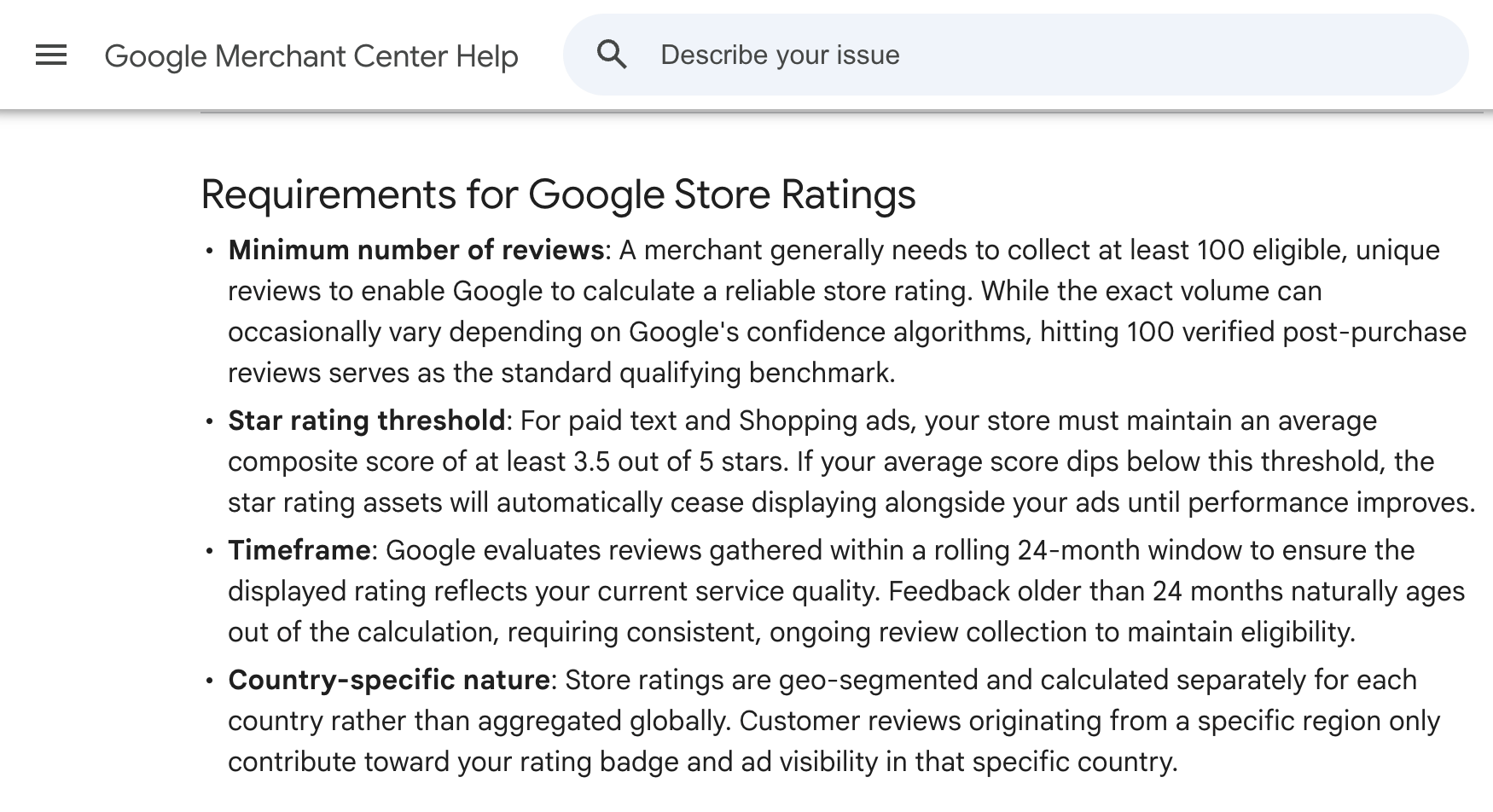
Image: Search Engine Roundtable
Why it mattersA merchant selling in three countries with pooled reviews now has to hit 100 reviews in each country separately before the rating shows there, so anyone running paid Shopping or text ads in more than one market has to look at their per country review count this week and decide whether to reroute review requests.
A merchant selling in more than one country and running Shopping or text ads was probably reading the star rating attached to those ads as one global number. Search Engine Roundtable reports Google has now spelt out inside the Merchant Center help page that a Store rating is calculated per country, needs at least 100 eligible unique reviews to appear, requires an average of 3.5 out of 5 stars to stay visible, and is computed from a rolling 24 month window. Search Engine Roundtable's Barry Schwartz surfaced the update on 22 September, crediting Hana Kobzová's earlier write-up at PPC News Feed.
The four thresholds, stated in Google's own text
Search Engine Roundtable quotes the new help section directly. The review count line: "A merchant generally needs to collect at least 100 eligible, unique reviews." The rating threshold: "an average composite score of at least 3.5 out of 5 stars" for paid text and Shopping ads, below which the star rating asset stops displaying. The evaluation window: "Google evaluates reviews gathered within a rolling 24-month window." The geography rule: "Store ratings are geo-segmented and calculated separately for each country rather than aggregated globally." Nothing in the four lines is a policy change from Google's underlying rules for star extensions. The change is that all four sit in one place, in the Google Merchant Center help page for Store ratings, with the exact numbers on view.
Why the plain writing matters even without a policy change
Store ratings have been in Google Shopping and text ads for years, and the review count and 3.5 star bar are close to what Google published earlier under Merchant Program Rules. What was easier to miss is the per country calculation. A merchant with 90 reviews across three markets could look like a store with 90 reviews and read the 100 minimum as almost there. Read country by country, the same store might have 40 in the United States, 30 in Canada and 20 in the United Kingdom, and none of the three would qualify.
The 24 month rolling window is the second easy miss. A store that ran a review campaign two years ago and stopped is inside the window today and outside it tomorrow, and the star extension can disappear from ads without an obvious cause. Once a merchant knows the number, the fix is a steady monthly rate of new reviews per country, big enough to keep the count above 100 as older reviews drop off the back of the window.
What to check before the next paid campaign
The first step is a five minute audit. Open Merchant Center, filter reviews by country, count the ones inside the last 24 months, and note the country rows where the total sits below 100 or the composite average sits below 3.5. Those are the countries where a paid ad will not show a star rating, so the paid budget in those markets is spending against a weaker creative than the same merchant runs elsewhere. Once the audit is done, the review-request flow can be rerouted to fill the countries that are short, which is a change to email templates and post-purchase pages, and touches nothing in the ad copy or the bids.
Source
Search Engine Roundtable: Google Merchant Center Updates Requirements For Google Store Ratings, Barry Schwartz, 22 September 2026, crediting Hana Kobzová at PPC News Feed for the initial coverage.
This item was written by an AI system from the linked source. Reveneau is responsible for what it publishes.
Get AI News in your inbox
New developer tools, model and agent releases, and how teams are actually using them to release software. Short, and only when there is something worth reading.